


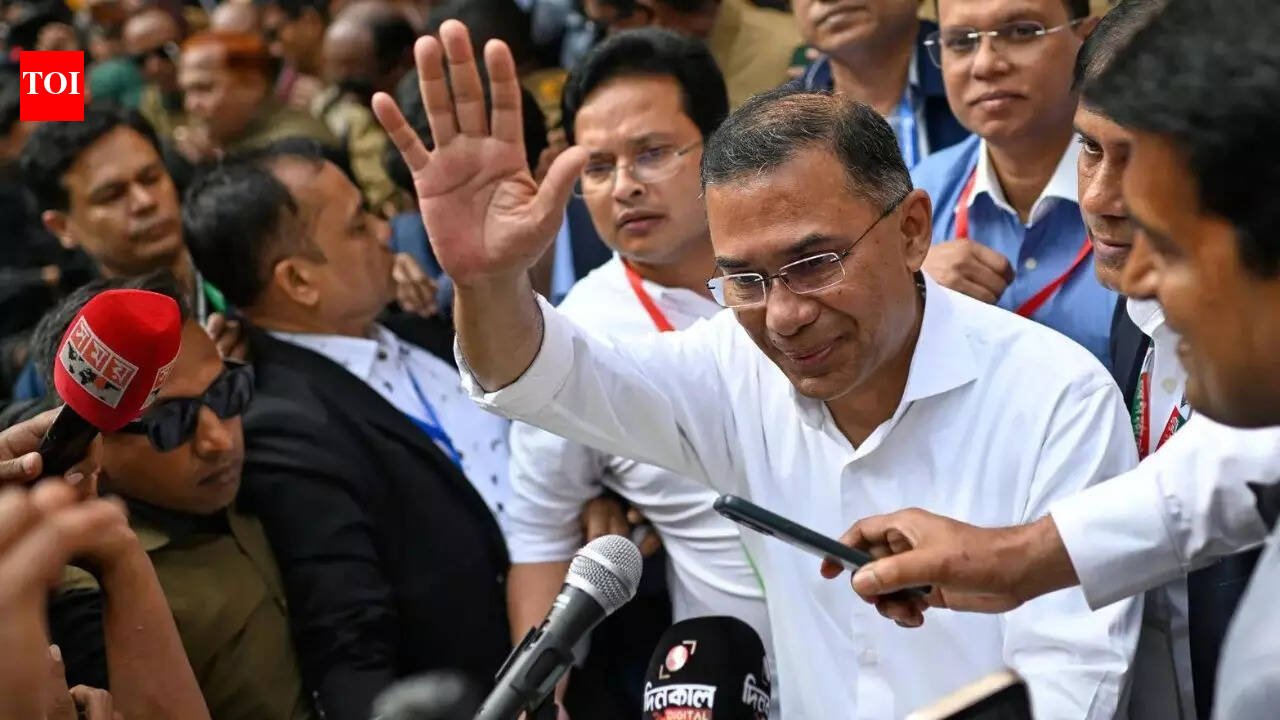
Less than two months after returning from 17 years of self-imposed exile in London, BNP chief Tarique Rahman has emerged as the new face of Bangladesh.Thursday’s election marked a remarkable reversal of fortune for 60-year-old, who left the country in 2008 saying he needed medical treatment after his release from detention under a military-backed caretaker regime. He had been held after a crackdown on corruption. He returned home to a hero’s welcome last Christmas after Sheikh Hasina’s ouster in Aug 2024. Rahman’s mother, Khaleda Zia, long dominated Bangladeshi politics, while Rahman’s father, Ziaur Rahman was a leading Bangladesh independence figure who ruled the country from 1977 to 1981 before he was assassinated.Events have unfolded so quickly since Rahman’s return with his cardiologist wife and barrister daughter that he said he scarcely had time to reflect. “I don’t know how we have passed every minute since we landed,” Rahman said on the sidelines of an interview last weekFive days after his return to Bangladesh, Rahman was struck by a personal tragedy as Khaleda Zia died after a prolonged illness. Rahman became the chairman of the BNP at a time when the party was facing a state of political wilderness ahead of the polls. A soft-spoken Rahman drew massive crowds as he spearheaded the campaign for his party. In speeches he has pledged to dismantle “the very monarchical” executive power on which his family once thrived.The bespectacled Rahman was born on Nov 20, 1965, in Dhaka. He studied international relations at the University of Dhaka, dropped out, and later started businesses in textiles and agro-products.Though his years abroad were marked by legal battles against money-laundering charges, he continued guiding the party from afar. In the UK, he lived a low-key life with his wife and daughter. From a home office that became the nerve centre of his party, Rahman ran the BNP via Zoom.Since his return, he has tried to project himself as a statesman ready to look beyond his family’s difficulties under Hasina. Gone is the image of a brash operator from the BNP’s 2001–2006 era, when his mother was PM. Although he never held a govt post, Rahman was often accused of running a parallel power centre during her tenure, a charge he denies. “What does revenge bring to someone? People have to flee from this country because of revenge. This does not bring anything good,” he said. “What we need at the moment in the country is peace and stability.”Under Hasina’s rule, Rahman became a central target of graft cases and was convicted in absentia in several of them. In 2018, he was also sentenced to life over a 2004 grenade attack on a rally Hasina was addressing that killed and wounded many. He has always denied the allegations, calling them politically motivated, and has since been acquitted in all cases following Hasina’s ouster.Since returning, Rahman has adopted a noticeably understated style, avoiding inflammatory rhetoric and calling instead for restraint and reconciliation. He has spoken of restoring “people’s ownership of the state” and rebuilding institutions — a message that has energised BNP supporters eager for a fresh start.In several interactions, Rahman acknowledged that the task ahead of him in the country of 170 million people would be daunting, with the recovery of a shattered economy being a key challenge. Rahman has pledged to recalibrate Bangladesh’s international partnerships to attract investment without tying the country too closely to any single power, in contrast with Hasina, who was seen as aligned with India. He has also highlighted expanding financial aid for poor families, reducing reliance on garment exports by promoting industries such as toys and leather goods.Analysts and observers said the lack of discipline within the BNP poses a major challenge for him. During the past 18 months, party activists largely earned a bad reputation in general for extorting and seizing the businesses of political opponents. Rahman’s grip on the party is strong. Party insiders said he directly oversaw candidate selection, strategy and alliance talks, roles he once performed remotely. He may be a product of dynastic politics, but Rahman said restoring democracy would be his biggest priority. “Only by practicing democracy can we prosper. If we practice democracy, we can establish accountability,” he said. “So we want to practice democracy, we want to rebuild our country.” Agencies


