


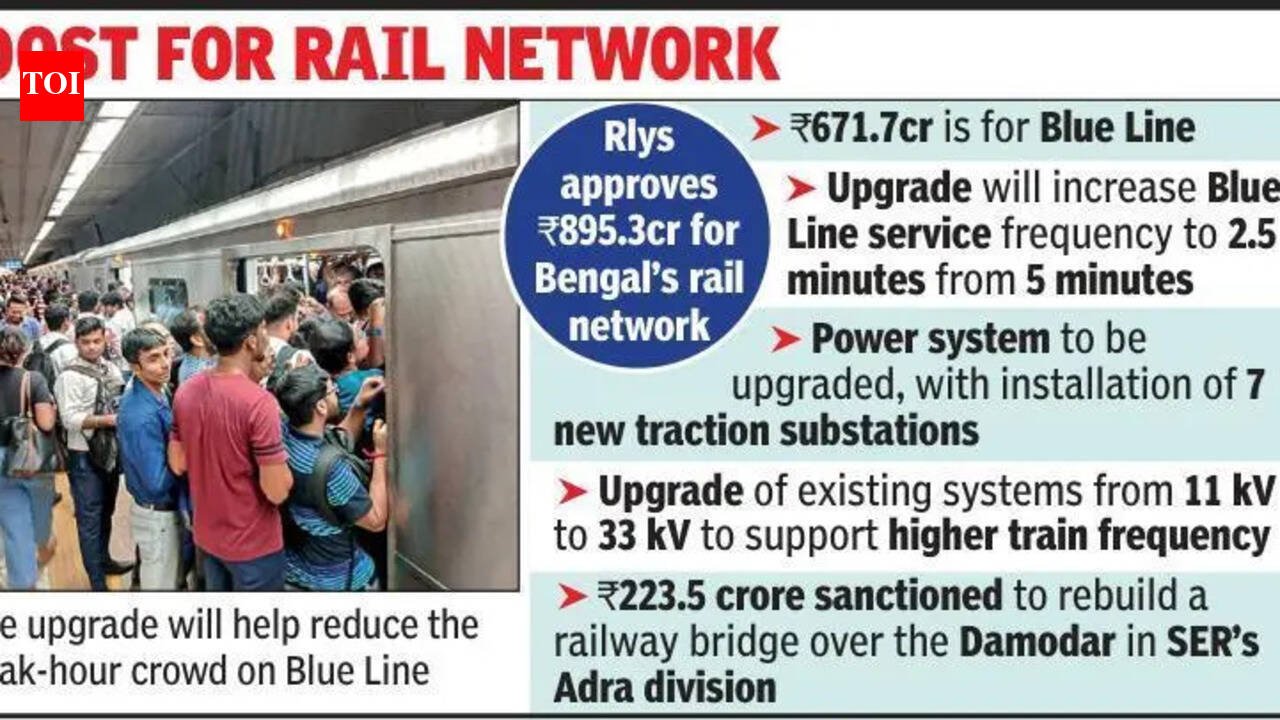
Kolkata: The state’s rail network is set for a major boost as the Centre approves projects, worth Rs 895.3 crore, aimed at upgrading the North-South Metro infrastructure and rebuilding an ageing bridge.Of the fund, Rs 671.7 crore is set aside for the upgrade of the Blue Line and Rs 223.5 crore is earmarked to rebuild the railway bridge over the Damodar under South Eastern Railway.The Blue Line enhancement will vastly help commuters, who have been seeking trains at shorter gaps. “With this sanctioning, the Blue Line will be capable of operating a 2.5-minute headway (frequency),” a Metro Railway official said. Currently, around 6 lakh commuters travel by Blue Line every day. An increased service frequency will mean shorter waiting time and less peak-hour crowding.For metro trains to run at shorter intervals, the network requires a traction substation at each station, replacement of the steel third rail with an aluminium one, upgrade of the signalling system to the communication-based train control system (CBTC), and increase of the maximum train speed. The power system overhaul includes seven new traction substations worth Rs 291 crore, augmentation and upgrade of auxiliary substations (ASS) and traction substations (TSS), power system upgrade from 11 kV to 33 kV across key stretches, strengthening of power supply between Esplanade and New Garia, and upgrade for elevated sections between Netaji and Kavi Subhas stations.“The 41-year-old Blue Line was originally designed to run at a five-minute gap. With rising demand, a higher frequency is needed,” the official said. The Blue Line suffered a major setback in July 2025, when the southern terminal, Kavi Subhas station, was closed after cracks appeared in one of its platforms. The corridor has since been operating till the second-last southern station, Shahid Khudiram. Work to rebuild the terminal station is about to begin.The existing substations and equipment are reaching capacity limits and face maintenance challenges due to non-availability of spare parts. The new system will ensure reliable power supply and reduce disruptions.The existing steel third rail is being replaced with one made of aluminium, in phases, aluminium being a better conductor of electricity. Aluminium third rail will reduce the system voltage drops and consequent energy loss. Fewer voltage drops will help achieve faster train acceleration. The second phase of the work, which is nearing completion, will cover most of the underground section. In the third phase, the elevated section between Tollygunge and New Garia will be covered.For a 90-second headway, the carrier needs the CBTC system and increased maximum speed. The Blue Line now operates through the train protection and warning system (TPWS). It will be augmented to the more advanced CBTC system, in which a train picks up signals from the tracks and turns into a moving block.Now, metro trains run at a maximum speed of 55 kmph. Only between Noapara and Dakshineswar, can trains speed up to 80 kmph. Plans were afoot to reduce the gap between two trains and increase the speed on the rest of the corridor, officials said.
