



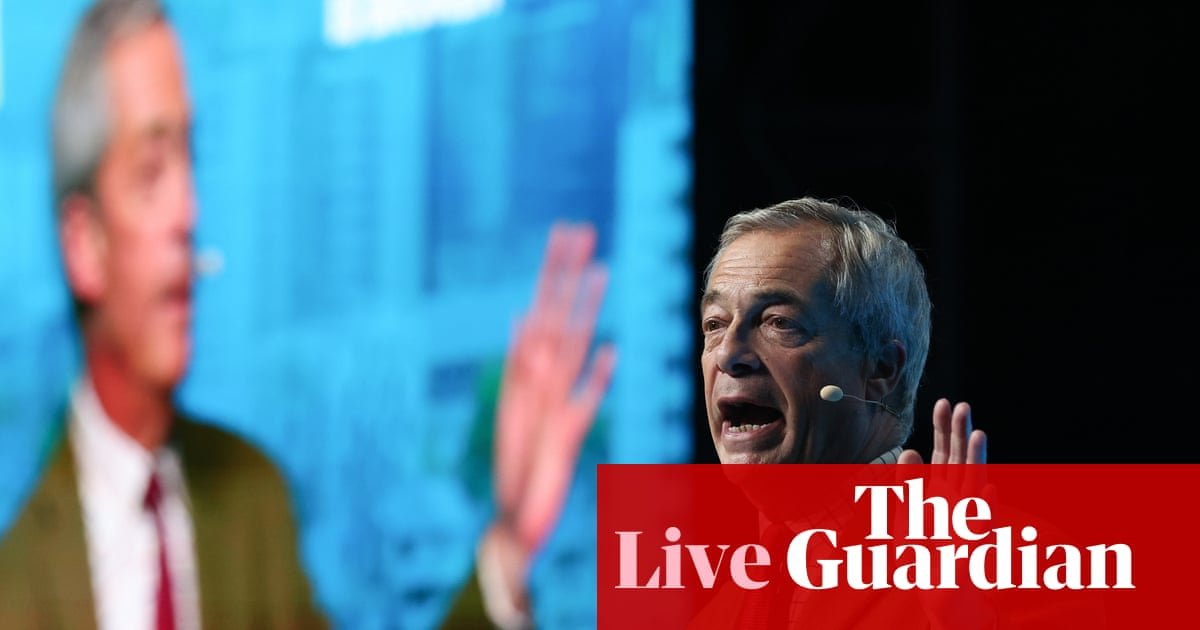
Reed says crypto donations moratorium, and cap on donations to parties from Britons living abroad, to take effect from today
Steve Reed has just told MPs that the new rules imposing a cap on donations to political parties from Britons living abroad, and a moratorium on donations in crypto, will take effect from today. The legislation to implement them will be retrospective, allowing that to happen, he said.
Key events
-
Swinney accuses Tories of ‘peddling doom-loop of despair’ in last FMQs before Holyrood elections
-
‘Fortunate timing’ – Badenoch not wholly convinced by McSweeney’s phone theft story, spokesperson suggests
-
Reform UK’s Richard Tice claims donations crackdown shows Labour ‘absolutely terrified’ of his party’s success
-
Reed accepts government has to act to stop shell companies funnelling ‘dark money’ to political parties
-
Reed says new rules coming into force today to stop ‘malign actors’ taking advantage of any delay
-
What Rycroft report says about how serious problem of foreign financial interference in UK politics is
-
Reed says crypto political donations ban coming into force today will cover even very small gifts
-
How cap on individual donations to political parties from Britons living abroad will work
-
Reed says from today Britons living abroad will only be able to give £100,000 a year to political parties
-
Reed says crypto donations moratorium, and cap on donations to parties from Britons living abroad, to take effect from today
-
Steve Reed makes statement to MPs about crackdown on funding rules for political parties
-
PMQs- snap verdict
-
Starmer confirms government to impose moratorium on crypto donations to political parties
-
Badenoch attacks Labour’s proposed approach to energy support as more spending for people on benefits
-
Met police releases transcript of McSweeney reporting phone theft to 999 to show he did not say he was PM’s chief of staff
-
Starmer faces Badenoch at PMQs
-
Streeting urges people to reject ‘conspiracy’ theories about theft of Morgan McSweeney’s phone
-
Hundreds of UK teenagers to trial six-week social media curbs for major study
-
Streeting says he wants female NHS patients to pilot system letting them propose payment cuts for bad providers
-
Average band D council tax in England rising by 4.9%, or £111, this year, government figures confirm
-
‘Doge of the left’ could save UK taxpayers up to £30bn, says new green thinktank
-
Wes Streeting defends Treasury’s indication that energy support package would help poorer families, not richer ones
-
UK inflation held at 3% before global energy price hit from Iran war
-
What joint committee on national security strategy said about case for ban on crypto donations to parties
-
Review of foreign financial interference in UK politics to be published, with ban on crypto donations expected
Swinney accuses Tories of ‘peddling doom-loop of despair’ in last FMQs before Holyrood elections
Libby Brooks
Libby Brooks is the Guardian’s Scotland correspondent.
Today was the final first minister’s questions – moved from the usual Thursday to Wednesday to fit recess timings – before the Holyrood elections on 7 May and it was very much as though the campaign has already started.
Scottish Tory leader Russell Findlay attacked “jaded” John Swinney and his “dishonest incompetent and sleazy government”. Swinney told Findlay he was “peddling a doom-loop of despair” and that his party was going to get “trashed” on election day.
Anas Sarwar likewise attacked the SNP government’s record, but Swinney hit back at the Scottish Labour leader’s very public U-turn in support for Keir Starmer showed him to be “a man of poor judgment the people of Scotland should not listen to on 7 May”.
More significant than the raucous end-of-term atmosphere in the chamber is the fact that a third of MSPs there – 42 of them – won’t be seeking re-election in May. A record number of members are stepping down – including two former first ministers, Nicola Sturgeon and Humza Yousaf, two former party leaders, Douglas Ross and Richard Leonard, a slew of former and current government ministers and the presiding officer.
After FMQs, a motion of thanks for their public service is the final debate in the chamber before the election.
But what does this turnover mean for the next parliament? As we’ve reported previously, many SNP women in particular say they’re stepping down because Holyrood is becoming a “hostile environment” for women, with bullying and online abuse rife.
A number of younger MSPs, including the ridiculously talented Kate Forbes, have said they are stepping down because they can’t make a government job work with raising a young family. There are, of course, many able candidates – with experience of local government and the Commons – who may replace them come May, but – particularly with Reform neck and neck with Labour in some polls – the new parliament is going to look and feel very different.
‘Fortunate timing’ – Badenoch not wholly convinced by McSweeney’s phone theft story, spokesperson suggests
Kemi Badenoch is not wholly convinced by Morgan McSweeney’s account of how his phone came to be stolen, her spokesperson has suggested.
At a post-PMQs briefing, the spokesperson said that Badenoch had “definitely raised an eyebrow” over the past 24 hours after hearing McSweeney’s account of how the phone got taken.
The phone is likely to have contained messages betweeen McSweeney and Peter Mandelson (they were close, and McSweeney was instrumental in persuading Keir Starmer to appoint Mandelson ambassador to the US) and the disappearance of the phone may mean that McSweeney/Mandelson messages meant to be disclosed to the public now don’t get retrieved. (See 11.36am.)
Badenoch is among those who think there may be something fishy going on. Asked if Badenoch thought McSweeney was lying about this, the spokesperson said it was now clear that McSweeney’s phone went missing around the time people in Downing Street were starting to worry about a humble address. (They have been reading Dan Hodges on X.)
Asked again if McSweeney was lying, the spokesperson said:
I think what Kemi would say is that it is very fortunate timing.
Reform UK’s Richard Tice claims donations crackdown shows Labour ‘absolutely terrified’ of his party’s success
Reform UK claims the crackdown on donations in crypto and from Britons living abroad announced today shows the government is “absolutely terrified” of the success it is having. Richard Tice, Reform’s deputy leader, has made the claim in an interview with GB News. He also said Reform would repeal the law if it won the election.
‘Everything they’re trying to do is to stop the incredible progress of Reform.’
Deputy Leader of Reform UK Richard Tice, slams Sir Keir Starmer’s intentions to introduce a moratorium on cryptocurrency donations to parties. pic.twitter.com/YrbETu4ZSm
— GB News (@GBNEWS) March 25, 2026
During PMQs Nigel Farage led a walkout of Reform UK MPs after Keir Starmer ignored the thrust of his question and instead used it as a platform to attack Farage’s party generally. (See 12.23pm.) You won’t seen any video footage of this because the Commons rules only allow MPs in the chamber to be filmed if they are speaking, or if they are directly referred to by the MP who is speaking.
But Suella Braverman, the Reform UK home affairs spokesperson, did return to the chamber to ask a question during the Reed statement. She pointed out that the husband of a Labour MPs has been arrested in connection with alleged spying for China, and she asked if the new rules would also apply to “those members of [the Labour] party who find themselves compromised with the Chinese Communist party”.
Reed told her the rules would apply “without fear and favour to members of all parties”, as did the bribery law that led to the jailing of the former Reform UK leader in Wales, Nathan Gill.
Reed accepts government has to act to stop shell companies funnelling ‘dark money’ to political parties
The Lib Dem MP Bobby Dean asked Reed if he accepted that the government had to do more to stop malign actors channelling money to political parties through companies. He said a recent report from CenTax (the Centre for the Analysis of Taxation) said a quarter of corporate donations were opaque.
Here is an extract from the CenTax report. (Bold type from CenTax.)
Almost one in every ten pounds donated by companies comes indirectly from individuals who are likely to be ineligible to donate directly. Their donations are on average almost twice as large as those from companies with UK-eligible owners. These are conversative figures: the true extent of foreign interference is obscured by the large proportion of opaque corporate donors.
Around a quarter of donor companies are opaque, meaning it is not possible to identify who controls them as they either report no person with significant control at all, or control runs through someone else, such as a trustee, rather than a beneficial owner. These opaque companies account for a quarter of all corporate donations by value and companies that donate are significantly less transparent than UK companies generally.
Reed said there were measures in the representation of the people bill covering corporate donations. But he implied more needed to be done.
I recognise the concerns we need to act on shell companies that can be used to funnel in dark money. We have no idea where that is coming from. There are legitimate concerns that could be coming from hostile states, who are seeking to weaken and undermine our country, by undermining our democracy.
Stephen Gethins (SNP) asked what impact the new rules would have on the “extraordinary number of members of the House of Lords” who also turn out to be donors to political parties. Reed did not address this point, but he told Gethins he would be talking to the Scottish government about the impact of the rules for Scotland.
In response to a question from Simon Hoare, a Conservative, Reed accepted that these rules would place new obligations on the Electoral Commission and he said “of course” the commission would get resources “adequate to any new demands that may be placed on them”.
In the Commons Lisa Smart, the Lib Dem Cabinet Office spokesperson, welcomed Reed’s announcement. But she said the government should be doing more to stop foreigners donating to political parties via companies operating in the UK. And she said politicians should be banned from taking money from state-run foreign TV stations, like Russia’s RT or Iran’s Press TV.
Reed says new rules coming into force today to stop ‘malign actors’ taking advantage of any delay
James Cleverly, the shadow local government secretary, responded to Steve Reed in the Commons on behalf of the Tories. He said that there was much in the report with which the Conservative would “instinctively” agree, but he complained about not being given enough time to look at the recommendations before the statement. And he also criticised the government for rushing to implement its recommendations.
Reed said, if he hadn’t announced that some of these measures would take place from today, that would allow a “window of opportunity to open which would allow malign and hostile actors to evade the intent that we’re all seeking”.


