


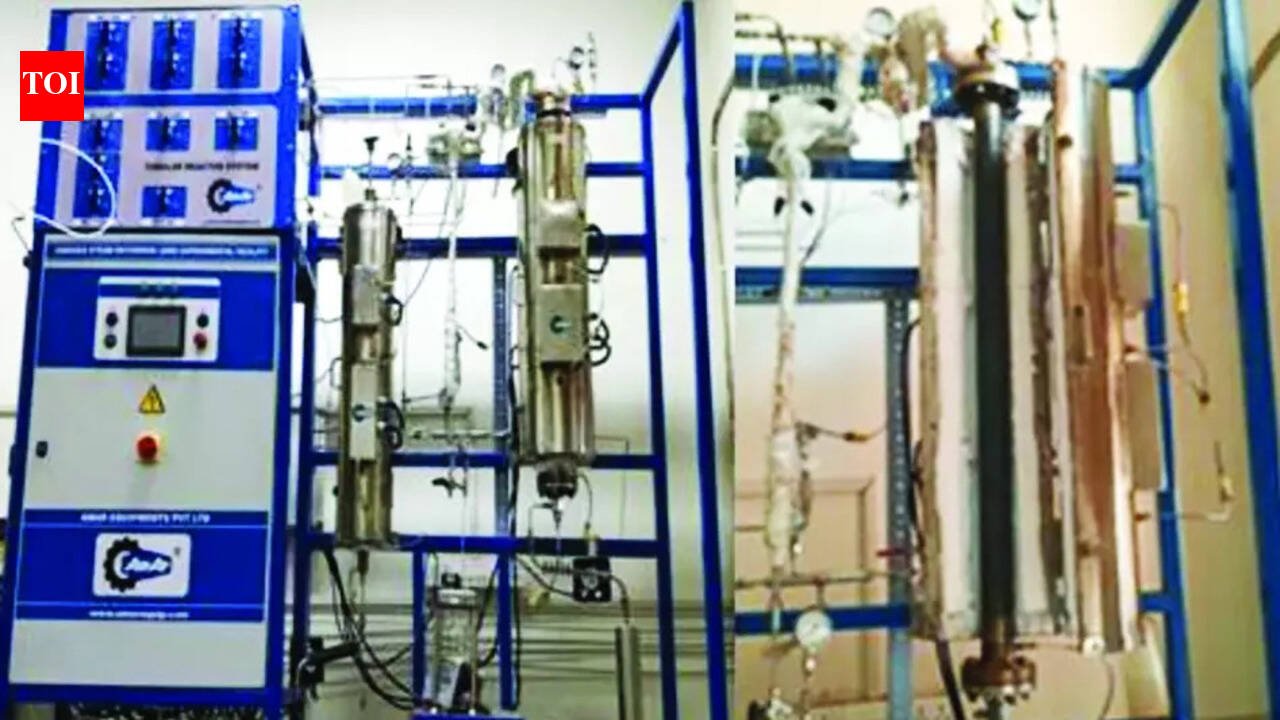
Panaji: Research by a team led by professor Srinivas Krishnaswamy from the department of chemical engineering at BITS Pilani K K Birla Goa Campus experimentally demonstrated a novel chemical looping approach under sustainable conditions for the first time in India, paving the way for more energy-efficient and cost-effective hydrogen and chemical production in the country.The team showcased sustained operation of chemical looping partial oxidation of methane (CLPOM) in a single-packed bed reactor for the production of syngas, an important chemical building block, including hydrogen. This project was funded by the Science and Engineering Research Board (SERB), department of science & technology (DST), govt of India.
Overall, chemical looping enables substantial reductions in energy demand, along with a lower environmental footprint with inherent CO2 capture.The group is currently partnering with GAIL (India) on a Rs 3 crore-funded project to develop a plant for chemical looping reforming (CLR), targeting sustained production of syngas. Unlike CLPOM, which focuses on syngas for chemicals, CLR will serve as an alternative to conventional steam reforming for continuous hydrogen production. The proposed plant will be based at the department of chemical engineering at BITS Pilani K K Birla Goa Campus and is expected to be completed in 2027, Srinivas said.“CLR has the potential to reduce feedstock use by 15-20%, cut energy demand by up to 40-60% and enable inherent carbon capture. We believe that this can complement India’s National Green Hydrogen Mission by advancing blue hydrogen, providing a practical bridge to large-scale green hydrogen,” the professor added.Srinivas and his team are also collaborating with academic and industrial partners in India, Sweden, Romania, and Spain on a project funded by DST under the Clean Energy Transition Partnership (CETP) platform, aimed at simultaneously valorising CO2 and H2S from the copper industry using this approach.“Future research will focus on extending the looping platform to produce green chemicals, including hydrogen, from cleaner fuels. Current and future work in this field will help BITS Pilani emerge as a key hub of clean energy innovation and help promote chemical looping as a complementary and alternative technology to support India’s transition to a low-carbon industrial future,” Srinivas said.


