



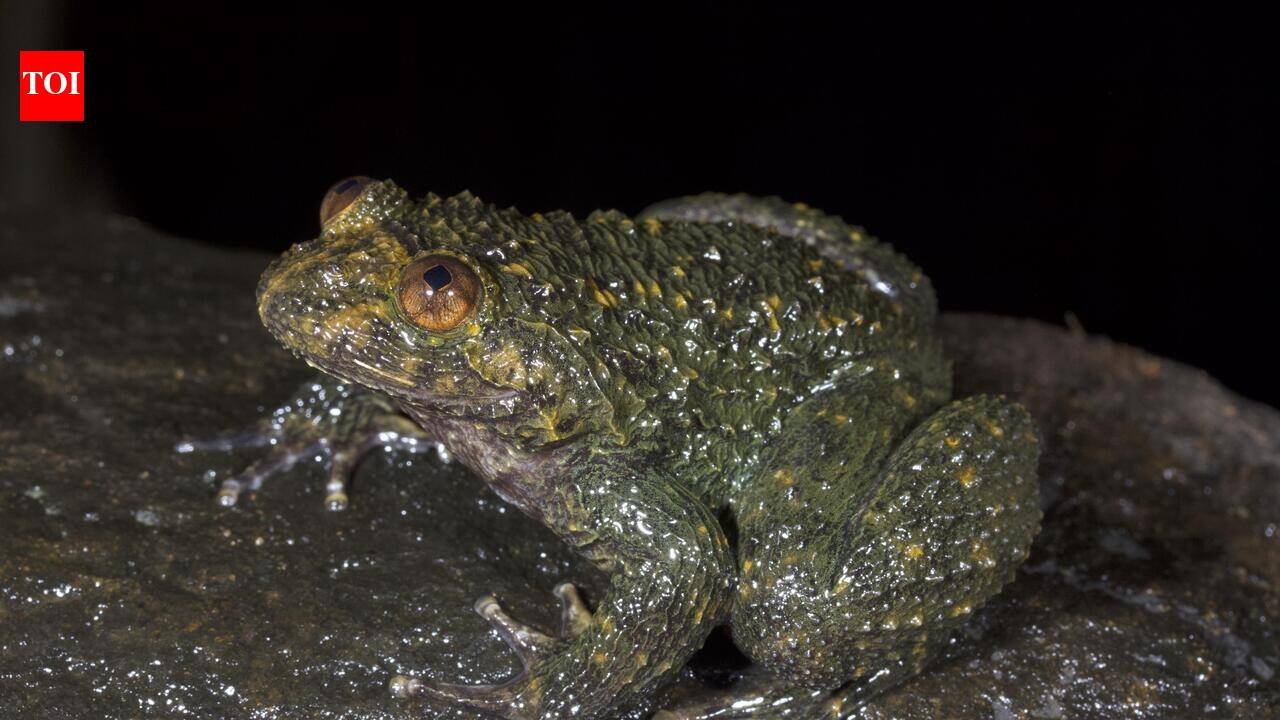
Bengaluru: Every stream in the Western Ghats tells the same story. Large frogs, medium-sized frogs, and tiny frogs live side by side, but they are rarely of the same size. According to a new study led by researchers at the Indian Institute of Science (IISc), this is no coincidence. Instead, the frogs appear to organise themselves in ways that minimise competition for food, space and other resources.The study, led by Kartik Shanker from the Centre for Ecological Sciences (CES), found that stream-dwelling frog communities across the Western Ghats consistently comprise species of different body sizes instead of closely related species. The findings have been published in the journal Evolution.The research examined three genera of frogs found across the biodiversity hotspot: Nyctibatrachus (wrinkled frogs), Micrixalus (dancing frogs), and Hylarana. During field surveys, the researchers repeatedly observed that streams inhabited by wrinkled frogs almost always contained a large, a medium, and a small species. Dancing frogs also tended to occur as pairs comprising one larger and one smaller species.To understand how these communities formed, the team analysed dozens of frog assemblages across the Western Ghats. They found that frogs living together were not more closely related than expected by chance, while closely related species generally shared similar body sizes.“The question we asked was: how did this pattern come about? Had frogs evolved into different-sized species within the region, or had they assembled this way to minimise competition?” Shanker asked. “Our analysis showed that frogs within a location were not more closely related to each other than expected, and that closely related frogs were similar in body size. This suggested that the size-assorted groups are likely a result of ecological processes such as competition, rather than local evolutionary diversification,” he explained.The study also showed that body size determines where frogs live within the same habitat. Larger Nyctibatrachus species occupy rocks in fast-flowing sections of streams, medium-sized species prefer shallower stretches, while the smallest frogs inhabit leaf litter along the banks. Among Hylarana, larger species are mostly stream dwellers, whereas smaller ones favour ponds and often breed at different times of the year, further reducing competition.According to Shanker, the findings are the culmination of nearly two decades of research. “This has been a work in progress for nearly 20 years. Starting from our first observations, through the work of PhD students and postdocs, it has been a gradual process of discovery. We started with one genus and kept adding others as we found more interesting patterns,” he said.The paper, titled ‘Body Size Evolution and the Co-occurrence of Stream-dwelling Frogs in the Western Ghats of India,’ was co-authored by Vaibhav R Torsekar, SP Vijayakumar, KP Dinesh, Aditya Marathe, and VP Cyriac along with Shanker. The researchers say the findings reinforce the importance of conserving the Western Ghats, where habitat loss and land-use change continue to threaten one of the world’s richest centres of amphibian diversity.


