


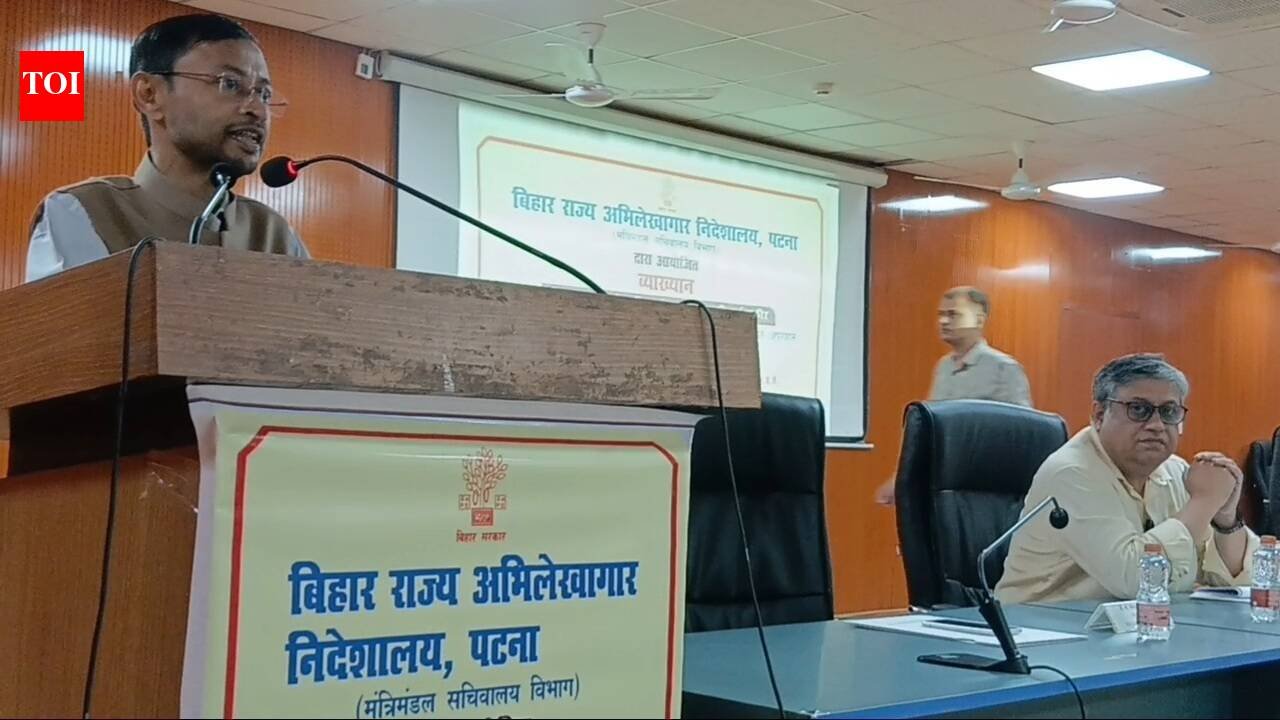
Patna: Bihar State Archives on Thursday organised a lecture titled “Sannyasis and Fakirs in India’s Struggle for Liberation”, highlighting a comparatively overlooked resistance movement through a fresh historical lens.The session examined the historical roots of the Sannyasi-Fakir movement, its socio-economic context, and the nature of its resistance to colonial rule.Welcoming the guests, Mohammad Faisal Abdullah, director of Archives, said the original colonial-era documents preserved at Bihar State Archives are invaluable for revisiting and rewriting history. He said the records provide insights not only into resistance movements such as the Sannyasi-Fakir rebellion, but also into contemporary society, administration, revenue systems and the lives of ordinary people.Delivering the lecture, Rajashekar Basu, professor in department of history, University of Calcutta, said the history of India’s freedom struggle included multiple layers of popular resistance. He emphasised that the contributions of sannyasis, fakirs, peasants, local communities and other social groups deserved greater recognition in the historical narratives.Basu said resistance to colonial rule began well before the Revolt of 1857, with widespread discontent against the policies of the British East India Company emerging across different regions. The Sannyasi-Fakir movement, he noted, was a significant chapter of this early resistance, with Bengal and Bihar as major centres.Sannyasi-Fakir Rebellion was an uprising by Hindu ascetics, including sannyasis and sadhus, and Muslim fakirs against British East India Company in Bengal and Bihar between 1763 and 1800. Prominent leaders were Majnu Shah, Chirag Ali, Musa Shah, Bhawani Pathak and Devi Chaudhurani. Bhawani Pathak, reportedly from Rangpur, led armed groups and was associated with Majnu Shah in the late 18th century.The programme was moderated by Rashmi Kiran, archivist. Uday Kumar Thakur, assistant director of Archives, Pallavi Anand, Ram Kumar Singh, Sarpanch Ram, archivist, Pankaj Kumar, Ramashish Kumar and others contributed to the successful organisation of the event.
