


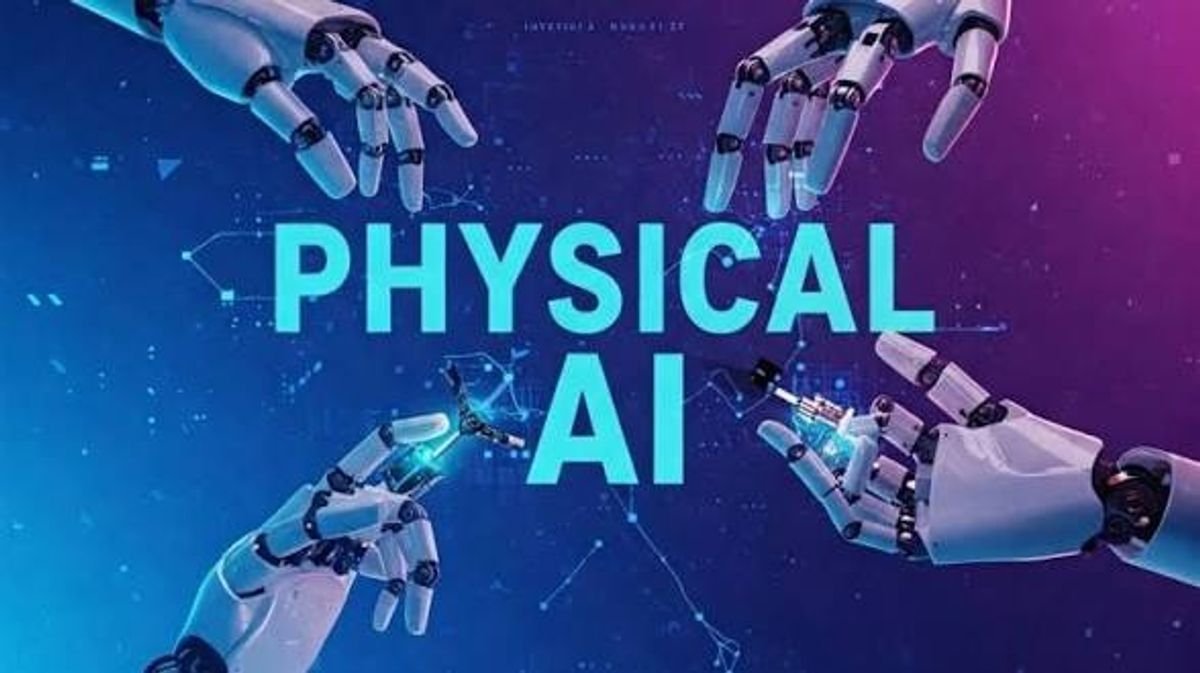
Imagine intelligent machines working in different parts of Kashmir. One could move through an apple orchard, another could observe a forest, while another could inspect equipment or assist scientific work. Such a machine could watch its surroundings, notice changes, adjust its movement and respond to what it sees. For humans, these actions look simple. For a machine, they require the ability to see, understand, decide and act. This is the idea behind Physical AI.
Artificial intelligence has mostly lived on screens. It can write, translate, create pictures, answer questions and find information. Physical AI takes AI into the real world by connecting intelligent systems with cameras, sensors, robots and other machines. It can also help machines take physical action.
Physical AI does not mean only human-shaped robots. It can be a robotic arm picking up an object, a machine moving through an orchard, a drone observing an area or a robot working in a laboratory. What matters is not appearance, but whether a machine can understand its surroundings and respond when conditions change.
The physical world is difficult for machines because it keeps changing. Light shifts, objects move, ground can be uneven and machines may encounter things they have never seen. A camera can show what is ahead, but the machine still has to decide what to do. Physical AI therefore brings together computer vision, sensors, machine learning, robotics and simulation.
Researchers are teaching machines to plan their next move. At MIT, researchers developed VLASH, a method that helps a robot plan its next movement while completing its current one. In a real-world sorting test, the system placed cubes in a box twice as fast as comparison methods while maintaining 90 percent accuracy. The idea is simple: a robot can prepare for what comes next instead of waiting for one action to finish.
Stanford researchers have studied movement through music. They recorded 10 hours of performances by 15 elite pianists, covering 153 pieces, and used computer vision to recreate hand movements in three dimensions. An AI model trained on this information generated hand movements for music it had not seen before, including Beethoven’s “Für Elise.” The study shows that machines can learn from movement, not only words and pictures.
This could eventually have relevance for Kashmir. A machine designed for an orchard could first practise in a digital orchard, where researchers change tree positions, fruit, light and ground conditions. A system designed to observe the natural environment could similarly be tested under different conditions. These are future possibilities, not established applications, but they show how global technology could be adapted to local needs.
Kashmir has varied physical environments. Orchards change with the seasons. Forests and mountain areas differ from towns. Laboratories require careful work, workshops involve tools and equipment, and environmental observation may require attention over long periods. Each setting would require machines to understand the physical world around them.
Research is advancing at leading institutions. MIT, Stanford, Carnegie Mellon University and UC Berkeley work on robotics, robot learning and embodied AI. Harvard is exploring AI systems connected with scientific instruments and robotics. Oxford, Imperial College London, ETH Zurich and EPFL are active in robot learning, machine perception and intelligent systems.
Energy is another challenge. Daniela Rus has highlighted the need for AI systems that use less energy and can operate on robots, sensors and other devices close to where work happens. Physical machines have limits on power and computing capacity, while some decisions must be made quickly. Future systems will therefore need to be capable and efficient.
India is exploring this direction too. At IIT Kharagpur, researchers developed a semi-automatic tracked agricultural robot using camera-based image analysis to detect crop diseases and automatically spray appropriate pesticide. The ground-based system has undergone real-time field testing. It shows that intelligent machines do not have to be humanoid to be useful. They can be designed around a clear practical need.
In Kashmir, practical value may matter more than the appearance of a humanoid robot. A first useful Physical AI system could be much simpler: observing an orchard, monitoring an environment, inspecting equipment, studying plants or assisting with a carefully defined task. Its value would come not from looking futuristic, but from solving a practical problem.
Consider an orchard. A machine moving between trees would have to deal with branches, uneven ground, changing sunlight and fruit in different positions. It could not simply repeat the same movement. It would have to observe, adjust and respond. Similar challenges could arise in environmental observation, laboratories, workshops and other settings.
But this technology should be approached carefully. A system that works in a laboratory may not perform the same way in an orchard, forest or workshop. Real environments are unpredictable. Sensors can fail and AI systems can make mistakes. Future use would require proper testing, safety and reliability, attention to cost and suitable human supervision.
The main idea is simple. Physical AI is not merely about making machines move. It is about helping machines understand enough of the world around them to act safely and usefully. In Kashmir, the better question is not how quickly advanced machines will appear, but where the technology could genuinely help.
AI began with words, numbers and images. It is now learning about movement, space, objects and the world around us. In Kashmir, its next chapter does not need to begin with a machine shaped like a human. It could begin with something much smaller: a system that understands an orchard, observes an environment, assists scientific work or makes a difficult task easier.
AI began on the screen. Its next chapter may be outside it. As machines learn to see, understand, plan, move and respond, the line between digital intelligence and the physical world is becoming thinner. In Kashmir, the important question is not simply what these machines will do, but how carefully and wisely this technology can be developed and used for practical purposes.
(The Author is a Columnist. Feedback: [email protected])
