


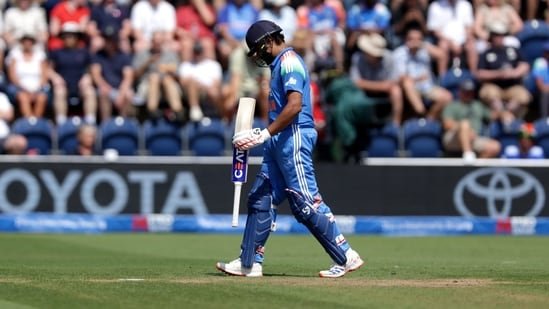
For a few hours, Rohit Sharma appeared to be walking towards an ending he had neither announced nor chosen.
Reports suggested that the selectors wanted to move beyond him after the ODI series against England, potentially turning the match at Lord’s into his final appearance for India. The timing made the speculation particularly uncomfortable. Rohit was still playing, still hoping to reach the 2027 World Cup and, crucially, had not publicly indicated that retirement was imminent.
The Board of Control for Cricket in India eventually intervened. Secretary Devajit Saikia dismissed the suggestion that Lord’s had already been designated as Rohit’s farewell, insisting that the former captain would continue representing India “as long as he is in the scheme of things”.
It sounded like a strong defence. It was also an exquisitely careful sentence.
Saikia confirmed that Rohit had not been handed a predetermined final match. He did not confirm that Rohit would be selected for the next ODI series. He did not guarantee that the opener remained central to India’s World Cup plans. Nor did he say that Rohit would continue to be preferred over younger alternatives.
The phrase “as long as he is in the scheme of things” left every important decision exactly where it had been before the clarification: with the selectors.
The space between selection and rejection
Indian cricket has often used phrases such as “in the scheme of things”, “the doors remain open”, and “the player is still under consideration” when dealing with accomplished cricketers approaching the end of their international careers.
Such language is not necessarily dishonest. It does, however, create a convenient middle ground. A player has not been permanently discarded, but neither has he been promised another opportunity. His career remains theoretically alive while the team continues planning without making any binding commitment.
Cheteshwar Pujara and Ajinkya Rahane were offered a more tangible route back when they were dropped from the Test side in 2022. The selectors publicly encouraged them to return to domestic cricket and score runs. Both eventually earned recalls, proving that an open door can occasionally be more than a ceremonial gesture.
But their experiences also demonstrated how fragile such comebacks can be.
Pujara returned, played through the 2023 World Test Championship final and was then dropped again. Rahane produced important runs in the same final, regained the vice-captaincy and was removed from the side after the subsequent West Indies tour. Neither was officially told that his India career had ended. Selection simply stopped arriving.
Shikhar Dhawan’s exit was even quieter. There was no elaborate farewell and no definitive public announcement from the selectors. India found a younger opener, moved in a different direction and allowed repeated squad omissions to communicate what nobody had formally declared.
Mohammed Shami’s more recent experience offers another warning. Public statements around him emphasised fitness and form, apparently leaving a pathway open. Shami returned to domestic cricket, took wickets and demonstrated his willingness to fight for another opportunity. Yet the national call did not immediately follow.
These cases do not prove that Rohit has already been pushed out. They show something subtler: remaining in the conversation is not the same as remaining in the team.
Rohit Sharma’s position is different because of his stature, his white-ball record and his role in shaping India’s recent ODI identity. He is not merely another senior player trying to extend his career. He is one of the format’s defining openers, a former captain and a central figure in India’s pursuit of major trophies.
Also Read: BCCI lays Rohit Sharma rumours to rest: ‘No discussion on Lord’s being his last match’
But reputation can delay a transition; it cannot cancel one. India must decide whether Rohit’s current performances still justify his place independently of everything he has already achieved. Yashasvi Jaiswal is demanding opportunities. Shubman Gill is firmly established. The selectors must also construct a World Cup squad in which every reserve position has a cost.
That is why the next squad announcement will matter more than the BCCI secretary’s reassurance. Rohit being selected for the upcoming series would indicate that he remains part of a genuine World Cup evaluation. Being omitted, rested without a clear explanation or reduced to a rotational role would tell a different story.
Lord’s may therefore not be his final international appearance. Saikia’s statement has made that clear. But it has not settled the more consequential question of whether Rohit remains India’s first-choice opener, a short-term option or simply a great player whose departure the board is not yet ready to describe openly.
The BCCI has prevented a farewell from being imposed upon him before he has spoken. It has not promised him another beginning.
