



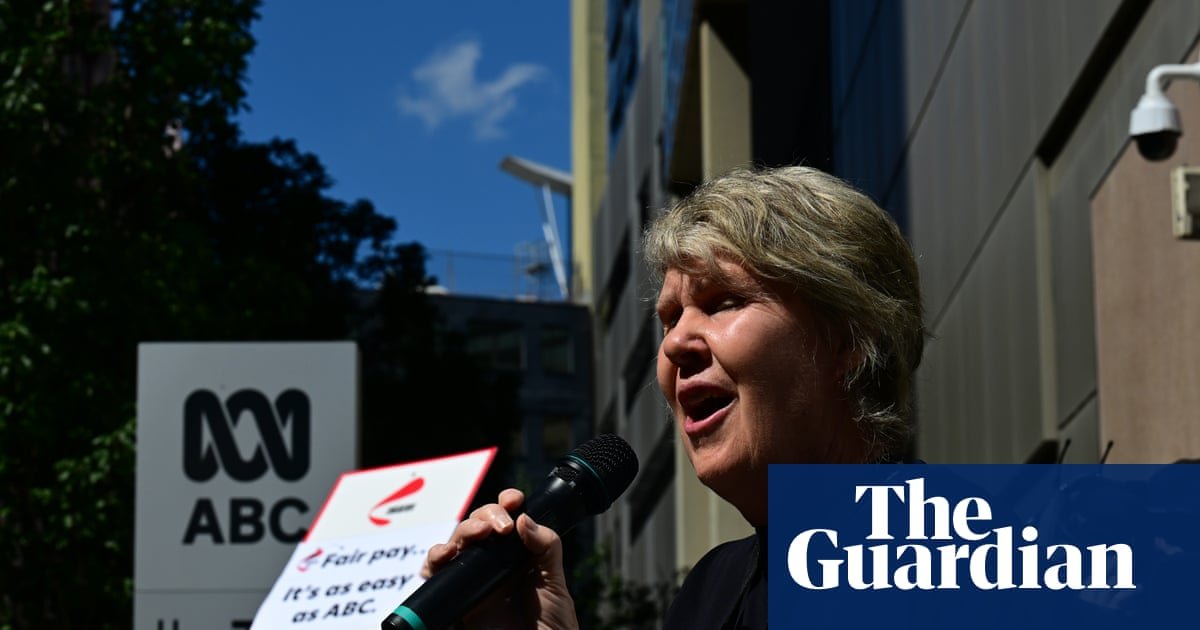
Broadcasters had warned their audiences that the ABC would look “a bit different” on Wednesday – and as the clock struck 11am, they weren’t wrong.
As more than 2,000 ABC staff walked off the job for the first time in two decades in protest of their working conditions, the public broadcaster’s news channel switched over to the BBC.
The ABC’s radio networks pivoted to the dulcet tones of classical music and pop hits.
“My colleagues and I are on strike,” Hilary Harper told listeners to Radio National’s Critics Corner program before a pre-recorded episode of The Law Report began at 11am. “Normal programming will resume at 11am tomorrow.”
ABC radio Melbourne and Sydney entered the first minutes of the strike with Boy Meets Girl’s 1988 hit Waiting for a Star to Fall.
Melbourne’s mornings host, Raf Epstein, told his listeners that staff were striking “because it’s an argument over how best to provide sustainable, secure work”. “We don’t like not talking to you and being with you but I’ll be back on your radio on Friday morning,” he said.
Sydney’s mornings host, Hamish Macdonald, gave the last word of his shift to his boss, with a clip from an earlier interview with ABC managing director Hugh Marks saying he was “very” sorry about the strike and its effect on listeners.
“We’ll be back Friday morning,” Macdonald concluded, before Boy Meets Girl warbled “I hear your name whispered on the wind / it’s a sound that makes me cry”.
Triple J staff abandoned their desks with a more pointed message, going out at 11am with Express Yourself by NWA, which the station had played 82 times in a row in 1990 in response to ABC censorship.
After emerging from ABC’s Ultimo office in Sydney to the cheers of union members and supporters, a breakfast newsreader at Triple J, Jack James, told Guardian Australia it was “tough to see a future” at the organisation.
For the remainder of Wednesday, the ABC’s radio stations largely relied on fill-ins, re-runs and soothing music. Some local radio programs on Wednesday afternoon and evening were broadcast across each state and were hosted by James Findlay, Spence Denny and Nikolai Beilharz.
If it weren’t for the BBC, the ABC’s TV news channel may have been reduced to humming static. From 11am onwards, it relied almost entirely on the UK broadcaster – except for Tim Ayres’ speech at the National Press Club, a repeat of Planet America and an extended version of Question Time.
Ayres’ speech finished at 1.37pm, at which point ABC cut to a live feed of the House of Representatives, treating ABC viewers to member statements to parliament until Question Time began at 2pm. It didn’t cut away from the chamber until 4pm, giving the audience a rare chance to watch the entire public importance debate.
Former AM presenter Sabra Lane read the headlines on Tuesday after choosing not to strike. “I’m here because it’s a vital community service,” the Hobart-based journalist – a reporter and weekend 7pm presenter for ABC News Tasmania – told Guardian Australia.
“Due to industrial action we can’t bring you your usual program,” a prerecorded voice announced periodically over the air waves. “We apologise for the interruption. Regular ABC programs will resume as soon as possible.”
Similar messages appeared on the ABC’s television stations and its online news website.
Flagship news programs including television’s News Breakfast, the 7pm news bulletins and 7.30 with Sarah Ferguson will also be replaced by the BBC World Service on Wednesday evening and Thursday morning.
Back at ABC Ultimo, James said the 24-hour-strike was a “day when we can finally all exhale” after fighting for months for better conditions.
“The only reason why the ABC keeps functioning is because we all work so hard,” he said. “Having a moment where we can stop that and actually speak up for ourselves without fearing consequences is a big deal for us.”


