


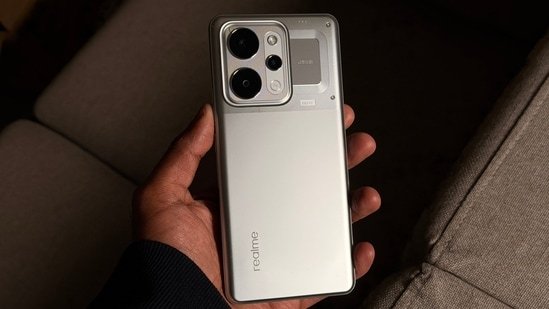
Until recently, a 10,000 mAh battery in a smartphone sounded more like a concept than a realistic mainstream product. That is why it feels almost surreal that we now have a 10,001 mAh battery inside a mid-range phone that is barely larger than devices with half the capacity.
The Realme P4 Power is built around that very idea. It is the core identity of the device. And in a market like India, that matters. The Indian market is demanding. It expects strong performance, exceptional battery life, high-quality displays and premium design, all at competitive pricing.
After using the Realme P4 Power for nearly a month, I can say that it delivers in several important areas. It is not perfect and it does have its share of compromises, but it is not pretending to be something it is not. It has a clear focus and a distinct personality. Here is my experience.
Goodbye battery anxiety
It makes sense to begin by addressing the elephant in the room, the battery, as that is the headline feature.
The phone has a massive 10,001 mAh silicon carbon battery, which on paper should confidently last at least a couple of days. Spoiler alert, it does. You can even push it further depending on usage.
Let me share a few real-world instances that highlight the battery performance.
I took the Realme P4 Power on a weekend bike trip. I mounted it on my bike holder and used it for navigation. That morning, I charged it fully to 100%, started my day early, and used Google Maps for around three and a half hours of continuous navigation. Throughout the day, I clicked photos, took multiple calls, replied to messages on WhatsApp, and watched Instagram reels, which amounted to mixed to fairly heavy usage.
By the end of the day, the phone still had around 52% battery remaining. Since I was testing it deliberately, I decided not to charge it overnight. The next morning, when I checked, it was at about 47%. That clearly reflects how efficient the standby battery performance is.
I continued using the phone the following day without charging it. I clicked more photos and carried on with regular usage. By around 7 pm, the battery had dropped to 8%. For most users, this is comfortably a two-day phone, even with moderately heavy usage. If you are a light user, it can easily stretch to three days.
There was another instance worth mentioning. After I finished testing the phone, I switched to another device, removed my SIM card, and left the Realme P4 Power at around 90% battery. When I checked it two days later, it was still around 80%. That again demonstrates how strong the standby performance is.
This is genuinely A+ battery life.
Another important aspect of this battery experience is the testing. I personally witnessed Realme testing this battery at its factory and from what I can tell, this thing seems solid. I will embed the video below where you can see how the company tests the battery cell to ensure user safety.
During my month of usage, I did not notice any abnormalities. Realme rates the battery for 1,650 charge cycles while retaining around 80% capacity, and it is also offering a battery guarantee. This should translate into long-term reliability.
Reliable performance with software polish
The Realme P4 Power is powered by the MediaTek Dimensity 7400 Ultra chipset. While it is not designed to be a performance powerhouse, it is well suited to the segment in which this phone competes.
In daily use, performance remains smooth and dependable. App launches and multitasking feel consistent, and boot times are quick. I did not experience major slowdowns in routine tasks.
My review unit is the 12GB + 256GB variant, which certainly helps with optimisation. Most applications stayed in memory, and reloads were minimal.
The phone runs Realme UI 7.0 based on Android 16 out of the box. The software experience feels mature and refined, comparable in smoothness to the Realme GT 8 Pro that I have reviewed previously. Animations are fluid, the interface looks polished, and there are no intrusive ads. Some pre-installed applications are present, but they can be uninstalled.
In terms of longevity, Realme is promising three years of major Android updates, which means support up to Android 19, along with four years of security patches.
If you care about benchmark numbers, the phone scored 2,955 in the Geekbench 6 multi-core test and 1,042 in the single-core CPU test. On the AnTuTu benchmark, it achieved a score of 10,17,466.
You would think it is going to be bulky, but you would be wrong.
Given the size of the battery, you might expect the phone to feel excessively bulky. In reality, it manages to remain surprisingly well balanced.
The design has been developed in collaboration with Pearl Academy, a design-focused institute in India. I have the TransSilver colourway, which, after seeing all three options including TransOrange and TransBlue, appears the most stylish to me.
Although the back and frame are made of plastic, the device does not feel cheap. It feels solid and well constructed. Fun fact: At approximately 219 grams, it is actually lighter than the iPhone 17 Pro Max.
Is it slightly thicker than an average smartphone. Yes. However, it does not feel uncomfortable in hand. Users with smaller hands may find it large, but that is increasingly common with modern large-display devices.
The curved back flows into the sides, and the curved front display enhances ergonomics while making the phone appear slimmer. Durability is also a strong point, with IP69, IP68 and IP66 ratings offering additional reassurance.
However, the single bottom-firing speaker can get muffled if covered. Considering the size of the phone, a dual stereo speaker setup would have been preferable. The speaker, although, is loud and does not distort at higher volumes, but it is still not a stereo setup.
Another issue is the placement of the in-display fingerprint scanner. It is positioned slightly too low. Given the size of the phone, reaching it can require some weird hand gymnastics.
Display: Curved, bright and beautiful
The front of the phone is dominated by a 6.8-inch 1.5K AMOLED panel. It supports a 144Hz refresh rate and reaches a peak brightness of 6,500 nits.
In everyday use, the display feels closer to a premium panel than a typical mid-range one. Colours are vibrant without appearing unnatural, and viewing angles are excellent, with no noticeable colour shift when viewed from the side.
I also strongly feel that the curved design enhances the overall aesthetic, though it can introduce reflections in certain lighting conditions. That said, I would take these tradeoffs for the premium look and feel, but that’s just me. Also, because of the curved edges, finding a standard tempered glass protector may be challenging. I would advise to keep the pre-applied screen protector for as long as possible.
Outdoor visibility is also strong. Even under bright sunlight, text and content remain clearly legible.
Cameras: Good for the price
The Realme P4 Power features a dual-camera system comprising a 50MP main sensor and an 8MP ultrawide lens. It supports 4K video recording at 30fps and up to 240fps at 1080p, with optical image stabilisation included. The 16MP front camera is limited to 1080p video.
In daylight conditions, I found that the primary camera delivers good results. I feel shadows and highlights look natural, and detail levels are more than satisfactory for the segment. In low light, however,I did notice slight shutter lag at times, which can lead to softer images if you are not steady.
Colour reproduction is generally accurate, although I feel blues can occasionally appear slightly off. I also noticed some purple fringing along high-contrast edges in certain scenarios.
Portrait mode performs reliably, in my experience, with both human and animal subjects. However, I did observe that complex edges can sometimes appear slightly imperfect.
Coming to the ultra-wide camera, it is usable in good lighting, and I feel it does a decent job outdoors. In low-light situations, however, it introduces noticeable noise and loses some detail.
Video performance at 4K 30fps is stable overall. I found that in scenes with dynamic lighting, the phone can shift white balance and exposure quite frequently. Under consistent lighting conditions, though, the footage looks detailed and suitable for most everyday purposes.
I also do appreciate Reame bringing the Pro video mode, which adds useful flexibility. It offers manual controls, including 16:9 and 2.39:1 aspect ratios, focus peaking, a histogram, audio level monitoring and 24fps recording, apart from your usual controls like ISO, Shutter speed and white balance.
Verdict: Delivers on its promise with strong basics
If battery life is your top priority, the Realme P4 Power stands out as one of the strongest options currently available in India. Importantly, it does not sacrifice the fundamentals. The display is impressive, performance is reliable, and the cameras are respectable for the price.
There are compromises, such as the single speaker and the low placement of the fingerprint scanner. Even so, the overall experience is stable and dependable. I did not encounter overheating, and the design feels solid and well executed.
That said, I would recommend the 8GB + 256GB variant, which costs a couple of thousand rupees more than the 128GB base model priced at ₹25,999. This offers the best overall value.


