


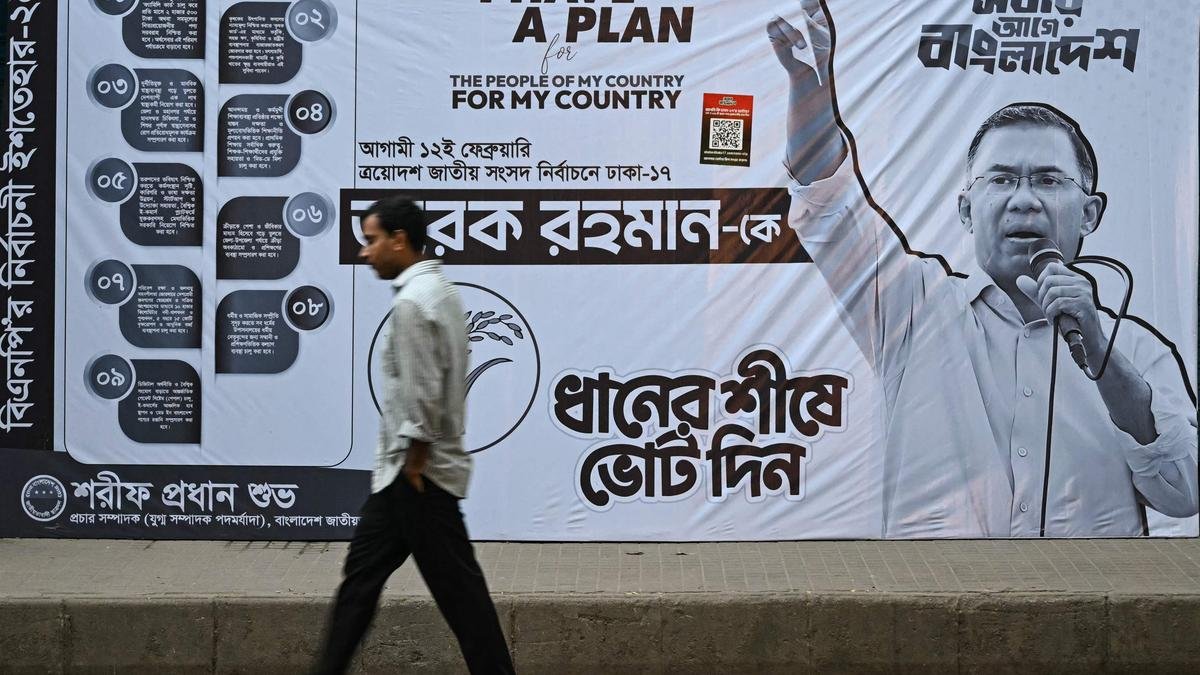
The Bangladesh Nationalist Party (BNP), after 20-years, is set to stake claim to form government in Bangladesh by winning over 200 seats in Bangladesh general elections. Tarique Rahman, son of BNP founder Ziaur Rahman and former prime minister Khaleda Zia, is poised to become Bangladesh’s prime minister, revealed senior politicians in BNP.
Mr. Rahman won in complete majority from Dhaka-17, and Bogura-6, a BNP stronghold.
Bangladesh election results LIVE: BNP wins sweeping election majority, promise of stability
BNP’s origin
The BNP was formed in 1978 by Ziaur Rahman, the voice that declared Bangladesh’s independence over radio on behalf of Sheikh Mujibur Rahman after the Pakistani military launched Operation Searchlight.
After the 1971 War of Independence, Sheikh Mujibur Rahman became the Prime Minister and in the coming years, brought in a constitutional amendment making him the “unimpeachable” President. The Bangabandhu and most of his family members were brutally gunned down on August 15, 1975 after a military coup. Army chief Brigadier Khalid Musharaf took over the regime and Ziaur Rahman was his deputy.
Ziaur Rahman’s role as a Deputy Army Chief marked turbulent period in Bangladesh. He gradually consolidated power and became President in 1977. Shortly after assuming presidency, he held a national referendum to support his role.
On September 1, 1978, Ziaur Rahman launched BNP as a party of “freedom fighters from the battlefield”, keen to promote a blend unique Bangladeshi identity and Bengali nationalism. He inducted politicians from Muslim league and leaders which were opposed to Awami League.
In 1979, BNP marked its first election victory, winning 207 of 300 seats. However, this was short-lived. On May 30, 1981, in a military coup, Ziaur Rahman was assassinated in Chittagong. Later, military ruler Hussain Muhammad Ershad seized power in 1982, sidelining BNP and other parties.
Rise of Khaleda Zia
Following Ziaur Rahman’s death, his wife Khaleda Zia became an identity of resistance against the military ruler and President Ershad. Her role from a widow to an unifying figure of BNP, soon resonated with the masses in Bangladesh. This mass uprising against Ershad marked a phase of hope for democratic rule in Bangladesh. The massive protests, fuelled by anger of students and communities across the country, Ershad to resign.
Eventually, BNP contested and won 1991 general elections, registering a victory in 140 of 300 seats. Khaleda Zia Bangladesh’s first woman Prime Minister with the support of allies. Continuing her winning streak, BNP won 2001 elections by clinching victory in 193 of 300 seats.
Khaleda Zia went on serve as Prime Minister of Bangladesh for 10 years from 1991 to 1996 and 2001 to 2006.
The fall of Zia, rise of Hasina
After the five-year term of the Bangladesh Nationalist Party (BNP) came to an end in October 2006, the party was expected to transfer power to a non-party caretaker government. The caretaker government would have seen conduct of elections within 90 days.
After an exhaustive process, President Iajuddin Ahmed took up the role of Chief Adviser. The opposition Awami League accused him of favouring the BNP. This went bitter with Awami League Party, led by Sheikh Hasina – daughter of Mijibur Rahman – and its allies accusing the BNP of manipulating the voter rolls with millions of fake namesand rigging the 2007 elections. This escalated into a full-scale mayhem into the streets. Hundreds of political supporters engaged in a violent scuffle, leading to imposition of curfew in few areas.
Also Read | Bangladesh elections: BNP promises to end ‘border killings’ by BSF, seeks fair share of cross border rivers
Following a political deadlock, a state of emergency was declared and President Iajuddin banned the elections.
After nearly two years under emergency rule, the Awami League Party swept the December 2008 elections, and abolished the system of caretaker government.
Turbulent times for BNP
After Ms. Hasina’s take over as the Prime Minister, BNP’s top leadership faced arrests and the party’s activities were restricted. This hampered BNP’s prospects to contest elections. In spite of such, the biggest setback to the party was restriction to hold political rallies and publicise anything in media.
Also Read | Grassroots workers of Awami League blame top Ministers, former General Secretary for downfall of party
Zia was jailed for corruption and her son Mr. Tarique Rahman went into exile. The BNP, however, continued to be a major opposition party of the country. It managed to win 7 seats in the 2018 elections when Zia was still in jail.
The BNP boycotted the 2024 elections since the Awami League government refused to hand over governance to a caretaker government. Ms. Hasina formed the government again, which was ousted in a few months in a mass uprising also supported by the BNP.
Zia was out of jail after the uprising giving fresh lease of life to the party. Eventually Tarique Rahman too returned days before his mother passed away.
Who are BNP’s allies in Bangladesh?
For 2026 Bangladesh General Elections, BNP contested for 292 seats out of the 300, leaving the remaining seats for its coalition partners. Unlike Jammat-e-Islami, the BNP didn’t enter into a pact with its allies, but its front included a group of seven smaller political parties.
BNP’s views towards India
BNP Chairperson Tarique Rahman, in an interview with Times, said guarding the interests of Bangladeshi people comes first. “Later, we will try to take relations further”, he added.
Rahman’s stance on India assumes much significance since India-Bangladesh ties took a backseat recently due to a spate of violences against minority Hindus.
However, on a positive note, Indian High Commissioner to Bangladesh Pranay Verma on Saturday (January 10, 2026) met BNP Chairman Tarique Rahman, a day after the party officially elected him to the position ahead of the scheduled February 12 elections.
“The meeting lasted for some 40 minutes,” Bangladesh Nationalist Party (BNP) media cell spokesman Sayrul Kabir Khan told PTI, calling it a courtesy call.
Published – February 13, 2026 02:57 pm IST


