



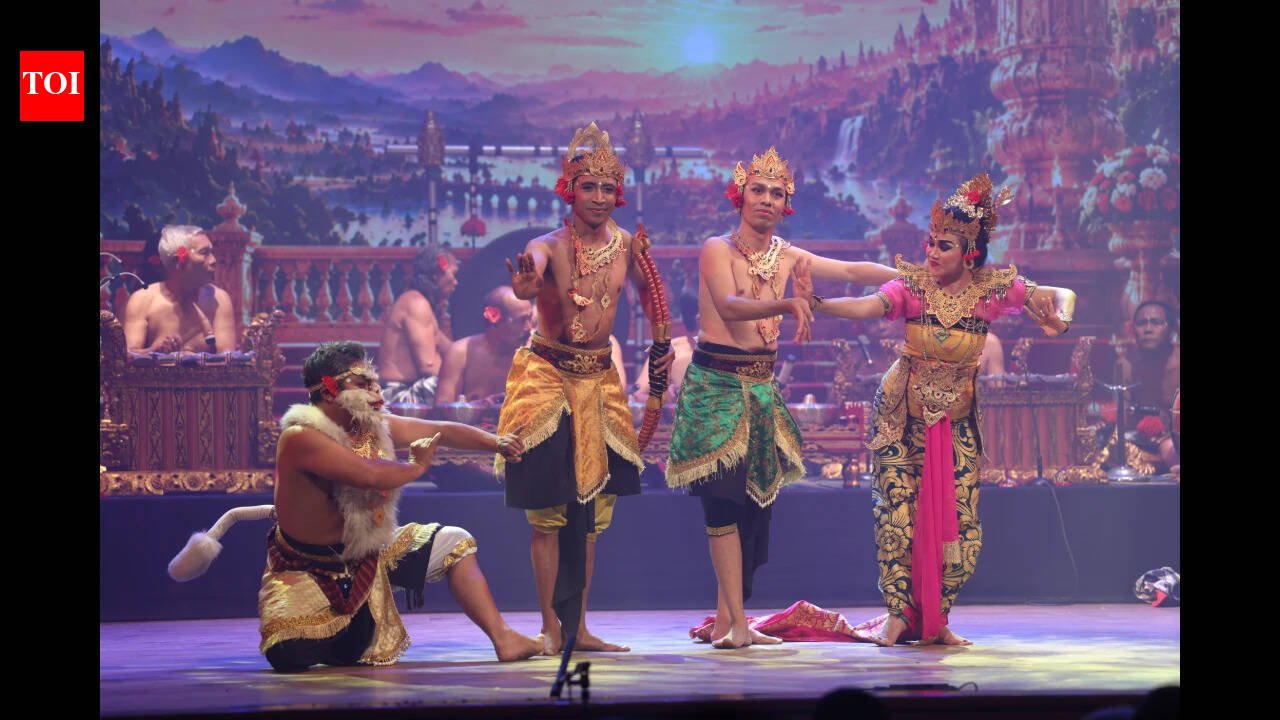
Bali and Bengaluru may lie thousands of kilometres apart, but they share a cultural inheritance rooted in Hindu traditions, temple rituals and the timeless epics of the Ramayana and the Mahabharata. The 16-day Bali in Bengaluru festival, organised by Param Foundation, brought that connection to life through Balinese dance, puppet theatre, workshops, seminars and interactive sessions.A landmark collaboration between Balinese performers and Karnataka’s Yakshagana artistes was at the heart of the festival, as they reimagined the Ramayana through two distinct theatrical traditions. Balinese grace and music met Yakshagana’s colourful costumes, expressive acting, spoken dialogue and rhythmic energy. From Ravana’s arrival and Sita’s abduction to Jatayu’s valiant fight and the ultimate triumph of good over evil, the performance demonstrated how an ancient story can cross borders and find fresh expression.A tale of two traditionsFor I Wayan Dibia, a Balinese dancer, choreographer and Padma Shri awardee, the connection goes beyond shared stories. “Although Bengaluru and Bali are so far away, the Ramayana and Mahabharata are very important in both cultures,” he says. “Around 95 per cent of Bali is Hindu,” he adds, explaining that Balinese retellings of the epics draw directly on Valmiki and Ved Vyasa.While the stories remain familiar, their visual treatment and theatrical vocabulary differ. In this joint production, Sita’s graceful and measured movements convey her elegance, while Rama’s green attire, bow, and arrows establish his identity. The interplay between good and evil is central to Balinese performance. “In Bali, good and evil are understood to sit side by side rather than apart, which is why Rama and Ravana appear as paired figures on stage,” Dibia explains.Finding Bali in Namma BengaluruDibia says a traditional Balinese village has three temples dedicated to Brahma, Vishnu and Shiva. Each temple has three zones: an outer public space, a transitional middle court and an inner sanctum, which is entered only after purification. Music and dance are integrated to community life, with neither absent from Balinese rituals.During his third visit to Bengaluru, and perhaps his ninth to India, Dibia found a familiar spiritual atmosphere in the city. “I can feel some kind of Balinese feeling here in Bengaluru, even though I cannot identify what exactly it is. The mood in India is one of prayer to God and the deities. In the morning, I hear bells, and that makes me feel at home,” he says.When Yakshagana meets Balinese danceAt the festival, Ramayana unfolded through alternating sequences of Balinese dance and Yakshagana. The opening scenes followed the Balinese tradition, while Jatayu’s battle and the monkey warriors were presented in Yakshagana style. For Yakshagana artiste K Krishnamoorthy Thunga, who has performed across India and abroad, bringing the two forms together proved to be smoother than he had anticipated. “Art is art. There is no boundary,” he says. “Dance,” he adds, “can convey more than words, even without a common language.”His daughter and disciple, Chithkala K Thunga, who has trained under him since 2007, points to Yakshagana’s spontaneous spoken dialogue as one of its defining features. “The headgear and ornaments are made of wood and covered in golden foil, and they are tied rather than pinned, as the Natya Shastra prescribes,” she explains. “Yakshagana’s musical ensemble relies on three key performers: the Bhagavata singer-narrator, and the maddale and chande drummers. They create the entire sound world, in contrast to the large Balinese orchestras,” she adds. Asked which role is the most challenging to portray, she says, “Sita is the most demanding role to portray as it requires a huge emotional range.”
Even the younger students are drawn to Yakshagana. Many come because of social media, and the Bali collaboration has made them even more excited. They are very excited to see what the experience will be like. Gen Z is talented, and Yakshagana can be a go-to hobby for them, or even a profession
Chithkala K Thunga, Yakshagana dancer
The collaboration between Bali and Bengaluru offered a compelling reminder that, despite differences in language, music and performance, two ancient theatrical traditions can find common ground in a shared story.
