



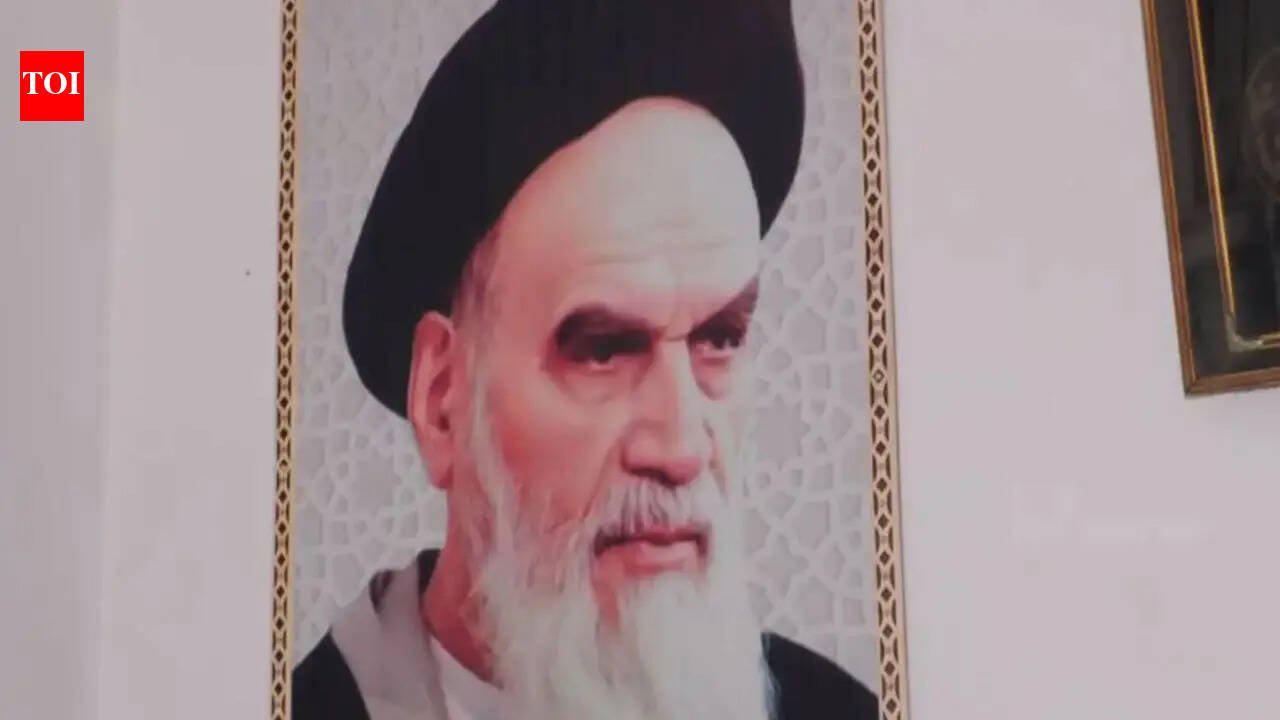
BARABANKI: Iran and India share long-standing civilisational ties, along with deep cultural and spiritual connections within the Shia community.According to news agency ANI, the quiet village of Kintoor in UP’s Barabanki district holds a notable historical distinction as the ancestral home of Ayatollah Ruhollah Khomeini, the leader of the 1979 Iranian Revolution.
Khomeini’s grandfather, Syed Ahmad Musavi Hindi, was born in Kintoor in 1790. He later migrated to Khomein in Iran, where the family lineage eventually established itself and flourished.Even after settling in the Iranian village of Khomein, he retained the suffix “Hindi” in his name to honour his Indian origins.It is said that around the age of 40, Syed Ahmad Musavi Hindi travelled to Iran via Iraq in 1830, accompanied by the Nawab of Awadh. There, disillusioned with British rule, he established his permanent residence in Khomein, Iran. After settling there, his family went on to become highly influential in both religious and social spheres.Syed Ahmad Musavi Hindi’s son, Ayatollah Mustafa Hindi, became a renowned scholar of Islamic theology. His son, Ruhollah, was born in 1902; he would later rise to fame under the names ‘Ayatollah Khomenei’ or ‘Imam Khomenei.’ Ruhollah Khomeini eventually overthrew the Pahlavi monarchy, forever changing the Middle East while carrying a lineage that started in the fertile plains of Uttar Pradesh.While the geopolitical ties between India and Iran are often discussed in terms of energy and trade, the spiritual and lineage-based connection remains a profound, living history for the residents of Barabanki.A resident of Rasoolpur in Barabanki, Dr Rehan Kazmi, noted, “Ayatollah Khamenei has a connection to the whole of India, and he was the supreme leader of the Shia community. We have learnt the way of life from him. Ayatollah Khamenei does not have a direct connection to Kintoor, but Ruhollah Khomeini, who led the Islamic revolution, his grandfather hailed from here. He migrated to Iran and resided in Khomein. The British regime did not want him to return to India. Ruhollah Khomeini’s father passed away when he was 5 years old, and he was raised by his grandfather.”Dr Rehan said that Ayatollah Ali Khamenei, who succeeded Ruhollah Khomeini as the second Supreme Leader of the Islamic Republic of Iran, was his most trusted disciple and was later elected to lead the country after Khomeini’s death.“Ayatollah Khamenei was the most trustworthy disciple of Imam-e-Khomenei, and he was made the Supreme Leader of Iran. Hence, we also have a connection with him. I have heard that some people from Iran came back here to find their ancestral roots. There has been an exchange of letters during the British rule. There is a trust in the name of Ayatollah Khamenei, under which we organise health camps and eye checkups, and we provide free education to students studying in government schools. I also run a free-of-cost education institute under the Trust,” he added.Syed Nihar Ahmad Kazmi, resident of Kintoor, noted that it was for the cultural ties and people of India that Iran allowed Indians vessels to pass through the Strait of Hormuz amid the West Asia conflict and blockade of trade routes.“Ayatollah Ruhollah Khomeini has a direct connection to Kintoor. We have heard that Ayatollah Khamenei was a disciple of Ruhollah Khomeini. There was discrimination against women and alcoholism, so they led the revolution. India and Iran have had an old connection. They had to block the route because of the circumstances, but still they allowed the Indian-flagged ships to pass,” Kazmi told ANI.India-Iran ties were also reflected when members of the Shia community in India took to the streets to mourn the death of Ayatollah Khamenei.After his demise, Ayatollah Mojtaba Khamenei, his son, was elected as the Supreme Leader of Iran.On the occasion of the 40th day of public mourning for the late Iranian Supreme Leader Ayatollah Khamenei, a ceremony was held at the Iranian Embassy in India on Friday, during which the Iranian flag was hoisted.Amid a two-week pause in the conflict between the US-Israel bloc and Iran, delegations from Washington DC and Tehran are set to meet in Islamabad, Pakistan, to discuss a permanent ceasefire.The conflict began on February 28 with US and Israeli strikes against Iran. In retaliation, Tehran targeted Israeli and US assets in the Gulf region, widening the scope of the conflict.(With agency inputs)


