



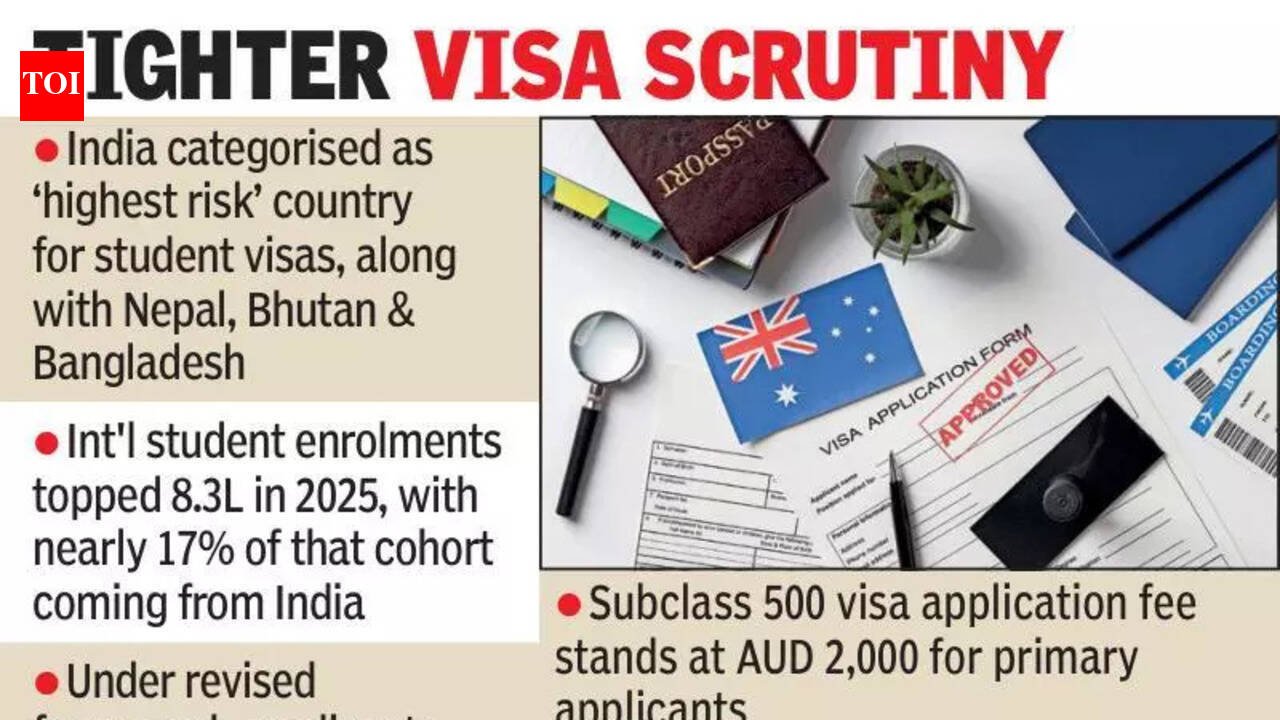
Hyderabad: Months after anti-immigration protests in Australia reignited debate over the country’s migration intake, Indian students are now feeling the ripple in the form of tighter visa scrutiny. The earlier protests called for reduced migration levels and stricter visa controls, arguing that high intake was putting pressure on housing and public services. While the demonstrations took place a few months ago, the policy shifts that followed are now beginning to impact prospective international students.Authorities have categorised India as a ‘highest risk’ country for student visas, along with Nepal, Bhutan and Bangladesh, a move expected to disproportionately affect Indian applicants. Indians form one of the largest migrant communities in Australia, with nearly 9.7 lakh currently residing there, according to data from ministry of external affairs. They also consistently dominate international student enrolments.Indian students typically head to Australia for courses in information technology, data science, engineering, nursing, business management and accounting. Many viewed Australia as a preferred destination after enrolments declined in the United States and Canada. “Australia offered relatively smoother visa pathways and clear post-study work options. That clarity attracted many Indian students over the past few years,” said Alisha Budhani from Abbaccy Global Group, a registered immigration consultancy in Himayatnagar.Under the revised framework, applicants from identified countries now face stricter scrutiny, higher documentation requirements and enhanced financial checks. The Subclass 500 visa application fee stands at AUD 2,000 for primary applicants. Students must also demonstrate proof of at least AUD 29,710 per year in living expenses, in addition to tuition fees.“The Genuine Student (GS) requirement, which replaced the earlier GTE system, places stronger emphasis on academic intent, career alignment, financial preparedness and home-country ties. Recent migration reforms also allow certain visa refusal reviews to be determined through written submissions, without a guaranteed in-person hearing, increasing the importance of a thoroughly prepared initial application,” said Saurabh Arora from University Living, a global student accommodation service provider.Students say the uncertainty is causing anxiety. “I am seeking admission to a master’s in data analytics course, but now I’m worried about possible delays or refusal despite meeting all requirements,” said Khushi Sharma, an engineering graduate. She added: “Being labelled ‘highest risk’ feels discouraging. We are genuine students, but the process suddenly feels unpredictable.”Consultants caution that while Australia continues to welcome genuine applicants, higher costs and tighter assessments could make the pathway more complex in the months ahead. “My biggest fear is that this could also translate into fewer opportunities. Post the protest, public opinion has hardened, and employers may hesitate to hire international graduates like me,” said a 25-year-old who pursued nursing in Sydney.According to University Living’s Report, international student enrolments topped 8.3 lakh in 2025, with nearly 17% of that cohort coming from India. The international students drive close to 76% of student housing demand in cities like Sydney and Melbourne. Australia’s international education sector contributed around AUD 47.8 billion to the economy in 2023, including AUD 30.5 billion from goods and services such as accommodation, food and transport, and AUD 17.1 billion from tuition fees. The sector also supports more than 250,000 jobs across education, hospitality and related industries.“But much like how we saw in the US in Jan intake that more quality students secured positions, we hope for a similar turnaround for Australia,” said Ankit Jain of One Window Overseas Education Consultancy in Hyderabad.


