


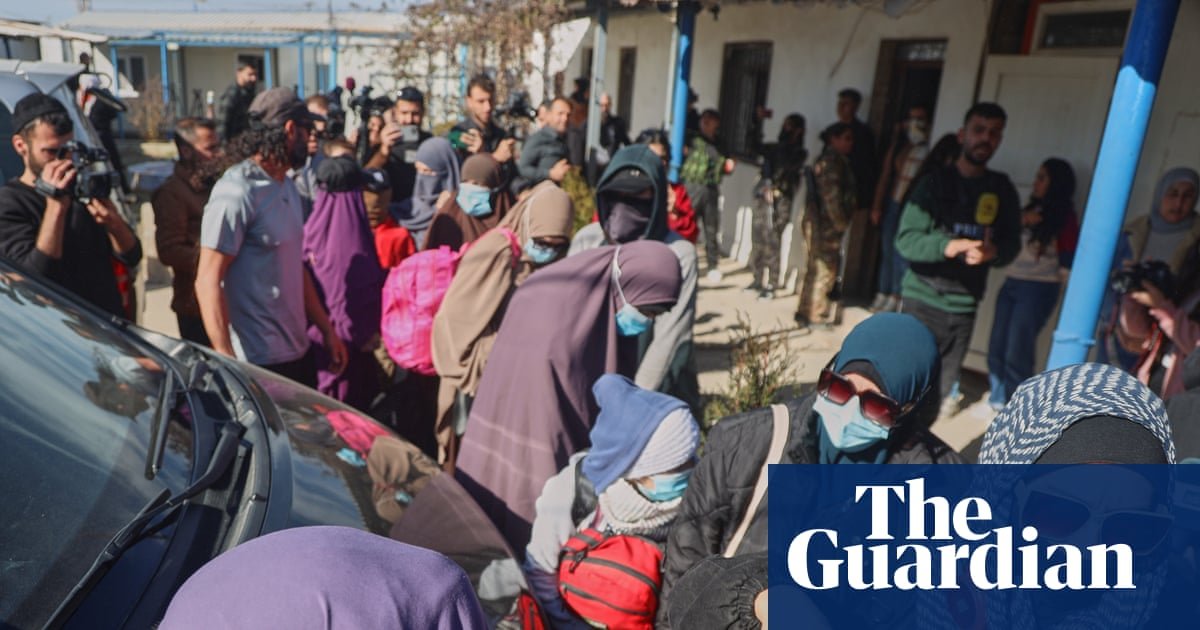
Syrian government officials warned a convoy of Australian families linked to Islamic State fighters that they would be fired upon if they continued towards Damascus last week, a Kurdish official said.
A group of 34 Australian women and children, assisted by their relatives, left al-Roj detention camp on Monday 16 February under a Kurdish military escort, with the aim of reaching Damascus before flying to Australia.
But about 50km away from the camp, Kurdish security forces received a call from the government in Damascus, telling them that the convoy would be “struck” if they tried to reach territory controlled by Syrian government forces. Kurdish forces de-facto control much of north-east Syria, including the area by the Iraqi border where al-Roj is located, and the convoy needed to “cross” a checkpoint controlled by the Syrian government to reach Damascus.
“We were halfway to Qamishli [the biggest Kurdish city in Syria] when my comrades informed me that Damascus said that once they reached government lands they would strike them, because the Australian government didn’t coordinate with them,” Çavre Afrin, an intelligence officer and the head of al-Roj camp’s security administration, told the Guardian.
She added that relatives of the families had brought documents from Australia for the entire group, which would allow them one-time travel, according to the papers that she saw.
Spokespeople for the Syrian ministry of interior and the ministry of information did not respond to a request for a comment on the alleged threat to shoot at the Australian convoy.
A Syrian official separately said the “issue stemmed from the absence of prior coordination with the Syrian government” and that Damascus had only learned of the repatriation effort after families left the camp.
The official added that whether they would be allowed to travel “will depend on the Australian government”.
The group of 11 women and 23 children are the wives, widows and children of alleged members of IS who travelled to Syria when the radical group controlled vast swathes of Syrian territory under its so-called caliphate. Most of the women claim that they either did not understand the situation in Syria or that they had been coerced into travelling there – none have faced charges or appeared before a court.
Sign up: AU Breaking News email
They have been held in detention camps guarded by Kurdish forces since at least 2019, after the territorial defeat of IS. Rights groups say their detention is arbitrary and that conditions in al-Roj are unsuitable for life, particularly for children, pointing to the spread of disease in the squalid tent encampment.
The aborted escape attempt left the Australians distressed and deeply shocked. Zahra Ahmad, a 33-year-old mother of three from Melbourne, collapsed to the ground and had what she described as a “seizure” when she was brought back to the camp. Her son, 14-year-old Mohammed, lost feeling in his hands for days after the brief release, and other children sob when they recount being forced to return to the camp.
Many of the children had never before glimpsed the world outside. They returned to find their tents disassembled and possessions gone – a procedure the camp administration said was standard when residents leave – but have since recovered most of their belongings and rebuilt their tents.
The families have said they are increasingly afraid of remaining in al-Roj amid an IS resurgence in Syria, as their repatriation attempt could expose them to reprisal from more radical families in the camp.
Their attempt to return home has kicked off a furore in Australia and has led to a wave of vitriol against the women. The Australian government has said that it does not support the women and children’s return, with the home affairs minister, Tony Burke, saying on Sunday that the government was “actively making sure we do nothing to help them”.
The Australian government cannot prevent Australian citizens from returning home of their own accord, except in the case of a temporary exclusion order, which can prevent an Australian citizen from entering the country for up to two years if they are deemed a security risk. One of the Australian woman has been issued a TEO, according to Burke.
The women have repeatedly said they would be willing to face trial when they return home to Australia.
Australia, under Scott Morrison as prime minister, repatriated eight orphaned children from north-east Syria in 2019.
Anthony Albanese’s government repatriated four women and 13 children in 2022 but, in the face of political and media opposition, changed its position, saying it had no plan to repatriate the final group.
One returned woman was charged with entering a proscribed area, Raqqah province. Mariam Raad pleaded guilty and was discharged conditionally in a New South Wales court.
Last October two women and four children escaped nearby al-Hawl detention camp, making their way across Syria to Lebanon, where they were given passports at the Australian embassy. They returned to Australia on a commercial flight.
Government rhetoric against repatriations has hardened even further. Albanese said last week he had “nothing but contempt for these people”.
The prime minister said he sympathised with the children – some of whom were born in the camp – but he said they had been “put in that position by their parents”.
The federal opposition said on Monday that it would try to introduce legislation to criminalise helping individuals re-enter Australia if they were linked to terror organisations, or if they had committed terror-related offences.
“We will take action and refuse to let people come here who abandoned Australia to support Islamic extremist terror overseas,” said the opposition leader, Angus Taylor.
Rights groups have repeatedly called on Australia to take back its citizens, saying the government has a legal obligation to repatriate stranded Australians – particularly children.
“Instead of investing effort in ways to stop help for innocent Australian children, politicians should be focused on finding ways to protect them,” Save the Children Australia’s chief executive, Mat Tinkler, said on Monday.


