



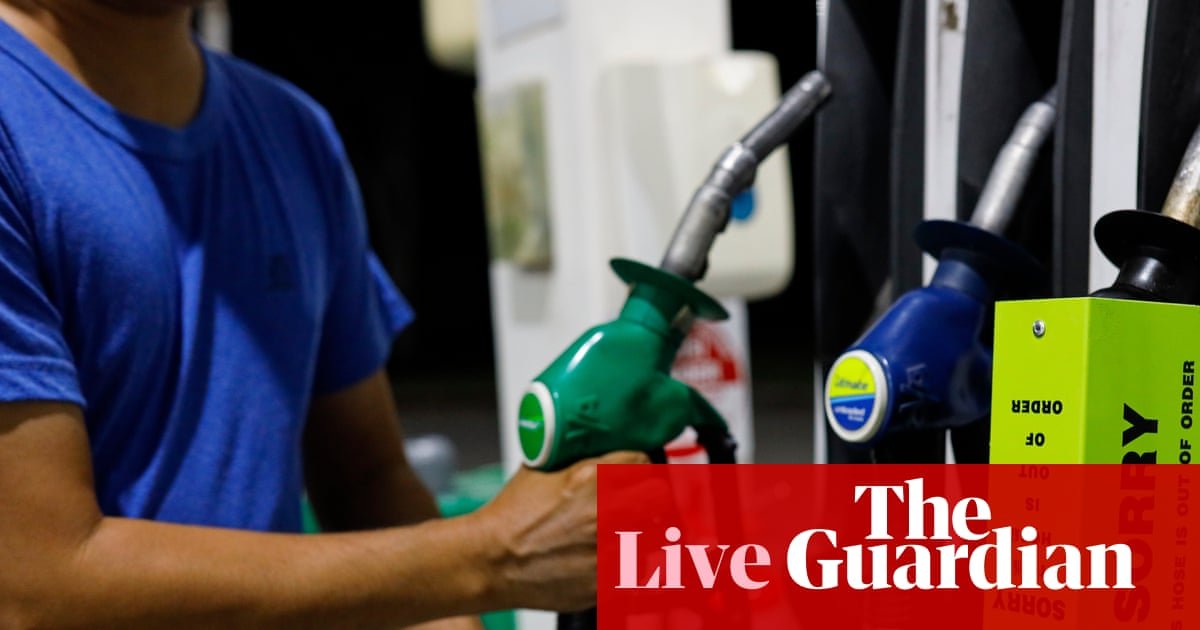
Chris Bowen lowers minimum stock requirements for fuel
The energy minister, Chris Bowen, is speaking now in Sydney. He said the country will reduce minimum stock obligations for both diesel and petrol, which will allow fuel companies “more flexibility to manage their supply chains”.
The obligations for diesel will reduce from 2.7bn litres to 2.2bn litres, and for petrol from 1bn litres to 700m litres. Bowen said:
It’s not like they can just press a button and get fuel out the door. But it will make a difference going forward and help them help regional communities, in particular.
He said it’s understandable that Australians are concerned about the fuel supply, but said the country’s minimum stock obligations are “high” and fuel continues to arrive:
Despite the fact that Australia’s fuel has been arriving and that our minimum stock obligations are in good shape, of course we have continued to see unacceptable impacts, particularly in regional Australia, as the supply chain has struggled to cope with massive spikes in demand.
Key events
Imams body warns against anti-Muslim hate ahead of Christchurch massacre anniversary
Australia’s peak body for imams is calling on the nation to stand up against anti-Muslim hate and religious discrimination ahead of the International Day to Combat Islamophobia on Sunday.
The day commemorates the Christchurch mosque massacre where 51 Muslims were murdered on 15 March 2019.
The president of Australian National Imams Council’s (ANIC), Imam Shadi, says a recent rise in Islamophobic incidents threatens the safety of Muslims and undermines social harmony:
Many mosques across Australia have recently received threatening letters and messages. Some have referenced a so-called “Christchurch 2.0”, while others have contained explicit threats of violence against worshippers.
Just a few nights ago, there was also a disturbing incident at a Ramadan Iftar gathering in Ballarat, VIC, where an individual reportedly stormed into a community dinner, threatened children, assaulted attendees and directed hateful anti-Islamic abuse toward those present.
Low-deposit lending records biggest jump on record
Patrick Commins
Banks in the final three months of last year lent a record $5.4bn to homebuyers with “wafer thin” deposits of 5% or less – the latest evidence that the Albanese government’s decision to uncap its home guarantee scheme supercharged demand in an already red-hot property market.
The latest figures from the banking regulator, Apra, show low-deposit lending jumped $2.1bn in the December quarter, up 63% on the previous quarter, which was the biggest increase in the history of the data, according to Canstar analysis.
Property prices continued to forge higher through last year, with values at the cheaper end of the market climbing particularly quickly over recent months as first home buyers rushed to take advantage of the scheme, which helps them take out a loan with a deposit of as little as 5%.
The cap on the number of places in the scheme was removed on 1 October, alongside increased income eligibility limits.
Sally Tindall, the director of data insights at Canstar, said the scheme had “removed a key barrier for first home buyers who have surged on to the market, wafer-thin deposits in hand”.
Tindall said saving a 20% deposit “had become an almost impossible task for many would-be buyers,” and that these super low deposit loans now accounted for 4% of new lending to owner-occupiers:
Which sounds small, but is actually the highest proportion on record.
The federal opposition’s energy spokesperson, Dan Tehan, has been speaking about the Albanese government’s announcement it will reduce minimum stock obligations for diesel and petrol.
Bowen earlier said the change would allow fuel companies “more flexibility to manage their supply chains”.
Tehan says Bowen does does not have a “clear plan” to guarantee Australia’s fuel security:
The Australian people need more. They need a plan. They need to be reassured that there are no problems.
Great Western Highway closure in NSW to remain for at least three months after failure of ‘Convict Bridge’
Penry Buckley
The NSW government has announced that a section of the Great Western Highway in the Blue Mountains will remain closed for at least three months following the failure of a historic bridge this month.
Victoria Pass in the Blue Mountains, which includes “Convict Bridge” built by chain gangs in 1832, closed last week after Transport for NSW detected cracking and movement in its substructure.
In a statement released this morning, the NSW roads minister, Jenny Aitchison, says at least two weeks of specialist testing and 3D imaging have to be carried out with no passing traffic to understand the full extent of the damage, and “under the most optimistic scenario”, work to make the road safe would take at least a further two months.
Aitchison says:
This is not a short-term repair job. We are dealing with a major geotechnical failure on a fragile and historic section of road, and it must be assessed and repaired properly … I know this closure is causing real hardship for families, workers, school communities, freight operators and local businesses, and I am deeply sorry for that disruption. But there will be no shortcuts on safety – we will not risk lives.
Aitchison says a diversion in place for traffic is adding up to 25 minutes to cross the Blue Mountains, but has warned of heavier delays on peak periods and weekends. Extra train, coach, school and regular bus services have been laid on, but the closure has raised questions about the failure of successive state governments to replace the nearly 200-year-old bridge.
‘Of course’ there will be further threats to fuel supply if war drags on, Bowen says, but ‘we are nowhere near’ running out
Guardian Australia’s Luca Ittimani just asked Bowen if Australia could run out of fuel. The energy minister said:
I think Australians know that our fuel supply is secure, it’s arriving on schedule. Will there be further threats to fuel supply, as the international circumstances continue to worsen? Of course.
That is a realistic thing which governments should prepare for and are prepared for, the Australian people are prepared for.
I think the sort of inflammatory running-out language, we are nowhere near that.
Bowen added that panic-buying of fuel is “unAustralian”, saying there was “no need” to do so.
Bowen maintains fuel supply is secure even though regions have seen shortages
Bowen stressed that the fuel supply remains secure, although he acknowledged that there were issues in regional Australia due to heavy demand. He said:
Our fuel supply is coming in. Australians should know that. When we say the fuel supply’s secure, that’s what we say, that’s what we mean, that’s the facts.
That doesn’t mean that Australians in regional areas haven’t faced real shortages, because demand has been so high.
Two things can be true, and these two things are true.
Chris Bowen lowers minimum stock requirements for fuel
The energy minister, Chris Bowen, is speaking now in Sydney. He said the country will reduce minimum stock obligations for both diesel and petrol, which will allow fuel companies “more flexibility to manage their supply chains”.
The obligations for diesel will reduce from 2.7bn litres to 2.2bn litres, and for petrol from 1bn litres to 700m litres. Bowen said:
It’s not like they can just press a button and get fuel out the door. But it will make a difference going forward and help them help regional communities, in particular.
He said it’s understandable that Australians are concerned about the fuel supply, but said the country’s minimum stock obligations are “high” and fuel continues to arrive:
Despite the fact that Australia’s fuel has been arriving and that our minimum stock obligations are in good shape, of course we have continued to see unacceptable impacts, particularly in regional Australia, as the supply chain has struggled to cope with massive spikes in demand.
Angus Taylor criticses government over soaring petrol prices, but doesn’t offer alternative solutions
The opposition minister, Angus Taylor, is speaking in Sydney about ongoing cost of living struggles amid surging petrol prices.
He said:
If you have an economy that’s not working any more, where inflation is crashing households and businesses, where your standard of living is going backwards, then frankly you can’t get ahead.
Taylor claimed energy minster Chris Bowen is “asleep at the wheel”. When asked what the Coalition would do differently, Taylor didn’t provide a concrete answer besides saying you needed to “admit there’s a problem”.
First of all, recognise that there’s a problem. I don’t know how many questions we asked where we laid out issues where people were trying to get fuel. …
The first thing you’ve gotta do if you’re going to fix a problem, is admit there’s a problem. Sadly the real problem here is Chris Bowen.
Bowen said yesterday Australia would relax petrol standards for 60 days in hopes of injecting an extra 100m litres a month into the system.
Qantas to pay $105m to settle Covid flight credit dispute
Jonathan Barrett
Qantas will pay $105m to settle a class action lawsuit over its Covid credit scheme, ending a long-running dispute with some of its affected customers.
Qantas said in a statement there was no admission of liability and that the settlement was subject to federal court approval.
The legal action, run by Echo Law, alleged that Qantas had breached its contracts with customers by failing to provide timely cash refunds for cancelled flights during the pandemic. It provided travel credits instead, with expiration dates.
The airline’s policy generated significant debate, with consumer groups raising concerns over the credit redemption rules.
Qantas later removed the expiry dates on the credits.
The affected flights caught by the class action were scheduled to depart between 1 January 2020 and 1 November 2022, but were cancelled.
Benita Kolovos
‘My heart sank,’ minister says after boy killed in crash
The Victorian minister, Nick Staikos, commented after a teenage boy was killed in the crash after an alleged attempted carjacking. He said:
My heart sank when I read the police statement this morning, I grieve the loss of any young Victorian life. I don’t know any more than what was in Victoria police’s statement, but what I would say to young people is, this risky behaviour is just not worth it.
I know Victorians have had enough of it and it can have tragic consequences.
Teen dead after fatal crash after alleged attempted carjacking
Victoria police are investigating a fatal crash in the Melbourne suburb of Hoppers Crossing that took place early this morning.
Officials said an allegedly stolen grey Skoda sedan was chasing another vehicle in what appears to be an alleged carjacking, just after 12am. The Skoda collided with the rear of the other vehicle, which managed to flee.
Shortly afterwards, the Skoda collided with two other cars, rolling several times.
Police said a teen boy inside the Skoda died at the scene. Two other teens, a boy and a girl, were taken to hospital with non-life-threatening injuries under police guard.
Another teen girl was arrested and taken to hospital with minor injuries. She has since been released and is expected to be interviewed later today. The occupants inside the other vehicles suffered minor injuries.
No charges have been filed.
Luca Ittimani
More airlines hike flight prices as Iran war continues to disrupt oil supply
Cathay Pacific, AirAsia and Thai Airways are among a growing number of airlines hiking air fares as conflict in the Middle East boosts oil prices and sends travellers flocking to alternative stopover destinations in Asia.
The US and Israel’s war on Iran has sent the price of oil soaring while restricting access to refineries, with experts predicting air fares could be elevated for months even if the conflict ends.
Some airlines have locked in the price of a portion of their crude oil purchases but not the costs of refining that into jet fuel, leaving them exposed to price shocks.
Cathay Pacific planned to increase fuel surcharges for travellers as it had hedged none of the refiner’s margin and only 30% of its fuel costs.
Read more here:
Jillian Ambrose
Middle East war creating ‘largest supply disruption in the history of oil markets’
Oil markets are facing the “largest supply disruption in history” as the war in Iran continues to block tankers from shipping millions of barrels of crude each day, the world energy watchdog has warned.
The International Energy Agency (IEA) said the supply shock ignited by Iran’s effective blockade of the strait of Hormuz meant the world faced a deeper crisis than after the Yom Kippur war of 1973 and the 2022 outbreak of war in Ukraine.
The warning came as Iran issued a statement that was said to be the first from its new supreme leader, Mojtaba Khamenei, to call for the vital trade artery to “remain closed”, in a blow to hopes of a resolution to the crisis.
In response, global oil prices passed US$100 a barrel on Thursday as widespread Iranian attacks on energy facilities in the Middle East overshadowed a vast release of government reserves.
Read more here:
Queensland police searching for man missing in flood waters
Queensland police are searching for a man reported missing after he went into the water in Burnett Heads this morning.
Officials said police and emergency services were called to the area around 1am amid reports the man had gone into the water from a houseboat and had not been seen since.
The river reached a major peak flood of 7.4 metres on Wednesday morning, bursting its banks and flooding major parts of Bundaberg.
The search for the man is ongoing.
Resources minister to meet with US, Japanese and other counterparts amid oil crisis
Australia’s resources minister is heading to Japan for talks with her global counterparts about shoring up fuel supplies in the face of oil market chaos that’s being driven by the war in the Middle East, AAP reports.
The price of brent crude, the US oil benchmark, surged to more than US$100 a barrel on Friday (AEDT) amid reports Iran had been laying mines in the strait of Hormuz – a key trade route for oil from the region.
The resources minister, Madeleine King, said she would meet her counterparts from the US, Japan, South Korea, Timor Leste and other countries at the Indo-Pacific Energy Security Forum, where petrol and diesel supplies would be on the agenda.
“I’m hoping to achieve good discussions about where everyone else is sitting in addressing the fuel supply or demand issues they’re facing in their countries,” she told ABC TV on Friday morning.
Benita Kolovos
New laws would require sold prices be made public in Victoria
Agents and homeowners will no longer be able to withhold the sale price of properties as part of a Victorian government bid to stamp out underquoting.
The consumer affairs minister, Nick Staikos, is holding a press conference to announce “Australian-first laws” to be introduced to parliament in June that would mandate sold prices be made public immediately after the sale contract becomes unconditional.
He says the change will give a clearer idea of the actual market:
The price of a home in large part is based on the property sales of comparable properties in the area and that is why non-disclosure of the sale price can distort the market. It means that it makes it more difficult to tackle underquoting.
Resources minister says Iran war will have lasting effects across the world, but Australia still well supplied with fuel
The federal resources minister, Madeleine King, said the longer the war in Iran lasts, the worse the effects will hit “the whole global economy”.
King spoke to ABC News Breakfast earlier this morning, saying:
The ripple effects reach everybody’s shores, including Australia’s. I want to take this opportunity to reassure Australians around the country that we are well supplied with fuel …
We are still seeing ships come in and deliver refined fuel on the west coast and the east coast and we have no indication that that will be delayed in any sense.
King said she couldn’t predict when the conflict will end, but Australia hopes it de-escalates soon.
Patrick Commins
Capital gains tax discount ‘overwhelmingly’ benefits investors in Australia’s richest electorates, analysis shows
Investors who live in the wealthy electorate of Wentworth in Sydney’s eastern suburbs claimed about $1.8bn from the 50% capital gains tax discount, according to new research. It reveals how a handful of rich enclaves in Australia’s two biggest cities account for a fifth of the annual benefit from the tax break.
The Australian Council of Social Services is lobbying for a halving of the CGT discount and has used analysis of Australian Taxation Office data from 2022-23 to highlight how the benefits “flow overwhelmingly to a small number of high-income, inner-city electorates in the eastern states”.
In Wentworth, where the average taxable income is $162,561, the average annual capital gains tax break is $13,450 per person, and in total accounts for 7.5% of the $20bn in total benefits.
In contrast, in Blaxland in Sydney’s west, where the typical income is $53,542, people received an average CGT concession of just $333, the report showed.
Read more here:
Joyce cagey on One Nation’s tax policy
Barnaby Joyce was also asked about One Nation’s tax policies in the lead-up to the South Australian election and the Farrer byelection in NSW.
Joyce said the party’s tax policy would be centred around “proper assessment” of expenses, but he wouldn’t be announcing anything concrete yet as there’s no upcoming federal election.
It’s just like saying to the Labor party or to the Liberal party or to the Nationals: what’s your tax policy for the coming election? Well, If you asked any of them, Sally, you’re going to get exactly the same answer as what I’m giving you. We will cost it.
RN host Sally Sara pressed Joyce for details. The MP responded that it was the “game people are going to play” that would only “confirm the votes of those who are never going to vote for us”. Joyce went on:
We will have a properly costed policy, like every other party has a properly costed policy.


