



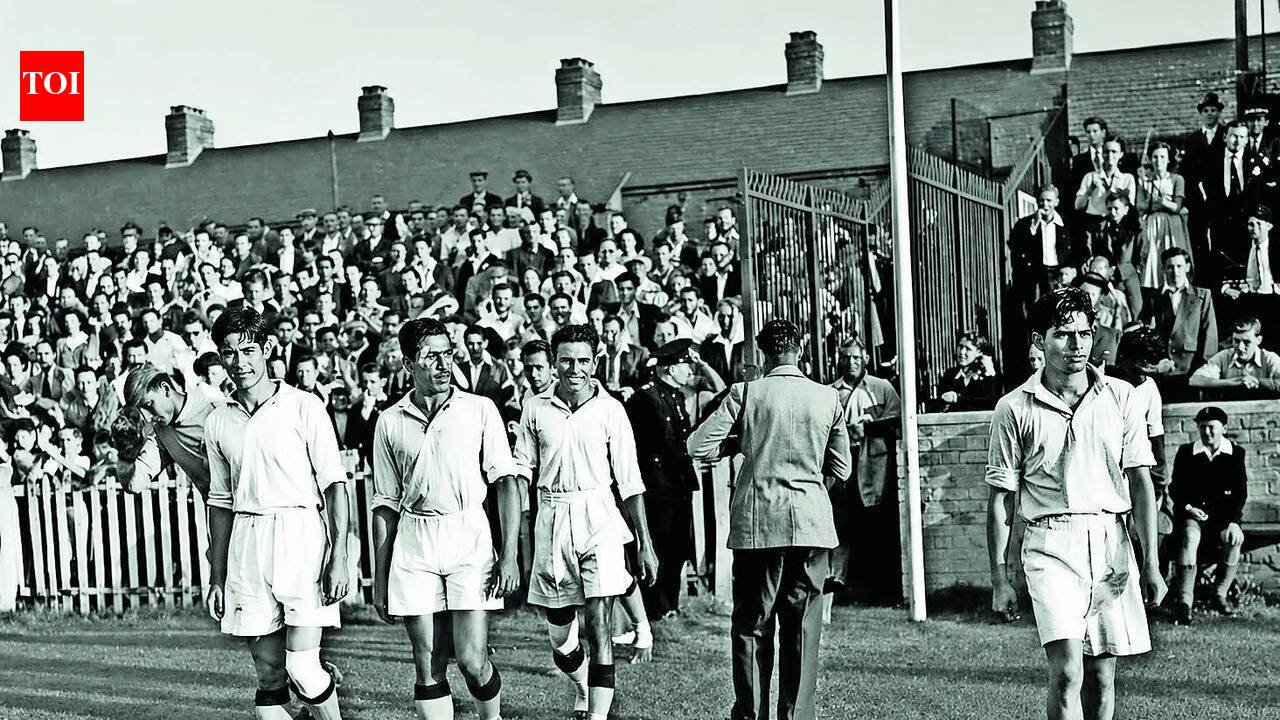
By Karthikeyan SairamLong before Bengaluru became synonymous with startups, software parks and traffic jams, it was known for something else entirely: football. At a time when football was arguably India’s most celebrated sport, the city emerged as one of the game’s most influential nurseries. From the military cantonments of the British Raj to the dusty grounds of Austin Town and Gowthamapuram, generations of local players transformed a colonial pastime into a homegrown passion.The story of football in Bengaluru is not merely about sport. It is a story of migration, empire, resilience and communities that turned borrowed games into local traditions.For many, the city’s footballing legacy is inseparable from memories of its heroes. Retired Indian Air Force officer and football enthusiast, Neogy, recalls being captivated as a child by one such legend. “As an eight-year-old, watching Raman play for Mohun Bagan was an absolute delight,” he says. “Growing up, I learned that he was the first international goalscorer for India. Little did I know that I would one day move to Bengaluru for my job and get a chance to meet him in his hometown. It felt like meeting my childhood hero — a dream come true.”Football’s roots in Bengaluru can be traced back to the British military presence in the cantonment. What began as a colonial recreation gradually became embedded in local life, particularly in neighbourhoods where access to grounds, equipment and organised competition created pathways into the sport. Former Indian footballer R D Babu, who grew up in Austin Town, sees that inheritance as a turning point for generations of young players.“One thing the British left us was the love for football. When they packed up and left for Britain, they left behind their equipment and gave generations of kids like me the freedom to express ourselves on the ground, to take sports seriously as a profession and hope to represent the country on a grand stage,” he says. Few places embody that legacy more vividly than Gowthamapuram, a neighbourhood often referred to as Bengaluru’s own “Little Brazil.” The comparison is more than a nickname. A statue of Brazilian football icon Pelé stands at the entrance to the locality, a symbol of a community whose identity has long been tied to the game. “Having produced many professional players, including stars from the 1950s to the 1970s — the golden age of Indian football — who represented the country in the Olympics and major leagues, there was always a strong belief that football could lead us to fruitful careers,” says Lawrence, a former state and HAL football player That belief helped sustain Bengaluru’s football culture across generations. While the city would eventually reinvent itself as India’s technology capital, pockets such as Austin Town, Richmond Town and Gowthamapuram continued to nurture footballing talent in the city.Today, traces of that past remain scattered across old grounds, neighbourhood tournaments and family stories. They serve as reminders that before coding campuses and glass towers came to define Bengaluru, it was the football field that united communities, created local heroes and gave countless young people a dream to chase. When football arrived in India with the BritishThe roots of Bengaluru’s football culture can be traced back to the early 19th century when the British established their military presence in the city. Among the earliest migrants to arrive were families from Tamil Nadu who settled in areas such as Gowthamapuram. They worked as cooks, cobblers, carpenters, washermen and domestic staff for British officers stationed in the cantonment.British soldiers frequently played the game on military grounds. Local workers initially watched from the sidelines, fascinated by the unfamiliar sport. But as British teams often struggled to field enough players, Indian workers were invited to join in. What began as casual participation soon evolved into something much bigger. The British may have introduced football to Bengaluru, but local players quickly learned the game, adapted it and, before long, began outperforming the very people who brought it to India.How barefoot players won one of India’s oldest football tournamentsIf there is one match that symbolises Bengaluru’s footballing rise, it is the 1937 Rovers Cup final. Established in 1891, the Rovers Cup was among India’s most prestigious football competitions. For decades, it was dominated by British military regiments. Indian clubs were only allowed to participate from 1923 onward. Yet for 45 years, no Indian team managed to win it. That changed when Bangalore Muslims reached the final at Bombay’s Cooperage Ground.More than 20,000 spectators packed the stadium to witness a historic encounter between two Indian sides — Bangalore Muslims and Mohammedan Sporting Club — both of whom had already eliminated British regimental teams. A solitary goal from Laxminarayan in the 18th minute secured a 1-0 victory and made Bangalore Muslims the first Indian team to lift the trophy. It was more than a sporting triumph. It was a symbolic moment in colonial India: local players defeating the institutions that had long dominated the game.Austin Town and the Italian connectionOne of the most fascinating chapters in Bengaluru’s football history began thousands of kilometres away in the deserts of North Africa. During World War II, nearly 22,000 Italian prisoners of war captured by Allied forces were transported to Bengaluru and housed in camps across Jalahalli, Jakkur and Hebbal. By day, many of the prisoners worked on military infrastructure projects, including airfields. By evening, they played football.The Italians played with flair, technique and tactical sophistication. Wearing heavy leather boots, they dazzled spectators who often watched barefoot from the sidelines. Soon, those spectators became participants. The prisoners began teaching local youngsters the finer aspects of the game. The lessons spread from one neighbourhood to another, eventually taking root in Austin Town, which would go on to become one of India’s most productive footballing hubs. The Italians eventually left. The football remained.Austin Town’s Olympic heroThe impact of those early footballing influences became evident just a few years later. In 1948, independent India made its football debut at the Olympic Games in London. The team’s match against France remains iconic, not least because many Indian players famously played barefoot. Among them was 21-year-old Sarangapani Raman from Austin Town. Raman etched his name into history by scoring India’s first international goal after Independence, a milestone that remains one of Indian football’s most cherished moments.The squad reflected Karnataka’s remarkable contribution to Indian football. Among those selected were:l A Sattar Basheerl Ahmed Mohammad Khanl Sarangapani Ramanl K V Varadarajl K P Dhanarajl B N VajraveluA forgotten legacy in a football-hungry cityToday, Bengaluru’s football identity survives through clubs such as Bengaluru FC and the city’s passionate football culture. Yet much of its pioneering history remains overshadowed by its modern image as India’s technology capital. The streets of Austin Town, Gowthamapuram and Frazer Town still carry echoes of a time when football was woven into the city’s social fabric; when British soldiers, Italian prisoners and local boys shared the same grounds; and when barefoot footballers from Bengaluru helped shape the story of Indian football itself. Long before coding boot camps and tech parks defined the city, Bengaluru had another school that made it famous: the Bangalore School of Football.


