


At the 2022 Beijing Winter Olympics, Russian athletes competed alongside their peers from around the world, albeit as neutrals because of past doping violations. Days after the closing ceremony, Russia would invade Ukraine — setting off a ban on Russian athletes from international sporting competitions.
For the Kremlin, sport has served as a potent tool of soft power since the Soviet era. But at the 2026 Milan-Cortina Winter Olympics, Russia has no flag, no national anthem and no national team.
Instead, 13 athletes with Russian passports have been cleared to compete as “Individual Neutral Athletes” in individual events only. Dozens of athletes with Russian roots are meanwhile competing under other countries’ flags.
How are Russians competing?
All 13 athletes across seven sport categories were approved by the International Olympic Committee (IOC) in a process that took months and varied across international federations.
While eligibility rules differed from sport to sport, athletes had to demonstrate no ties to the Russian military or security services and must not have publicly supported the war in Ukraine.
Because they are competing as neutrals, the athletes formally represent only themselves — not Russia. They cannot participate in team events such as hockey or take part in the opening and closing ceremonies.
Russia’s figure skating team will be led by Adelia Petrosyan, 18, and Pyotr Gumennik, 23, who are seen as strong contenders. Both took gold at the Russian Figure Skating Championships last year.
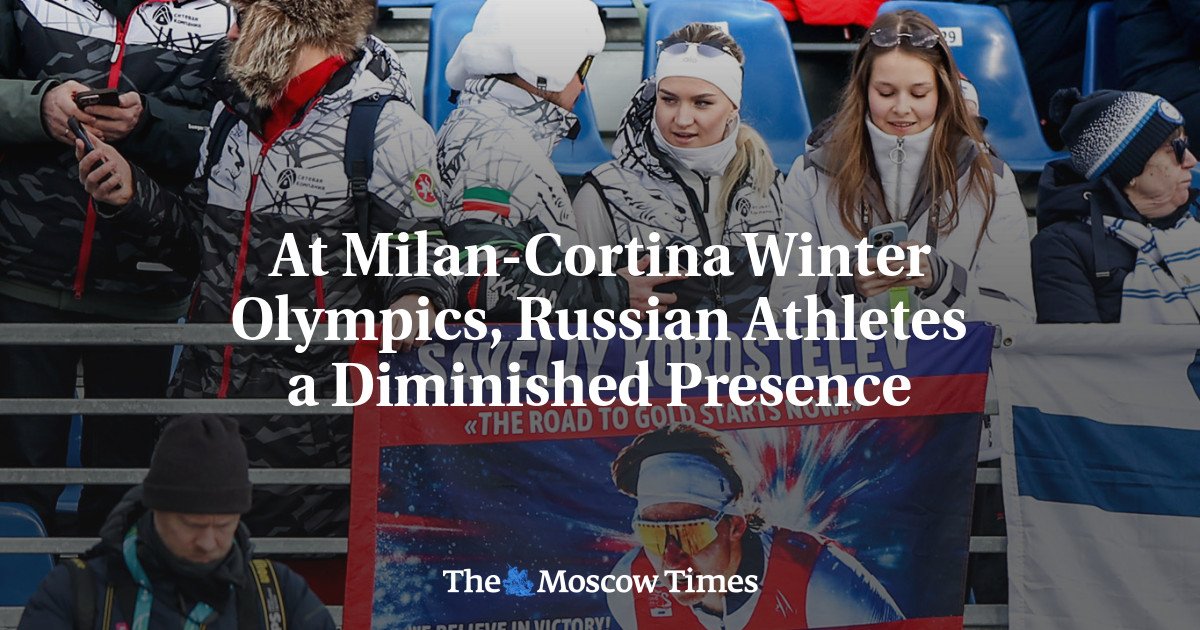
Cross-country skiers Daria Nepryaeva, 23, and Saveliy Korostelev, 22, are also considered potential medal contenders, as both won the Russian Cup last year.
The list of approved athletes also includes Daria Olesik and Pavel Repilov in luge; Semyon Yefimov and Yulia Pleshkova in alpine skiing; Alyona Krylova and Ivan Posashkov in short track; Ksenia Korzhova and Anastasia Semenova in speed skating; and Nikita Filippov in ski mountaineering.
As of Thursday, Russian athletes competing under a neutral flag had not yet won any medals.
Hector Retamal / AFP
Can people watch the Olympics in Russia?
The Olympics have traditionally been a major event for Russian television, with millions tuning in to the country’s main broadcasters to watch the Summer and Winter Olympics alike.
But with Russia officially banned from the Games, only 15% of surveyed Russians said they planned to watch the Winter Olympics this year.
Streaming platform Okko acquired the rights to broadcast the Games inside Russia, but they are not being shown on Russia’s state television channels.
State-run TV channels have also provided very limited news coverage of the Games.
Channel One briefly reported on protests in Italy the day after the opening ceremony.
“They are protesting against everything at once: the participation of Israeli and American athletes, the environmental damage caused by the construction of Olympic facilities and social issues. Pyrotechnic devices were used,” the presenter said.
It also aired short segments on the final list of Russian athletes at the Games and on a copyright dispute that forced Russian figure skater Petr Gumennik to change the music for his short program just before he flew to Italy.
As alpine skier Pleshkova and cross-country skier Nepryaeva prepared to compete at the Games on Thursday, state-run TV channel Rossia 24 had not mentioned their participation on air.
State broadcasters appear to be following a broader trend among some Russian officials who say they have chosen to ignore the Games because Russia is not represented as a country.
When asked whether he would watch the Olympics, State Duma lawmaker Vitaly Milonov said: “Why watch the Games if Russia won’t be there?”
Lawmaker Vyacheslav Fetisov called the neutral status “a serious humiliation of national identity.”
Mikhail Tereshchenko/TASS
Who is competing for other countries?
While only 13 athletes are competing as neutrals, many more Russian-born athletes now represent other nations after changing their sporting nationality.
Russia’s Sports Ministry said in August 2023 that 67 national team athletes had changed sporting citizenship since the full-scale invasion of Ukraine. No official figures have been released since then.
The exiled news outlet Novaya Gazeta Europe said ahead of the 2024 Paris Olympics that at least 350 athletes had left Russia after the invasion, with 77 athletes of Russian background competing in that year’s Summer Games.
Athletes from Russia often move to other countries where they have a better chance of competing at the highest level than in Russia, where competition among elite athletes is so intense that only a handful make it to the national team for events like the Olympics.
Over 30 Russian athletes who have changed sporting nationality are competing for other countries at the 2026 Winter Olympics. Figure skating accounts for the largest share, with 18 athletes of Russian background competing under different flags, the RBC news website reported.
Three former Russian figure skaters are competing for Poland at the 2026 Olympics: Moscow-born Yekaterina Kurakova in women’s singles, Moscow native Vladimir Samoylov in men’s singles and Nizhny Novgorod-born Yulia Shchetinina in pairs.
Kirill Kukhmar / TASS
Kazakhstan is represented by 2020 Russian Cup winner Sofia Samodelkina, who changed her sporting nationality in 2023, while the pairs team of Alexei Sviatchenko and Maria Pavlova are competing for Hungary.
Alpine skier Alexandra Skorokhodova and speed skater Kristina Silaeva, who won the Russian national championship in the 500 meters in 2021 and 2023, are also now competing for Kazakhstan.
Ice dancer Diana Davis, whose mother Eteri Tutberidze has coached several Russian Olympic figure-skating champions, now competes for Georgia and was seen carrying the Georgian flag at the opening ceremony.
Davis competed at the Games with her partner, former Russian figure skater Gleb Smolkin, who has also represented Georgia since 2023.
After Davis and Smolkin finished 13th in the ice dance competition Wednesday, some Russian websites ran headlines like: “Davis and Smolkin fail to make the top 10 at the Olympics. Was it worth switching Russia for Georgia?”
A Message from The Moscow Times:
Dear readers,
We are facing unprecedented challenges. Russia’s Prosecutor General’s Office has designated The Moscow Times as an “undesirable” organization, criminalizing our work and putting our staff at risk of prosecution. This follows our earlier unjust labeling as a “foreign agent.”
These actions are direct attempts to silence independent journalism in Russia. The authorities claim our work “discredits the decisions of the Russian leadership.” We see things differently: we strive to provide accurate, unbiased reporting on Russia.
We, the journalists of The Moscow Times, refuse to be silenced. But to continue our work, we need your help.
Your support, no matter how small, makes a world of difference. If you can, please support us monthly starting from just $2. It’s quick to set up, and every contribution makes a significant impact.
By supporting The Moscow Times, you’re defending open, independent journalism in the face of repression. Thank you for standing with us.
Continue
Not ready to support today?
Remind me later.
×
Remind me next month
Thank you! Your reminder is set.


