


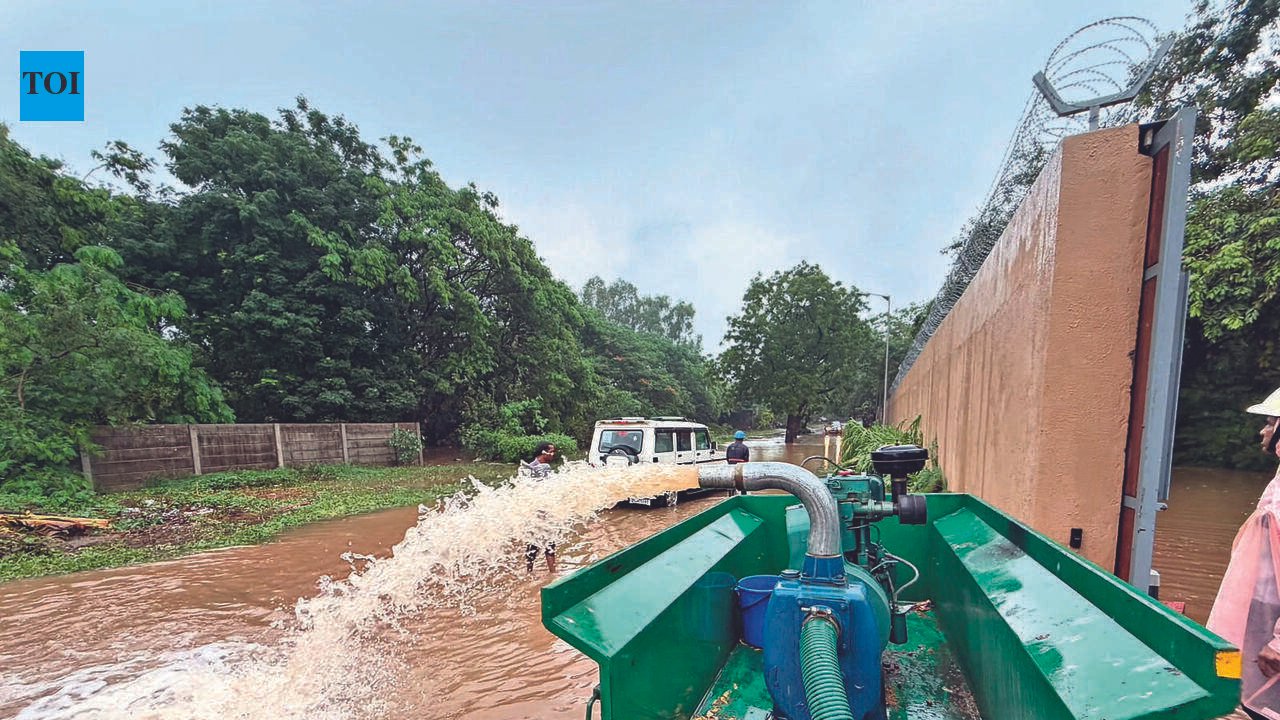
Ahmedabad: The scale of Thursday’s deluge became clear on Friday when the met department ranked it as Ahmedabad’s fourth-highest rainfall event in nearly 100 years. The city recorded 294.6mm, more than the 288.1mm that caused widespread flooding in July 2014. Met officials said the intensity of the rain exceeded the runoff capacity in several areas, resulting in extensive waterlogging.Only three rainfall events rank higher in the city’s records: 414.8mm on July 27, 1927; 325.9mm on July 14, 2000; and 322.3mm on July 29, 1967.
Ahmedabad rain record
Met officials said waterlogging occurs when rainfall intensity exceeds an area’s capacity to drain the runoff. The severity and duration of flooding also depend on factors such as drainage infrastructure, availability of open land, percolation wells, stormwater drains and rainwater-harvesting systems.Ashok Kumar Das, head of IMD Gujarat, said a combination of weather systems produced the heavy rain over Ahmedabad and other parts of Gujarat.“There were multiple factors at play for Ahmedabad and Gujarat at large on Thursday. There was an existing shear zone along with a cyclonic circulation over the state. A trough brought in the required moisture. Thus, several regions of the state received heavy to very heavy rainfall,” Das said.The wet spell is expected to continue. IMD has issued a warning for the next three days, with heavy rain likely in several parts of Gujarat, particularly central and south Gujarat and parts of Saurashtra, Das added.The rain over the past three days also erased Gujarat’s seasonal deficit. The state had a 31% rainfall deficit on July 21, but it had fallen to zero by July 24.Around 130mm of the 304mm of rain recorded in Gujarat so far this season fell during these three days. This means nearly 43% of the state’s cumulative monsoon rain was received during the brief spell.State Emergency Operations Centre (SEOC) data showed that seven talukas, all in south Gujarat, had already received 100% of their average full-season rainfall. Most of it was recorded this week.Gujarat had received 45.8% of its average seasonal rainfall by Friday morning, according to SEOC figures, but the rain remained highly unevenly distributed.South Gujarat had received 73.7% of its average seasonal rainfall, while Saurashtra stood at 38.7% and east-central Gujarat at 35.9%. North Gujarat had received 22.1%, while Kutch trailed at just 6.3%.The SEOC data also showed that 27 talukas had crossed the 1,000mm mark this season. At the same point last year, 20 talukas had received more than 1,000mm, even though the state had recorded above-normal rain from the beginning of that monsoon.Met experts said the higher number of talukas crossing 1,000mm amid sharp regional differences points to sporadic spells of extremely heavy rain rather than evenly distributed precipitation.
