CM expresses regret, seeks expunction of words from Assembly records
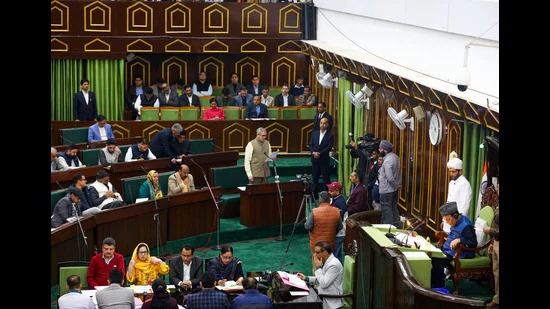
Srinagar, Feb 11: The Jammu and Kashmir Assembly on Wednesday was scheduled to discuss some of the most consequential business of governance: the grants for the Health, Education, and Social Welfare departments. Instead, it became a study in how a single political sentence can derail an entire legislative agenda.
Before the House could meaningfully take up the grants, the opposition arrived with a clear objective: secure an apology from Chief Minister Omar Abdullah for his “inko jootay paday hain” remark made the previous day. What followed was less a parliamentary session and more a contest over dignity, narrative, and political authority.
The morning began with BJP MLA Sham Lal Sharma raising the issue and insisting that the Chief Minister apologise. The confrontation quickly escalated beyond parliamentary procedure into a wider political dispute over who had wronged whom.
Senior NC leader and Health Minister Sakeena Itoo countered sharply, alleging that the BJP had jeopardised the careers of 50 students at Shri Mata Vaishno Devi Institute of Medical Excellence (SMVDIME) and hurt the sentiments of the people of Pir Panjal. The House erupted. Members shouted across benches, slogans followed, and the debate on public spending was pushed aside by a debate on political morality.
The BJP staged a walkout, a familiar but effective legislative tool. It signalled protest, created headlines and ensured the controversy would travel beyond the Assembly walls. Though members later returned, the purpose had already been achieved, the day’s proceedings were now defined not by governance, but by grievance.
When the Chief Minister finally rose to speak, he attempted to reframe the confrontation. Rather than a simple apology, he offered context, emotion and procedure.
“Sham Lal Sharma said he knows me, yes, he knows me and other members also knows me. Yesterday, they didn’t allow me to speak, while BJP MLAs were ready to listen to me, but their ‘field commander’ LoP had something else in mind. While the General (LoP) left but the rest of the army stayed in the House. But I as a leader of the House won’t leave anyone alone.” His remarks turned the controversy into a story about conduct inside the House. He portrayed the comment as a reaction to provocation rather than an insult.
“Yesterday, in emotions, I said something, that hurt them, ‘I regret what I said.’ But what I said was against them but their field commander LoP didn’t even spare my father and grandfather.”
The statement was carefully balanced, regret without surrender. He acknowledged hurt but did not concede political defeat. He then widened the argument beyond the immediate clash:
“The way I think of my own MLAs, I give similar treatment to opposition MLAs. When I said I am an elected CM, that means I am the CM of all voters be that BJP voters or NC voters.” Finally, he placed the resolution in institutional hands rather than political negotiation.
“I leave it to you Speaker, if there was something unparliamentary word in my speech yesterday, I request you to expunge that from the Assembly records.” That line mattered. In legislative practice, expunction is often the bridge between confrontation and closure, it allows tempers to cool without forcing either side into a public climbdown. Yet by then, the damage to the day’s agenda had been done.
The irony was striking. The Assembly had gathered to debate hospitals, schools and welfare schemes, subjects that directly affect citizens. But the political system gravitated toward honour instead of policy. The grants survived; the discussion did not.