



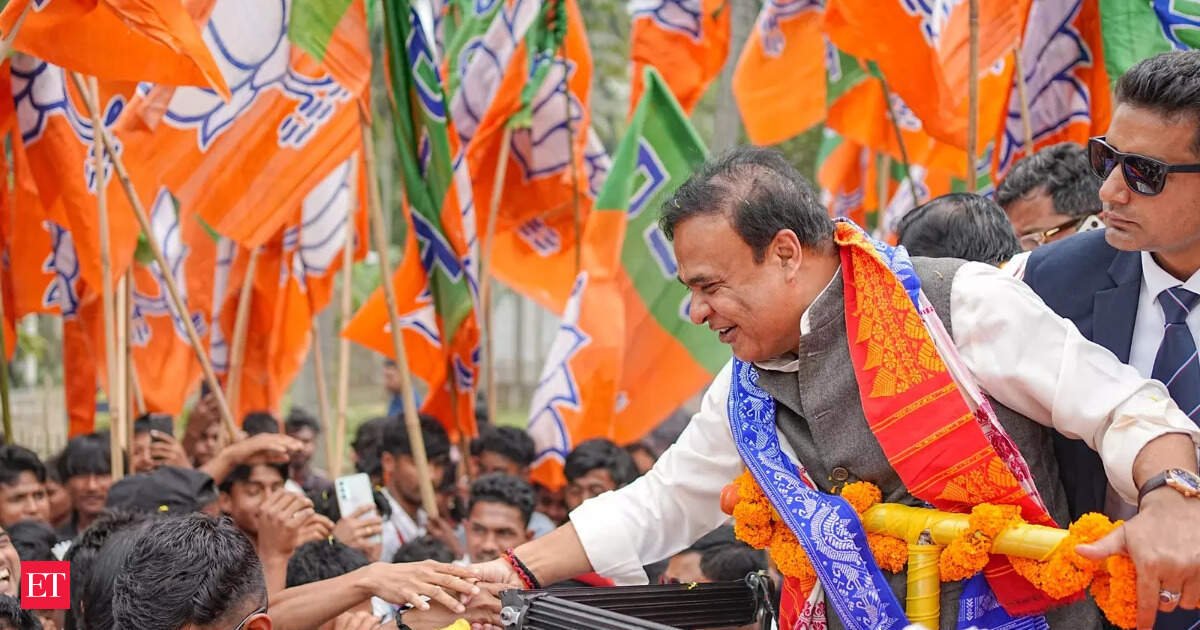
This victory marked a significant departure from historical trends, as it represented the first time a non-Congress government successfully secured a consecutive second term in the state.
The saffron party and its allies managed to navigate a complex socio-political landscape to cross the magic number of 64, finishing with a comfortable tally of 75 seats in the 126-member house.
Also Read | Amit Shah launches projects worth Rs 2,092 crore in Assam ahead of Assembly polls
The Bharatiya Janata Party (BJP) emerged as the single largest party not only in terms of seats but also in vote share, polling approximately 33.2% of the total valid votes. Its primary ally, the Asom Gana Parishad (AGP), secured a 7.9% share, while the United People’s Party Liberal (UPPL) garnered roughly 3.4%.
Collectively, the NDA coalition enjoyed a total vote share of about 44.8%, which provided the foundation for its 75-seat victory.
On the other side, the Indian National Congress maintained a robust presence with a 29.7% vote share. Its partner, the All India United Democratic Front (AIUDF), recorded a share of 9.3%. When combined with other smaller allies like the Bodoland People’s Front (BPF) and the CPI(M), the “Mahajot” alliance actually trailed the NDA by only a slim margin in the popular vote, securing approximately 43.7% of the total votes cast.
This consolidated mandate eventually led to a leadership transition within the state, with the influential Himanta Biswa Sarma being sworn in as Chief Minister, taking over the mantle from Sarbananda Sonowal.
Assam Last Election Result: Failure of ‘Mahajot’
The primary challenge to the incumbents came from the “Mahajot,” a ten-party grand alliance spearheaded by the Indian National Congress.
In an attempt to consolidate the anti-incumbency vote, the Congress joined forces with Badruddin Ajmal’s All India United Democratic Front (AIUDF).
Also Read | Assam elections: Congress releases second candidate list, leaves out 15 seats for alliance partners
However, despite this strategic pooling of resources, the alliance fell short of the majority mark, collectively securing 50 seats.
The Congress managed to win 29 seats, while the AIUDF showed a strong performance in its traditional strongholds by winning 16.
Other smaller partners, such as the Bodoland People’s Front (BPF) and the CPI(M), contributed a handful of seats to the opposition tally. Analysts noted that while the alliance performed well in certain pockets, it failed to resonate across the broader demographic of Upper Assam, where the BJP maintained its dominance.
The post-election period saw immediate friction within this bloc, leading the Congress to officially terminate its partnership with the AIUDF later that year, citing the alliance’s inability to achieve its primary objective.
2021 Assam Results: Evolving dynamics in politics
Beyond the two main blocs, the 2021 polls highlighted the emergence of new political entities born out of regional protests and local identity movements.
A notable highlight of the results was the victory of activist Akhil Gogoi, who contested from the Sibsagar constituency as an independent candidate representing the Raijor Dal.
Also Read | AAP releases list of 14 candidates for Assam assembly polls
Despite being in judicial custody during the campaign, Gogoi’s win signalled that grassroots regionalism remains a potent factor in Assam’s electoral fabric.
The election process itself was a logistical feat, conducted in three phases between March 27 and April 6, 2021, under the shadow of the ongoing pandemic.
The BJP’s victory was largely attributed to its focus on developmental schemes and “pro-people” governance, which seemingly outweighed the controversies surrounding regional identity issues.
With this mandate, the NDA solidified its position as the primary political force in the state, fundamentally altering the traditional power structure that had favoured the Congress for decades.


