





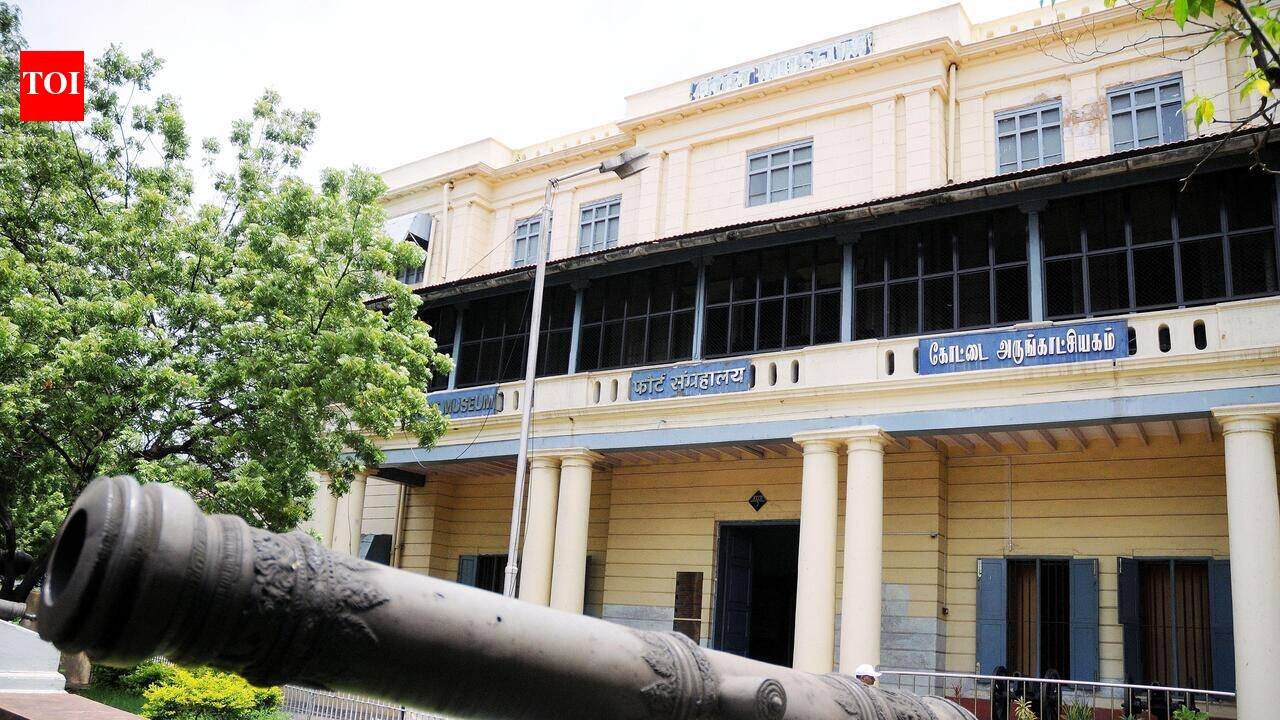
Chennai: Archaeological Survey of India (ASI) will soon restore the 230-year-old colonial-era exchange building, which currently houses the Fort Museum inside Fort St George. It also plans to upgrade the Fort Museum, which exhibits more than 3,500 artefacts from the colonial period to enhance the visitors’ experience.The three-storey building (ground + two floors), constructed between 1790 and 1795, is considered one of the strongest buildings in Fort St George. The ground floor, with its vaulted roof, was designed to withstand the cannon fire from the sea.“We will take up the structural conservation of the exchange building. We are also planning to revamp the Fort Museum. This work will be carried out in a phased manner over the next two years without affecting the visitors,” said Sushanta Kumar Kar, superintending archaeologist, Chennai Circle, ASI.The museum will showcase the artefacts in a modern way and the lighting also will be upgraded.“The museum houses the only surviving flag of India, which was hoisted in 1947. Further, the register of St Mary’s Church, which recorded the marriage of Robert Clive, is also at display,” he added.The Indian national flag was 12 feet long and 8 feet wide, and it was hoisted on Aug 15, 1947, at 5.30am at Fort St George. It also houses many galleries, including an arms gallery displaying swords, rifles, pistols, mortars, cannon shots, breastplates and shell fragments.At its peak, the Exchange Building was the hub of trading activities, teeming with merchants, dealers, ship captains, and others concerned in trade. The building had a warehouse, auction room and a library on the ground floor. The most notable room of the building was the long room located on the first floor. This room now houses the portrait gallery. In colonial times, it saw public meetings, lottery draws and official entertainments organised by the Governor. In 1861, the building became the officers’ mess for the British Regiment quartered in the fort.“We have unearthed an underground chamber at the ground floor of the building. We were told that it could have been used to store ice when it served as officers’ mess. Another highlight of the exchange building is that it has a very high ceiling,” said T Sathyamurthy, former superintending archaeologist, Archaeological Survey of India.The building also housed Madras Bank and the first lighthouse of Madras in 1796. The lamp was located at a height of 90 feet above sea level.


