


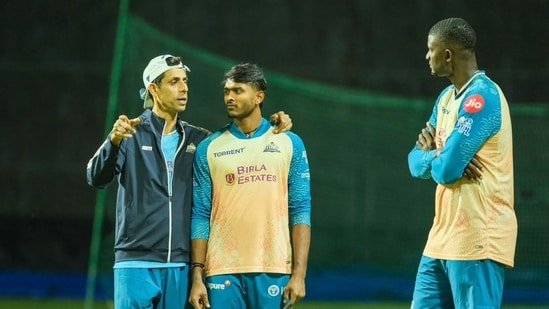
Gujarat Titans are spoilt for choice. The fact that an all-rounder of Jason Holder’s calibre can’t even break into the playing XI speaks volumes about the squad’s depth. The former West Indies captain has only grown in stature over the years, continuing to age like fine wine. At 34, he remains one of the most experienced players in the setup, and it may only be a matter of time before he gets his chance, especially given the recent underwhelming returns from Glenn Phillips, Shahrukh Khan and Rahul Tewatia.
Holder, who has featured in 69 Tests, 138 ODIs and 96 T20Is, was most recently part of the West Indies’ T20 World Cup squad, returning with 10 wickets and 141 runs. His best outing with the ball came against Nepal, where he picked up four wickets, while he also chipped in with a 49-run knock against South Africa in the Super 8s.
However, these performances weren’t enough for Holder to break into the Gujarat Titans’ playing XI at the start of the Indian Premier League (IPL) season. The Shubman Gill-led side slipped to sixth on Monday after a defeat to five-time champions Mumbai Indians.
Ahead of the Gujarat Titans’ clash against the Royal Challengers Bengaluru (RCB) on Friday, The Hindustan Times Digital caught up with Holder. He spoke about the ongoing season, the game’s growing tilt towards batters, what makes Gill an effective leader, and why proactive coaches like Ashish Nehra are the need of the hour.
Excerpts:
How did you assess the Gujarat Titans’ performance so far? Yesterday must have been a deflating defeat against the Mumbai Indians.
Look, the season has had its ups and its downs like any normal season, any part of life. Look, in tough defeats, you obviously take them pretty tough. For us as individuals, we just need to understand how we can get better. And if each individual understands how they can at least get one per cent, you know, that adds to the collective. That adds to our overall performance. Yeah, we fell down badly last night. But it’s not the end of the world. We’re not even halfway through the tournament yet. But for us, we know what we need to do to improve. And I’m sure every individual will be scratching their heads and putting their hands and heads together to get better and do better for the team.
Just want to pick your brains about T20 cricket in general. Is the game moving more and more towards the batters, with bowlers having less to play with?
It’s been that way for a long time, actually. One thing I really commend the IPL for is having a second short ball for seamers. But even when you look at the second short ball, you look at the scores, you’ve got to ask yourself if it’s actually really helping the bowlers per se. But at least the bowlers have another option, you know. A lot of times, when you bowl to good players, and you bowl a short ball early into the over, they literally just camp on the front foot, knowing that you can’t bowl another one. So at least now, you know, you can bowl on the front end of the over. You can have one up the sleeve for the back end of the over. But when you look at the scores and just the way the game has gone, no boundaries are too big for anybody these days. So it’s now a matter for bowlers to be even more precise, even more skilled at executing difficult balls.
Just a follow-up on this. In that case, can we look to increase the size of the boundary ropes?
We would love bigger boundaries. And I don’t think it has to be crazy, crazy big. But when you look at some of the grounds that we play on and the way the ball travels through the air, it’s pretty tough. A lot of mishits, a lot of top edges, inside edges, they just end up finding their way to the boundary very quickly. And then you’ve got wonderful outfields here in India, particularly. So a lot of times when the ball pierces through the gaps, it’s half-chased because the outfield is so quick. And you’ve got literally no chance.
It’s a good place to bat. You get value for your shots. It’s not like you feel that you have to overhit the ball or overpower the ball to get the ball to the boundary. But yeah, it’s a tough gig for bowlers. But for me as a bowler, I look, and I feel motivated in these conditions because they’re the toughest conditions. So I feel like if I can perform really well here, then yeah, I perform in tough conditions.
I just remember it was tough, particularly during the World Cup. But finding a way has always been my mantra in a sense. When you get success in conditions such as these as a bowler, you’ve got to take it around with you.
You must have observed Shubman Gill up close. What makes him such a good captain?
One of his greatest attributes is leading by example. You see the way he goes about his business. He’s very professional. I’ve been observing him for a little while now. Just how he goes about his whole preparation. He’s very structured. And yeah, it’s no secret where he’s gotten so much success. So I think his biggest attribute as a leader is leading by example. Obviously, players can see how he plays his cricket and emulate it. And I think that’s really important.
One of the things I’ve always said when I’ve captained teams before is that it’s difficult to ask players to do something when you don’t do it yourself. So you’ve got to lead by example and make sure you set the right mantra, in a sense, so people can follow and learn to follow.
Is T20 cricket the closest we will ever come to a football-style of coaching? The support staff continues to give input as the game goes on. Do you see any similarities between the two sports?
I wouldn’t even say only in T20 cricket. I think my experience is in international cricket. I think that’s where a head coach’s job is really going to. Head coaches now are seen more as managers, managers in a sense. And then you have your specific skills coaches around them. And I think that’s probably where the game is going overall. It’s important, too, that coaches still coach.
Particularly in this team I’m part of, with Ashish Nehra leading it. He’s pretty much very hands-on as well, with his expertise in bowling, particularly. That’s really, really good to see, because you need a coach involved. You need to feel his presence. He spreads a big energy through the gesture. I call him the energy god. He’s one of those people who can get you up for a challenge and give you good advice. He’s very knowledgeable about the game as well. So I think he’s got really good attributes as a coach.
The impact player rule continues to polarise opinions. What do you make of it? Are you a fan, or does it negate the impact of all-rounders?
Very controversial, the impact player rule. It’s one of those that has its pros and cons. Let’s say you look at a situation last night where it’s Tilak Varma. He got 100, and he spent quite a considerable amount of time on his feet. He also got hit in his groin while batting. Sometimes, being forced to field that way in that situation is tough. But with the impact player rule, you can pretty much put your feet up, and somebody else can come in and take his place. But when you look at the overall game and particularly the all-rounders’ gig, I wouldn’t say it’s killing the all-rounders. I think I strongly disagree with that because I think if you’re a quality all-rounder, then you stay in the game regardless.
What the impact player rule has probably done is separate, like, the genuine all-rounders from basically those players who would either make up a couple of overs as an all-round option or come back in and hit a few balls as an all-round option. One of the things for me personally that the impact player has done and the impact player rule has done is just made me really get better at my skills to ensure that I’m not one of those players who’s sitting there as an impact player because one of my skills maybe doesn’t match the other.
It’s a case where I guess all-rounders have to be better to be able to command that spot both as a back-up and a bowler. There’s been so much debate about the impact player rule. And it’s one of those where, yes, there are days that you say, yes, I love it. And there are days that you say, no, I don’t really like it. But I guess that’s generally how life goes.
Last question, more and more T20 leagues around the world are adopting the auction model. There’s a lot of social media chatter about the price one gets. Do players think about the weight of the price tag when they step on the field, or is it a case of parking it all on the outside?
I’d be naive to say a player wouldn’t think about a price tag at times. How you cope with it, on the other hand, is key. When you look at the IPL, there aren’t many leagues that hold auctions. Obviously, there’s the Hundred that just had an auction. I think SA20 had an auction. And ILT had an auction, I think, last year. But pretty much all the rest have been drafts. Oh, PSL had an auction this year. But yeah, I think it’s good for players.
But maybe we can move completely away from auction-style and go to football-style, where you know, you command your price based on your value. And you’d be able to negotiate what a team can pay. And there are pretty much no limits. I guess, in the NBA, you’ve got a massive salary cap. Football, I’m not sure if there’s a salary cap. But at the NBA, you pay the player, or you negotiate with the player to get what you believe is the right price.
Maybe that’s the way cricket might get to. And if teams can afford it within a salary cap, then you manage your budget and your papers based on what you think they’re valued at. But I have no problem with the auction system. But as a player, you need to understand, like, that’s beyond your control. So whether you bought for INR 1 crore or you bought for INR 25 crore, like, that’s beyond your control. For you, it’s mainly about focusing on what you need to do to earn your next 25 crore, your next one crore, or move your one crore from one to three, or move your 25 from 25 to 27.
Who knows? But it’s just dealing with what you need to deal with. And as a player, all we can deal with is our performances and our skills. So ultimately, if you focus on that, you’re more likely to stay switched on and dialled in.
