


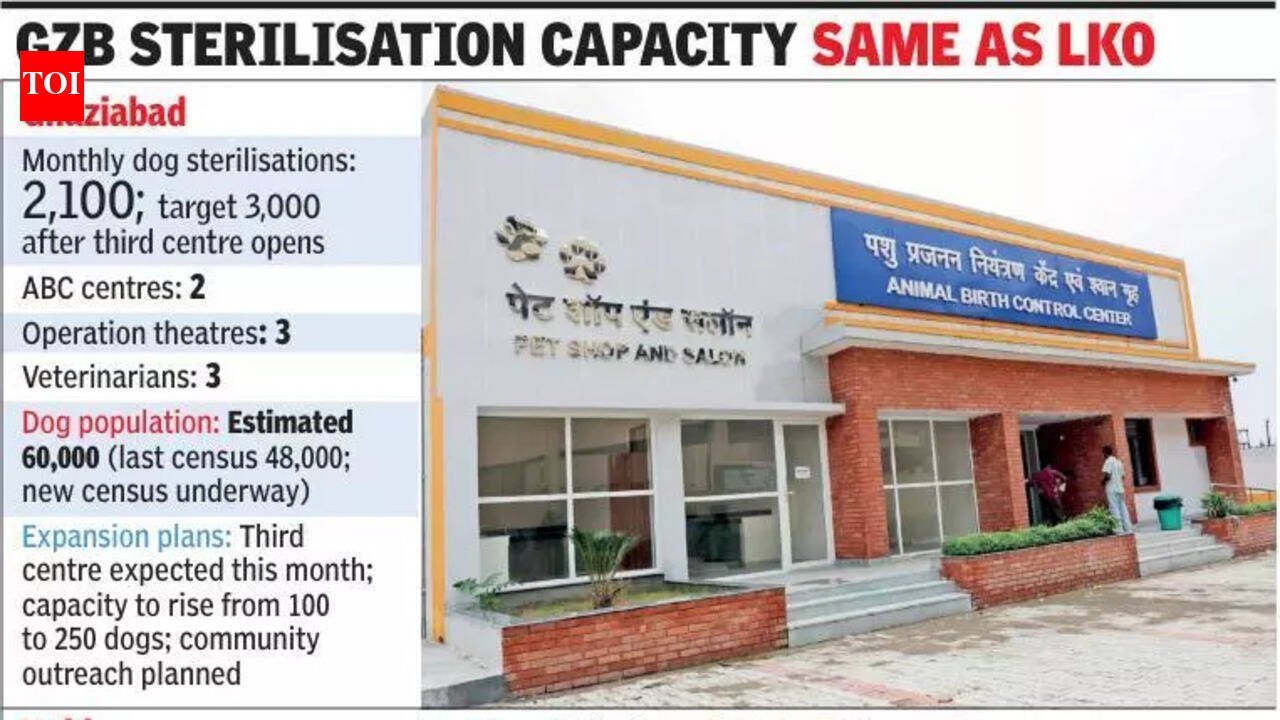
Noida: As Supreme Court explores ways to manage the stray population and disturbing reports come in from Telangana on mass poisoning of street dogs, the template on how to bring down the numbers – and do it scientifically and humanely – could well come from UP.In SC hearings, state capital Lucknow has been cited as an example for running one of the most efficient ABC (animal birth control) programmes. The Lucknow municipal corporation has sterilised 85% of the 1.35 lakh stray dogs on its streets, well above the threshold of 70% recommended by World Health Organization (WHO, a mark Indian cities in general are struggling to reach.Other UP cities are now trying to follow the Lucknow model. Ghaziabad, for example, recently achieved parity with Lucknow in the number of dogs it can sterilise in a month – at 2,100. This month, capacity will increase to 3,000 in the NCR city as another ABC centre opens, making Ghaziabad the only corporation in UP to operate 3 ABC centres. Noida is catching up as well, with a capacity to sterilise 1,500 dogs a month. Lucknow has also effectively shown that ABC does not necessarily need many centres to be successful.Rather, it’s consistency that’s important. The base year from which Lucknow has been conducting targeted sterilisations is 2019 when a dog census estimated the stray population to be around 75,000.Abhinav Verma, animal welfare officer at Lucknow Municipal Corporation, told TOI the city’s sole ABC centre, which is run as a private-public partnership with NGO Humane World for Animals India (HWAI), has eight operation theatres and eight veterinarians conducting surgeries. The centre has a holding capacity of 300 dogs. “In 2020 and 2021, the number of sterilisations per month dropped because of Covid restrictions. However, since 2022, we have regularly sterilised 2,100 dogs in a month, which helped us achieve 1 lakh sterilisations by Dec 2025,” Verma said.The Lucknow ABC also invested time and resources in data management. The total dog population in the UP capital is currently estimated by the ABC at 1.35 lakh. But Lucknow did another dog census in 2025 for a better scientific assessment of its programme. The NGO has, meanwhile, been carrying out a monitoring survey of the dog population every six months to assess the targets of the sterilisation programme.According to officials, a key to Lucknow’s success is community engagement. While most animal welfare NGOs rely on feeders or caregivers to catch dogs for sterilisations, HWAI and the Lucknow corporation go beyond that with community awareness programmes at residential areas, slum clusters, schools and colleges about ABC as well as understanding dog behaviour, which is essential to prevent conflict within the community – something NCR is struggling with.“When we educated people about the programme and the rules, we found more and more stray dogs being brought for sterilisation. This also helped maintain harmony within the community and the stray dogs, as they are also informed about dog behaviour and how to control it,” Verma told TOI.HWAI senior director Keren Nazareth said since 2019, they had reached out to over 500 localities in Lucknow under the community engagement programme. “Under the ‘Abhay Sankalp’ initiative, teams regularly engage with people on safe interactions with dogs and feeding practices. Residents are also informed about ABC Rules that prohibit relocation of stray dogs. Relocation creates territorial vacuums and increases aggression,” she said.Explaining the biannual surveys carried out by HWAI, Keren said they generate a reliable estimate of the relative dog population per street kilometre. “For example, if the Lucknow municipal corporation area extends across 900 km, we take around 15-20% of that area and divide that stretch into wards or zones. We have the demarcation of the area from corporation maps, and our team goes to these streets before sunrise to count the number of dogs and how many have ear notches (sign of sterilised dogs). Every year, we do this activity on the same track, and then, using a scientific method, estimate the coverage of sterilised dogs per kilometre. This gives us our new baselines,” she explained.HWAI started working with a 66-member team, which it has now scaled down to 30 because of the high sterilisation coverage. The corporation also established an ABC Training Centre for vets, para-vets, animal handlers and organisations working in street dog management.Can NCR cities follow suit?Conflicts over stray dogs are a regular affair in densely populated NCR cities, increasing the rift between animal lovers and others. But there’s no reason why the Lucknow template cannot be applied here. Ghaziabad has made meaningful progress in that direction. Anuj Singh, deputy chief veterinary and welfare officer of Ghaziabad Municipal Corporation, told TOI that the city could only sterilise around 650 dogs a month till 2025. “Now, we have started sterilising 2,100 dogs in a month, which will increase to 3,000 with the third ABC centre opening,” he said.Holding capacity, important to sustain a scientific ABC, will increase to 250 with the third centre. Currently, it’s 100. Ghaziabad has sterilised 45,000 dogs since 2013, of which around 23,000 have been sterilised since 2023. “With the current pace, we are confident we will be able to control the stray dog population in Ghaziabad by next year,” said Singh.Numbers alone, however, will not do. Ghaziabad still needs to conduct a dog census to assess coverage of sterilisations. The current ABC works to an estimate of 60,000. “The census is under way and is being carried out by the same NGO (Friendicoes) that is carrying out our ABC programme,” added Singh.Following the Lucknow template seems harder for Noida, which is currently sterilising 1,000 dogs a month at its lone ABC centre. Even after expanding this centre, scheduled by March, capacity will increase to 1,500 a month. Holding capacity of the centre is currently only 62, which will increase to 100 after the expansion.Though ABC has been under way for over a decade, it has shown limited results because of the lack of scientific planning. Before 2020, an NGO worked in the city for six years and sterilised around 20,000 dogs. Since 2020, Animal India Trust has been implementing the programme and has carried out nearly 40,000 sterilisation and immunisation procedures.However, coverage cannot be assessed because Noida too does not have a stray dog census. A Noida Authority official said they are in the process of finalising an agency to conduct the census.Where both cities have a big gap with Lucknow is community engagement. Piyush Patel, director of HWAI, said, “The Lucknow model can be replicated in cities because of its highly comprehensive approach that checks all boxes. If these protocols are implemented, other cities can also control their stray dog population,” he told TOI.Salman Syed from Friendicoes said, “We have so far not looked at community engagement programmes as focus has been on expanding infrastructure. However, once the new ABC centres are fully functional and running, a similar community engagement programme can be carried out in Ghaziabad.”Singh said community outreach is part of the Ghaziabad corporation’s plan for an effective ABC. “The corporation has called on RWAs and AOAs to set up designated feeding points for community dogs in their societies. We will carry out awareness programmes soon,” he said.Dr Devi from Animal India Trust said that community outreach cannot be done without support and funding from the authorities. “We are a small NGO running on limited resources, limited people and limited funds. For such outreach programmes, we need more people and for that we need more funds. If the authorities can provide enough, then we can carry out such awareness programmes so that we can also be on a par with Lucknow’s sterilisation coverage,” she told TOI.Officials in Lucknow said following the state capital’s ABC success, a dog sterilisation and management exercise through mandated ABC centres has been launched across 17 municipal corporations in the state. From April 1 to Dec 31, 2025, around 1.2 lakh dogs were sterilised in these corporation areas, the officials said, adding chief minister Yogi Adityanath has been closely monitoring efforts to manage the stray population of animals, particularly dogs and cattle.


