






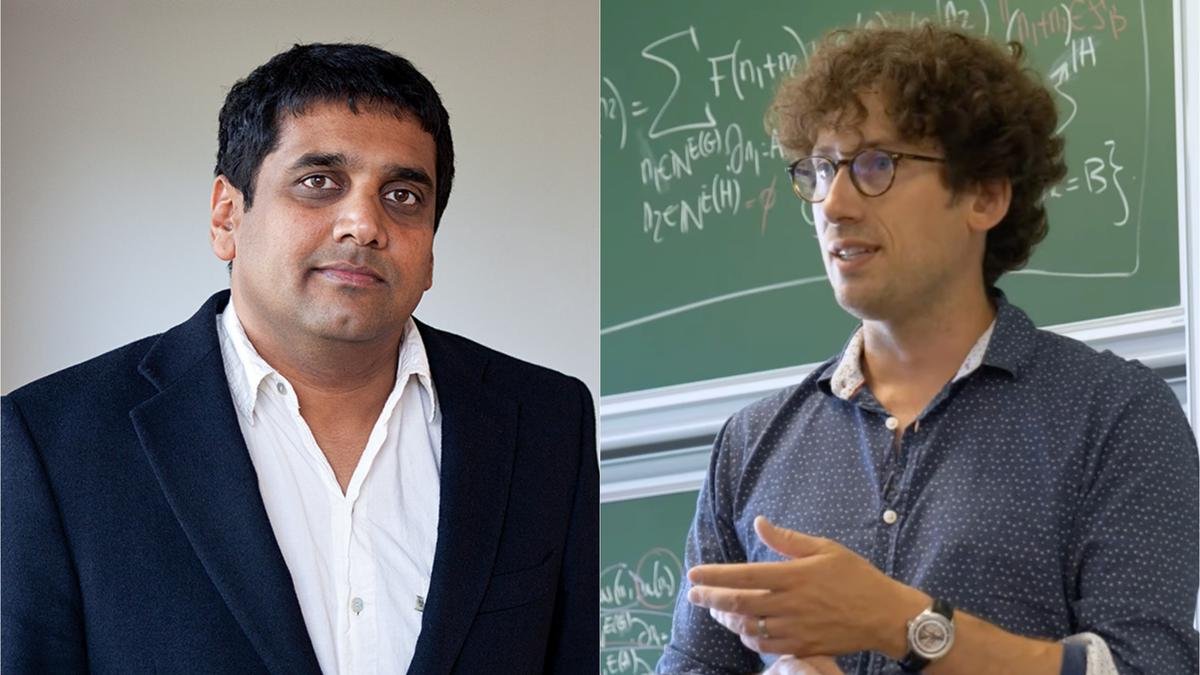
The French mathematician Hugo Duminil-Copin, who won the Fields Medal — mathematics’ Nobel — in 2022 for his work on phase transitions in statistical physics, said in a video call of the French Mathematical Society on October 8 that years of his research agenda had been “wiped out” thanks to a tumult of mathematical proofs and results released by OpenAI a day prior.
Sixteen of the AI giant’s claimed results answered questions he had spent years trying to solve. In one case the model had produced 13 papers at once, standing in for the stages of a programme that takes humans many years. Duminil-Copin said he cried so loudly that night he woke his daughter, and said his field had been “annihilated”.
Building skyscrapers
OpenAI released some 700 manuscripts from an unreleased model, claiming results on a weaker form of the Riemann hypothesis, as unsurmountable so far as Mt Kailash is, with implications for prime numbers and their many applications; the nature of the number π; and the speed of multiplying matrices. Last month, OpenAI had claimed a proof, certified by the Lean proof-checking software, that Navier-Stokes equations of fluid mechanics are incomplete. The answer could potentially settle a $1-million Millennium Problem.
But while much of it has been machine-checked, little has been refereed or even read by humans. While mathematicians build skyscrapers of abstraction, it does not become ‘true’ until they have thoroughly vetted every logical nook and cranny. Gifted practitioners with the dazzling ability to see connections between phenomena as different as cowlicks and coconuts must still wade through the quicksand of proof.
For example, the ‘hairy ball’ theorem says you cannot comb the hair on a woolly ball flat without leaving a bald patch or a whorl, as on a coconut. Henri Poincaré established the two-dimensional case around 1885 and Luitzen Brouwer proved it comprehensively in 1912. Srinivasa Ramanujan did not lack for results but he had to go to Cambridge, less to learn mathematics than to be tutored in the language of proof-writing.
Eclipsing computers
Ever since computers began to outpace human calculation, there have been discussions on whether machines understand the way humans do. In 1980, the philosopher John Searle offered a thought experiment that, in his view, proved they weren’t. Imagine an English speaker who knows no Chinese, locked in a room. Through one slit come questions in Chinese characters. A rulebook in English tells him which characters to push out through the other slit, by shape alone, and he follows it without knowing what any symbol means. To someone outside, he seems to understand Chinese. Computers, Searle argued, are mere rapid manipulators of symbols, and their solutions shouldn’t be mistaken for understanding.
However, the capabilities of the large language models (LLMs) of today eclipse those computers. Powered by vast arrays of graphics processing units, these devices code better than experienced coders, write award-worthy novels, and devastate laboriously wrangled cybersecurity infrastructure — but at their core they are still essentially predicting the next probable word-fragment, crawling through a mathematical space of billions of parameters in a guessing game. But as they have laboured through the weave of intricate mathematical logic, stunned mathematicians appear less concerned about Searlian distinctions of understanding than what it bodes for the future of the field.
“Proof only offers the guarantee of correctness, but a good, elegant exposition of a proof tells us why something is true,” Sabyasachi Mukherjee, mathematician at the Tata Institute of Fundamental Research, Mumbai, whose research spans conformal dynamics and complex analysis, says in an email. The latter is more valued than the mere fact that something is true.”
Terence Tao of the University of California, Los Angeles, who co-signed an influential statement with other Fields Medallists called ‘A Severe Misalignment of AI in Mathematics’, has argued that the journey to proof is nearly as important as the destination. An advanced AI model, he has said, is told to find a cancer cure that passes a stage-3 trial. It produces a drug cocktail whose effectiveness is confirmed, though no one knows how it was found. Could it be exploiting a weakness in the trial itself? Wouldn’t you want at least one human expert to understand the mechanism before it went into your bloodstream? Verification, according to Tao, is necessary but not sufficient, because somebody must still understand what has been verified.
A deep result in mathematics is not just about examples: it is about finding lasting connections between different areas, connections that are mutually enriching, Dr. Mukherjee says. He adds that he uses AI only for literature surveys, running numerical experiments, and drawing mathematical pictures, and was “uninterested” in purely AI solutions.
“To this date, AI has not found such a deep connection,” he says. “AI is extremely good at solving a well-formulated problem (a problem that has already been formulated by humans through years of work), mostly by pushing well-established strategies with its computational superpower. But there is no evidence that AI has imagination like a human does.”
‘Continuing influence’
Chandrashekhar Khare, also of UCLA, told The Hindu by email that AI’s ability to make connections between seemingly unrelated ideas did appear to be one of its “dazzling abilities”.
“I do not know in what sense an LLM [large-language model] understands a mathematical argument… If it correctly establishes its conclusion from its assumptions, it is a proof regardless of how it was produced. Fluent mathematical prose alone, however, does not establish correctness,” he explains. “In some ways, I find it reassuring that they seem to be drawing extensively on ideas and methods developed by human mathematicians, combining them in extraordinarily creative ways and pushing them further than we had managed. Their progress seems to grow out of the mathematics people have created, rather than bypassing it through some wholly unfamiliar method.”
The 17th century polymath Pierre Fermat’s ‘Last Theorem’ was written out in a single line; Fermat said the margin of his book was too small for the proof. It eventually took over 300 years and considerable advances in mathematics to arrive at.
“Connecting different areas of mathematics supplied a strategy; making that strategy work required many new ideas and arguments,” Dr. Khare says. “Only time will tell how far the new AI-generated solutions have this depth and continuing mathematical influence.”
Inscrutable steps
Their abilities notwithstanding, the opacity of AI-generated proofs bothers Dr. Khare. “Mathematicians generally discuss ideas freely and make their work available to others. There is competition, and occasionally priority disputes, but openness is an important ideal of the subject. Tremendously powerful proprietary models, whose availability is controlled by companies and whose use depends on financial resources, introduce an element that sits uneasily with this ideal.”
At the Indian Institute of Science, Bengaluru, Mahesh Kakde, recently awarded the Ramanujan Prize for work on noncommutative Iwasawa theory and the Gross-Stark and Brumer-Stark conjectures, which have implications for one of number theory’s oldest ambitions, called the Hilbert’s 12th problem, says: “My AI concerns are much wider than mathematics. Firstly, I have concerns about the great environmental costs of AI. Secondly, I am concerned about the concentration of power in the hands of a few. In the last 50 years, every advancement in digital technology was predicted to democratise various things … but by and large, it has concentrated power in the hands of a few. AI will most likely exacerbate all these problems.”
OpenAI executives have put the computational cost of cracking the Navier-Stokes equations problem at “millions of dollars”.
“The money spent hasn’t given anyone any jobs and we are not counting the expenses of thousands of mathematician hours that will go into understanding and verifying these proofs. So what is the end game?” Dr. Kakde asks. “They are using mathematics only to benchmark their systems for their IPO, whenever that happens.”
Dr. Mukherjee seconds this. “AI companies are not interested in the true value of mathematics. They simply want to flex their muscle to advertise the power of technology. There is also a lot of foul play (absence of citation or acknowledgement, etc.) involved,” he contends.
‘PoV of their own’
Lean, Dr. Kakde adds, is effective “but with caveats”. The kernel that applies the rules may have a bug or a definition or theorem can be mistranslated into Lean. “Since LLMs seem to want to accomplish a task at any cost, even by finding a kernel bug to get a certificate, I wouldn’t put even deliberate mistranslation beyond them.”
The training of future mathematicians worries both.
“Training PhD students usually involves giving a problem that is well within reach. … This is how a student learns to survey the literature, get familiar with the mathematical objects, and develop their own intuition about them. If these can just be put in LLMs to get a solution, then they lose out on building these important skills,” Dr. Kakde says. “Secondly, if LLMs keep solving hard open problems regularly, then we will be left far behind.”
“A PhD should,” Dr. Khare adds, “help a student become an independent mathematician with a point of view of their own.”
jacob.koshy@thehindu.co.in


