



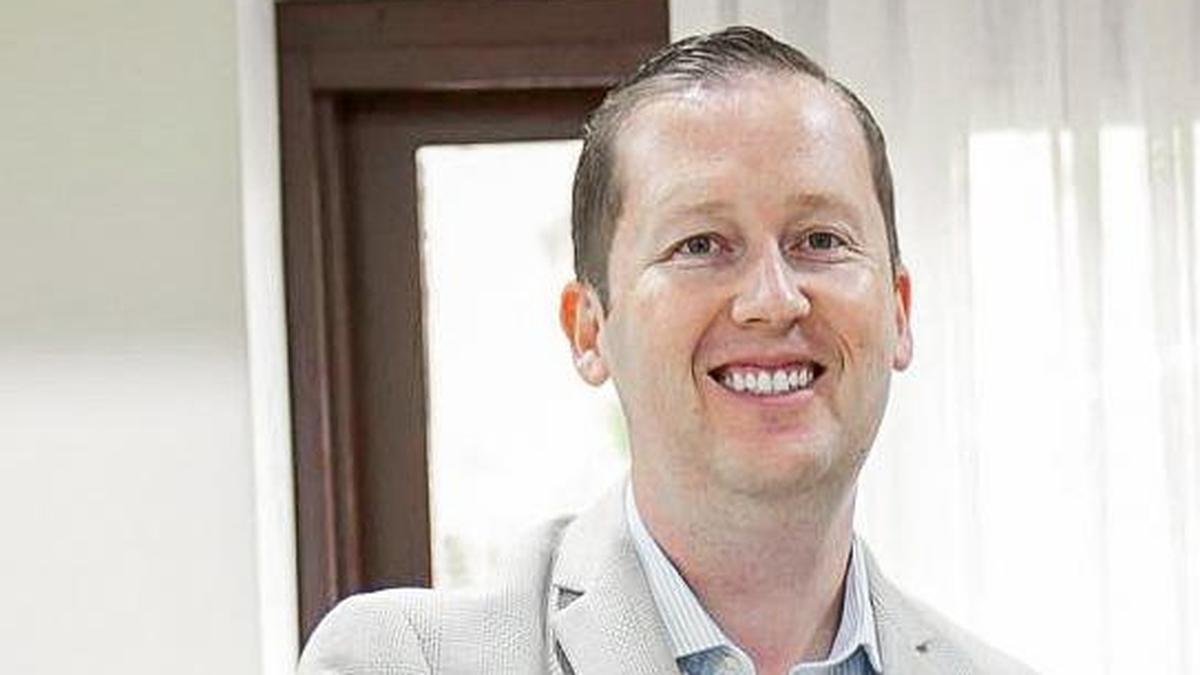
U.S. Ambassador to India Sergio Gor
| Photo Credit: ANI
United States Ambassador to India Sergio Gor’s visit to Sri Lanka, his first visit in the region in his role as U.S. Special Envoy for South Asia, is a “quiet strategic signal”, said experts, as it comes amidst the war in West Asia, and U.S. action in the Indian Ocean. While the Narendra Modi government has made no comment about the visit, Mr. Gor met with National Security Advisor Ajit Doval before embarking on the six-day regional tour to Sri Lanka and Maldives, and the government is understood to be watching its outcomes carefully.
Iran-Israel war updates on March 22, 2026
India’s response to Mr. Gor’s position is a contrast to the last time the U.S. nominated a Special Envoy for the region. In 2009, when the Obama administration nominated Richard Holbrooke, the government had protested vociferously, calling a “broad mandate” for the envoy “risky” and “interfering”, according to diplomatic cables released by Wikileaks in 2016, and the U.S. had backtracked, appointing him and subsequently Zalmay Khalilzad only as Special Representatives for Afghanistan and Pakistan (SRAPs). Prior to Mr. Gor, South Asia was dealt with bilaterally via U.S. Ambassadors in each capital, and by the Assistant Secretary of State for South and Central Asia, a position currently occupied by S. Paul Kapur.
This time around, Mr. Gor has a much broader mandate, with U.S. President Donald Trump appointing him as his Special Envoy to South and Central Asia in August 2025. Mr. Gor has already made visits to Central Asian capitals as Special Envoy, and also travelled to Bhutan last week although that was in his capacity as Ambassador to Bhutan, where he is concurrently accredited.
After his visit to Sri Lanka and Maldives, all eyes will be on whether Mr. Gor would travel next to Pakistan and Bangladesh, and whether his role as Special Envoy would also include any attempts to mediate between India and its neighbours, which it would oppose.
In addition, experts and officials said Mr. Gor’s visit is being tracked particularly as South Asia appears to be drawn in to the U.S.-Israel war with Iran, with a U.S. submarine bombing the Iranian ship IRIS Dena, and the latest Iranian strikes towards the U.S.-United Kingdom’s Diego Garcia base in the Chagos Islands.
“Sergio Gor’s visit to Colombo is best read as a quiet strategic signal rather than a substantive breakthrough: the United States is reasserting a calibrated presence in the Indian Ocean at a moment when tensions in [West Asia] are spilling into the maritime space,” said former Foreign Secretary and Ambassador to U.S. and China Nirupama Menon Rao, who pointed out that Sri Lanka had balanced the optics of the visit carefully, “welcoming engagement without overt alignment”. While no agreements were announced during Mr. Gor’s visit, it pointedly included trips to naval facilities and ships, as well as the Colombo Port.
Visiting Colombo Port, Mr. Gor said in a post that it was “clear how this critical hub connects South Asia to global markets — and why maritime security here matters”. Sri Lankan President Anura Kumara Dissanayake also “briefed” Mr. Gor’s delegation on the “ongoing conflict situation in the Middle East, as well as the challenges faced by the country in light of these developments”.
Mr. Gor’s travel to Sri Lanka came two weeks after the Iranian ship IRIS Dena was torpedoed by a U.S. submarine close to Sri Lankan waters, and Mr. Dissanayake refused U.S. warplanes permission to land in Sri Lanka’s Mattala airport during the war, stressing that Sri Lanka wanted to maintain its “neutrality”.
When asked, former Sri Lankan Foreign Secretary and Ambassador to the U.S. Prasad Kariyawasam said that the visit of Mr. Gor was a positive development and an opportunity to discuss ways to “promote stability” in the Indian Ocean, given commercial projects in the pipeline.
“It’s very good that high level contacts are maintained actively with the USA in the context of war affecting Iran, the region and beyond, given that U.S. is a leading maritime power in the Indian Ocean and that Iran is highly connected with Indian Ocean countries including Sri Lanka”, Mr. Kariyawasam told The Hindu.
Published – March 22, 2026 09:19 pm IST


