


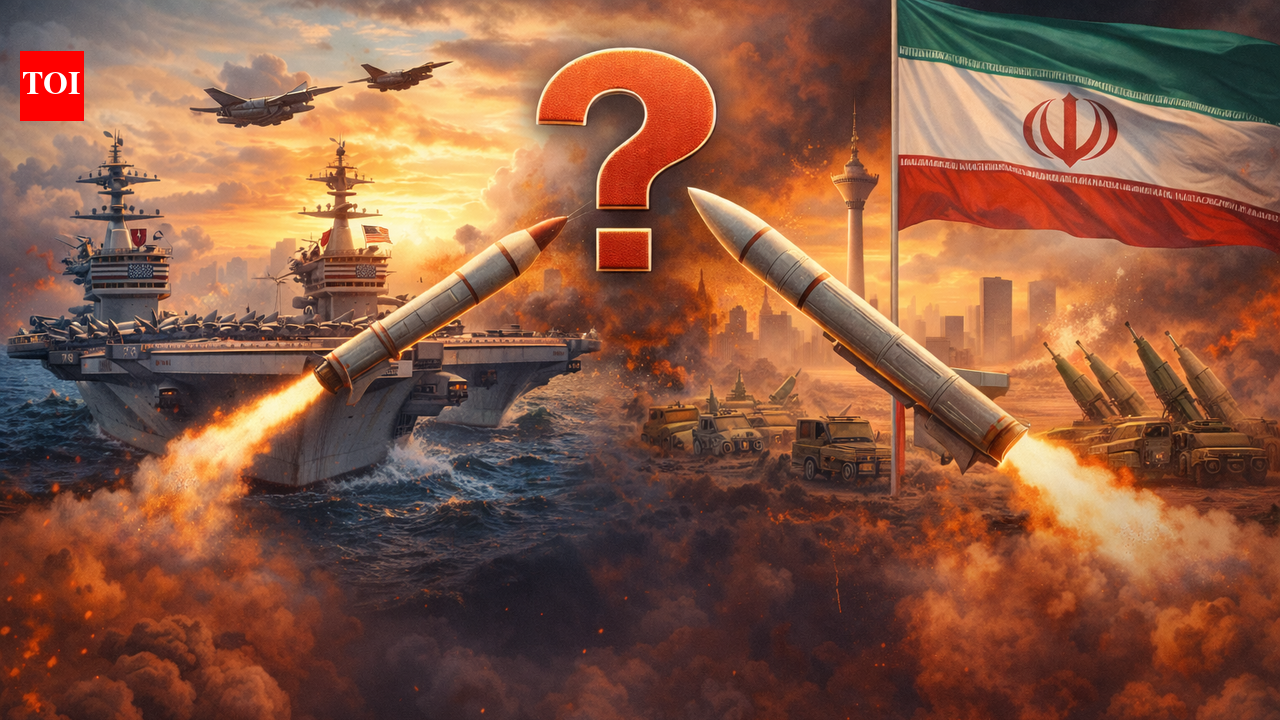
The United States has significantly expanded its military footprint in the Middle East by deploying two aircraft carrier strike groups within operational reach of Iran. The USS Abraham Lincoln was first redirected from the Indo-Pacific and placed under US Central Command, bringing with it Carrier Air Wing 9 and guided-missile destroyers including USS Spruance, USS Michael Murphy and USS Frank E. Petersen Jr. Soon after, the USS Gerald R. Ford, the world’s largest aircraft carrier, was ordered to the region, marking a rare dual-carrier deployment. Each carrier functions as a floating airbase, capable of launching sustained strike missions, enforcing air superiority, conducting electronic warfare and supporting missile defence. The presence of two nuclear-powered carriers dramatically increases American operational flexibility, allowing continuous air operations while maintaining defensive coverage for US assets and allies across the Gulf.
How the escalation unfolded
The current escalation between the United States and Iran has unfolded in stages, shaped by domestic unrest, stalled diplomacy and calibrated military signalling.The first trigger emerged in late December, when protests broke out across Iran, initially driven by economic grievances but quickly expanding into broader anti-government demonstrations. From early January, security forces launched a sweeping crackdown. Rights groups reported large casualty figures, and as 40-day mourning ceremonies began for those killed, tensions inside the country remained high. Washington publicly warned Tehran against further repression, with President Donald Trump signalling that “all options” remained available.By mid-January, the military dimension intensified. The USS Abraham Lincoln Carrier Strike Group, originally deployed to the Indo-Pacific, was redirected toward the Middle East. Around January 19, it transited the Strait of Malacca and soon began operating in the Indian Ocean. By January 27, US Central Command confirmed its arrival in theatre. The carrier’s deployment significantly expanded US strike capacity in the Arabian Sea.Between January 27 and 29, rhetoric sharpened. Trump warned that failure to reach a nuclear agreement would result in consequences described as “very traumatic.” Indirect diplomatic contacts through intermediaries in Oman were discussed, but no breakthrough followed.On February 3, tensions escalated operationally when a US F-35C from the USS Abraham Lincoln shot down an Iranian Shahed-139 drone in the Arabian Sea after it allegedly approached the carrier aggressively. The same day, US forces responded to Iranian vessels that reportedly threatened a US-flagged tanker in the Strait of Hormuz.In early February, satellite imagery revealed expanded US air deployments at bases in Qatar and Jordan, including Patriot missile systems mounted on mobile launchers, refuelling tankers and strike aircraft. Shortly thereafter, Washington ordered the USS Gerald R. Ford to join the Lincoln, cementing a rare dual-carrier posture in the region.
US military preparing for sustained operations
According to Reuters, US officials indicated that military planners are preparing for the possibility of sustained, weeks-long operations against Iran if ordered by the president. Unlike previous limited strikes, current contingency planning reportedly includes scenarios that extend beyond nuclear infrastructure to encompass state and security facilities. The presence of additional fighter aircraft, guided-missile destroyers, reconnaissance platforms and refuelling tankers suggests preparation for prolonged air operations rather than a single punitive strike. Officials have acknowledged that any such operation would likely invite retaliation, raising the risk of back-and-forth exchanges over an extended period. This level of preparation signals readiness, though not necessarily imminent execution.Also read – Patriot missiles, stratotankers & C-17s: Satellite photos reveal massive US military build-up near Iran
What is driving the escalation?
Several factors appear to be converging. The most immediate driver is the stalled diplomacy surrounding Iran’s nuclear programme. Indirect talks via Oman have yet to produce a breakthrough, while President Trump has pressed Tehran to reach an agreement swiftly. Israel has urged Washington to expand negotiations to include ballistic missiles and regional proxy activity, demands that Iran has resisted. At the same time, Iran’s internal unrest following recent protests has added instability. Regional dynamics also weigh heavily. The Middle East remains volatile after the Israel-Hamas war, and Gulf states have warned that any direct US-Iran confrontation could spark a broader regional conflict. Together, these elements create a combustible environment in which military positioning serves both deterrent and diplomatic purposes.
What military options does the US now have?
With two carrier strike groups deployed in the Middle East, alongside expanded air and missile defence assets at regional bases, the United States now has a broad spectrum of military options available. These range from deterrent posturing to sustained combat operations.At the lower end of the spectrum, the US can maintain a visible show of force designed to pressure Iran diplomatically. Carrier-based aircraft can conduct patrols, intelligence missions and exercises with regional partners without initiating combat. This posture reinforces deterrence while keeping escalation thresholds intact.If tensions rise further, Washington has the capability to conduct limited precision strikes. These could target specific nuclear facilities, missile storage depots, drone infrastructure or Revolutionary Guard command centres. Carrier-based strike aircraft, long-range bombers and cruise missiles launched from guided-missile destroyers could be employed in tightly controlled operations aimed at degrading particular capabilities without broadening the conflict.A more expansive option would involve suppression of Iranian air defences to establish temporary air superiority. Electronic warfare aircraft and stealth fighters could disable radar networks and surface-to-air missile systems, creating operational corridors for follow-on strikes. This would represent a deeper level of engagement.The US could also focus on maritime security operations. With significant naval assets in theatre, Washington can protect commercial shipping lanes in the Strait of Hormuz, escort tankers and deter attempts to disrupt global energy flows. Naval blockades or exclusion zones, though more escalatory, remain within operational reach.In a sustained campaign scenario, the United States could target not only nuclear infrastructure but also state security facilities, missile launch sites and logistics hubs over a period of weeks. Such an operation would likely involve layered air, naval and missile strikes supported by regional bases.
Iran’s deterrence posture
Iran’s deterrence posture is built on a combination of conventional capabilities, asymmetric tools and strategic signalling designed to raise the cost of any military strike against it. At the heart of that posture is one of the Middle East’s largest ballistic missile arsenals, with medium- and long-range missiles capable of striking targets across the region, including military bases, infrastructure and major cities. Tehran has repeatedly stated that its missile programme will not be a subject of negotiation, underscoring how central these systems are to its defence strategy.Beyond ballistic missiles, Iran’s anti-ship cruise missiles, coastal defence networks and drones form part of an anti-access/area denial (A2/AD) framework that could challenge adversaries attempting to operate near its shores or in the Strait of Hormuz. These systems can threaten naval vessels, commercial shipping and logistical lines, potentially inflicting economic as well as military disruption. Iran also possesses naval mines and fast-attack craft that could complicate transit through the crucial waterway that carries a significant portion of global oil exports.Asymmetric elements, including support for allied militias and proxy groups in Iraq, Syria, Yemen and Lebanon, multiply Tehran’s leverage. Although attacks by some proxies have weakened in recent years, these networks remain part of Iran’s regional deterrent. Tehran has also used high-profile military drills, firing ballistic and cruise missiles during exercises in the Strait of Hormuz and Gulf of Oman, issuing warnings to the United States not to approach its forces — signalling capability and resolve.Iran’s leadership has publicly insisted it will not be intimidated by US military deployments in the Gulf, framing the presence of American warships as pressure that will not alter Tehran’s stance. While its air force and some longer-range missile stocks were reportedly degraded during past conflicts, Iran still retains significant short- and medium-range strike assets that form the core of its deterrence against both regional adversaries and external military action.
Why the US has not attacked — yet
Despite the visible military buildup in the Middle East, several strategic, political and operational factors help explain why Washington has not launched an attack on Iran.
- First, diplomacy has not collapsed. Indirect talks between US and Iranian representatives through intermediaries in Oman remain open, even if progress has stalled. President Donald Trump has combined sharp warnings with statements suggesting that a deal could still be reached. As long as negotiations remain technically alive, immediate military action carries the risk of foreclosing diplomatic options and hardening positions inside Tehran.
- Second, the risk of retaliation is significant. Iran possesses a substantial arsenal of ballistic missiles, drones and proxy networks across the region. Any US strike could trigger missile attacks on American bases in Qatar, Bahrain, Kuwait, the United Arab Emirates or Saudi Arabia. Tehran could also activate allied militias in Iraq or Lebanon, or attempt disruption in the Strait of Hormuz. US planners are likely weighing the costs of a retaliatory cycle that could stretch beyond a limited exchange.
- Third, regional stability concerns act as a constraint. Gulf states have warned that a direct US-Iran confrontation could spiral into a wider conflict, particularly in a region already strained by the aftermath of the Israel-Hamas war. Even limited hostilities could disrupt global energy markets and trigger economic shockwaves.
- Fourth, military posture does not automatically equal imminent action. Carrier deployments historically serve as coercive leverage, signalling capability and intent without necessarily crossing into combat. The current buildup strengthens Washington’s bargaining position while preserving flexibility.
Finally, domestic political and strategic calculations matter. A sustained campaign against Iran would demand significant resources and could reshape US foreign policy priorities at a time of global commitments.Previous US actions against Iran, including last year’s reported “Midnight Hammer” operation, were limited and targeted. That strike involved stealth bombers flying from the United States to hit specific nuclear facilities in a one-off mission, followed by a contained Iranian response. Current preparations appear more expansive. The presence of two carrier strike groups, additional strike aircraft and enhanced defensive systems suggests planning for sustained operations rather than a singular strike. The scale and diversity of assets indicate a more comprehensive contingency framework, raising the potential stakes compared to earlier limited engagements.
Three possible scenarios
As tensions mount and military assets concentrate in the region, three broad scenarios emerge from the current US-Iran standoff. Each carries distinct strategic and geopolitical consequences.
- Scenario 1: Coercive diplomacy succeeds – Under sustained military pressure, Iran could agree to resume meaningful negotiations over its nuclear programme. In this scenario, backchannel diplomacy through intermediaries such as Oman produces a framework agreement addressing enrichment levels, inspections and sanctions relief. The dual-carrier deployment would function as leverage rather than a prelude to conflict. Gradual de-escalation would follow, with naval assets eventually redeploying and regional tensions stabilising. This outcome preserves deterrence credibility while avoiding military confrontation.
- Scenario 2: Limited precision strikes – If negotiations stall or intelligence indicates accelerated nuclear or missile activity, the United States could conduct calibrated, targeted strikes. These might focus on nuclear facilities, missile storage depots, drone infrastructure or Revolutionary Guard sites. The objective would be to degrade capabilities without triggering full-scale war. Iran, in turn, might respond symbolically or in a limited manner to avoid broader escalation. This scenario resembles previous limited engagements, though risks of miscalculation remain high.
- Scenario 3: Escalation spiral – The most serious possibility involves an unintended or rapid escalation. A drone incident, missile strike, tanker seizure or proxy attack could trigger retaliatory exchanges. Sustained back-and-forth strikes could extend across multiple theatres, involving US bases, Gulf infrastructure and maritime routes. Proxy groups aligned with Tehran could open additional fronts. Energy markets would likely react sharply, and regional stability could deteriorate quickly.
Armadas and uncertainty
The deployment of two aircraft carriers to the Middle East represents one of the most significant US force concentrations in the region in recent years. Combined with expanded air assets, missile defence systems and intelligence platforms, Washington has assembled substantial military capability within reach of Iran. Yet capability alone does not determine outcome. Diplomatic efforts continue, even as rhetoric intensifies. Iran maintains its own deterrent posture and has signalled readiness to respond to any aggression. The situation reflects a delicate balance between pressure and restraint. For now, the armadas remain positioned, negotiations remain fragile and the region stands at a crossroads shaped by both force and uncertainty.


