



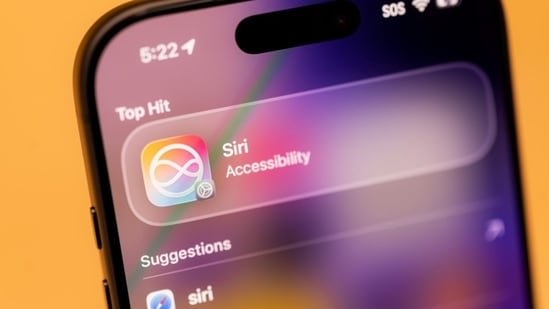
Siri is one of the dumbest chatbots on the market. Apple hopes a reboot can power its AI comeback.
When Apple stages its annual developer conference next week, the big reveal is expected to be a modern version of Siri that will look more like ChatGPT. Gone will be the old version, which has been so limited for so long that many people, if they ever use it, do so only for basic functions like setting timers.
The new Siri, built atop Google’s Gemini technology, is expected to offer a more modern search experience, remembering users’ prior queries and accessing data from their devices for personalized responses. A new stand-alone Siri app with a paid tier, similar to competing artificial-intelligence apps, is also expected.
The question is whether the new Siri, and other operating-system updates, set Apple on a path to bring generative AI to the masses, harnessing the company’s formidable assets that, paradoxically, give it pole position to dominate the market even though it is years behind rivals.
“I think Apple is going to win on AI,” said Ron Johnson, Apple’s retail chief under Steve Jobs. “The phone is the primary device on which people will use AI. And Apple is partnering with the right people to bring a unique AI experience to the phone.”
Tim Cook leveraged Apple’s dominance in devices to make his company a tollbooth: tens of billions of dollars in annual fees from apps so they can reach consumers and a like amount from Alphabet’s Google to be the default search in the Safari browser. A smarter Siri could collect new tolls at the on-ramp to AI.
Today most consumers have only experienced AI as a more sophisticated online search. But the explosion of Anthropic’s business, powered by professionals who use Claude to complete tasks, points to the AI future for consumers too: when smartphones will act as sophisticated assistants that do something similar.
A smartphone might book restaurant reservations on its own because it has users’ calendars and knows their dietary restrictions. It could hail a ride because it knows the user’s home address and stores credit-card information. Apps themselves might be abstracted away as smartphone agents call online services directly on behalf of their users.
Apple’s key advantage in this future world is that iPhones already know everything about their users. Companies spending hundreds of billions of dollars to build the most sophisticated AI models, and who want to reach consumers, will likely have to go through Apple.
In a recent investor note, Bank of America analyst Wamsi Mohan argued that Apple could become the marketplace for app actions. Apps now compete for downloads and screen time. In the future, they might compete to be the service that smartphone agents call on. If Uber Technologies wants to be pinged by Siri for ride requests, for instance, it will likely have to pay Apple a hefty fee.
OpenAI, wanting to control its own destiny, teamed up with Apple’s former design savant Jony Ive to make its own AI device. It also launched an App Store strategy last fall. So far, its apps initiative has failed to excite, and it seems unlikely it can deliver a device that will convince consumers to trade in iPhones.
Apple has promised a smarter Siri before. Two years ago it said the chatbot would interact with messages and apps and understand the user’s screen. It later settled a class-action lawsuit for failing to deliver those features.
“The challenge that stands starkly in front of Apple is its ability to turn its (imagined?) Apple Intelligence capabilities into a product or service that people will actually use,” wrote MoffettNathanson analyst Craig Moffett in an investor note.
Indeed, none of Apple’s advantages will matter if Apple can’t deliver competent AI to guide iPhone users through this new world. Ironically, when Siri launched as an independent app 16 years ago, what its co-founders built was an agent to complete tasks like booking restaurant reservations. Yet after buying the app, Apple failed to deliver on that vision. It has struggled so badly to modernize the chatbot that, after years of trying, it still had to turn to Google to provide the technology back end.
Another of Apple’s AI advantages, its emphasis on protecting users’ privacy, is also a handicap. That stance builds trust with consumers, who are likely to continue to share personal data with Apple instead of with other companies known for stealing data or selling it. Yet hiding users’ information even from itself complicates the ability of Apple’s engineers to train better AI models.
Apple’s struggles to secure memory supplies will prove another challenge. IPhones will need more memory in the future to run sophisticated AI models “on-device,” protecting user data from being uploaded to the cloud, yet AI chip makers such as Nvidia are gobbling up memory, causing prices for it to skyrocket.
Last year Apple announced the retirement of its head of AI after he failed to deliver a better vision for Siri. It has no excuses left not to deliver.
Write to Rolfe Winkler at Rolfe.Winkler@wsj.com


