



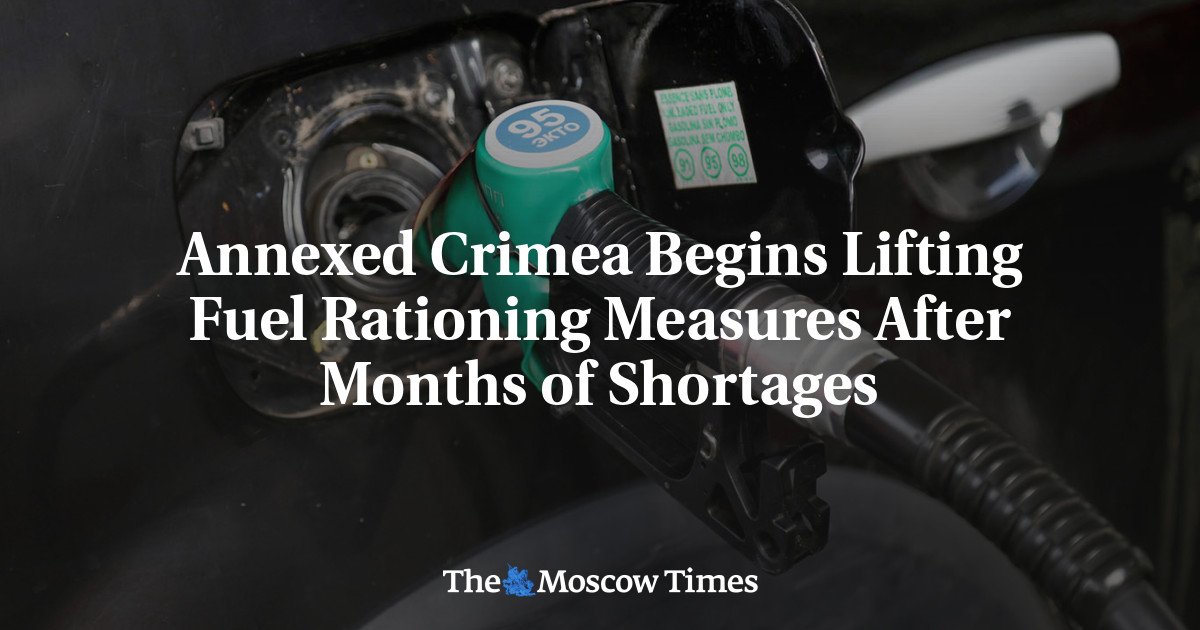
Kremlin-installed authorities in Crimea have begun lifting fuel rationing measures introduced months ago in response to shortages caused by Ukrainian attacks on Russian oil refineries and supply routes leading to the annexed peninsula.
Mikhail Razvozhayev, the Russian-appointed governor of Sevastopol, said Monday that purchase limits in the port city had been officially lifted as of midnight as shipments of fuel began to stabilize.
“We’ve removed the restrictions because the logistics situation with gasoline has practically stabilized,” the Interfax news agency quoted Razvozhayev as saying.
He said Sevastopol had enough fuel to ensure its “smooth sale over a short-term period,” though he said some gas stations ran out of certain fuel grades by midday on Monday before being restocked later in the day.
“Let’s hope the logistics situation will remain this way from now on,” Razvozhayev said.
Crimea began rationing fuel in May after Ukrainian drone strikes targeted military trucks and fuel tankers that supply the region from the north, triggering local gasoline shortages. The supply crisis later spread into mainland Russia as Ukraine ramped up its attacks on refineries, causing two major waves of nationwide fuel shortages.
On Oct. 12, the average price of gasoline in Sevastopol hit 131.76 rubles per liter ($6 per gallon), according to Rosstat data, which tracks the annexed city alongside Russian regions and lists it as being among the places with the highest gasoline prices nationwide.
Across Russia, the average price of gasoline has increased more than 21% since the start of the year.
Ukrainian strikes on Russian oil refineries began to drive a wedge between the White House and Kyiv this month after U.S. President Donald Trump blamed them for the soaring cost of diesel in the United States, though analysts say the U.S.-Israeli war against Iran is the main cause of high energy prices.
Trump announced an “energy ceasefire” between Russia and Ukraine earlier this month, which neither side said they had agreed to beforehand. That apparent pause in strikes collapsed immediately as the Russian army continued its attacks against Ukraine’s power grid.
A Message from The Moscow Times:
Dear readers,
We are facing unprecedented challenges. Russia’s Prosecutor General’s Office has designated The Moscow Times as an “undesirable” organization, criminalizing our work and putting our staff at risk of prosecution. This follows our earlier unjust labeling as a “foreign agent.”
These actions are direct attempts to silence independent journalism in Russia. The authorities claim our work “discredits the decisions of the Russian leadership.” We see things differently: we strive to provide accurate, unbiased reporting on Russia.
We, the journalists of The Moscow Times, refuse to be silenced. But to continue our work, we need your help.
Your support, no matter how small, makes a world of difference. If you can, please support us monthly starting from just $2. It’s quick to set up, and every contribution makes a significant impact.
By supporting The Moscow Times, you’re defending open, independent journalism in the face of repression. Thank you for standing with us.
Continue
Not ready to support today?
Remind me later.
×
Remind me next month
Thank you! Your reminder is set.
