


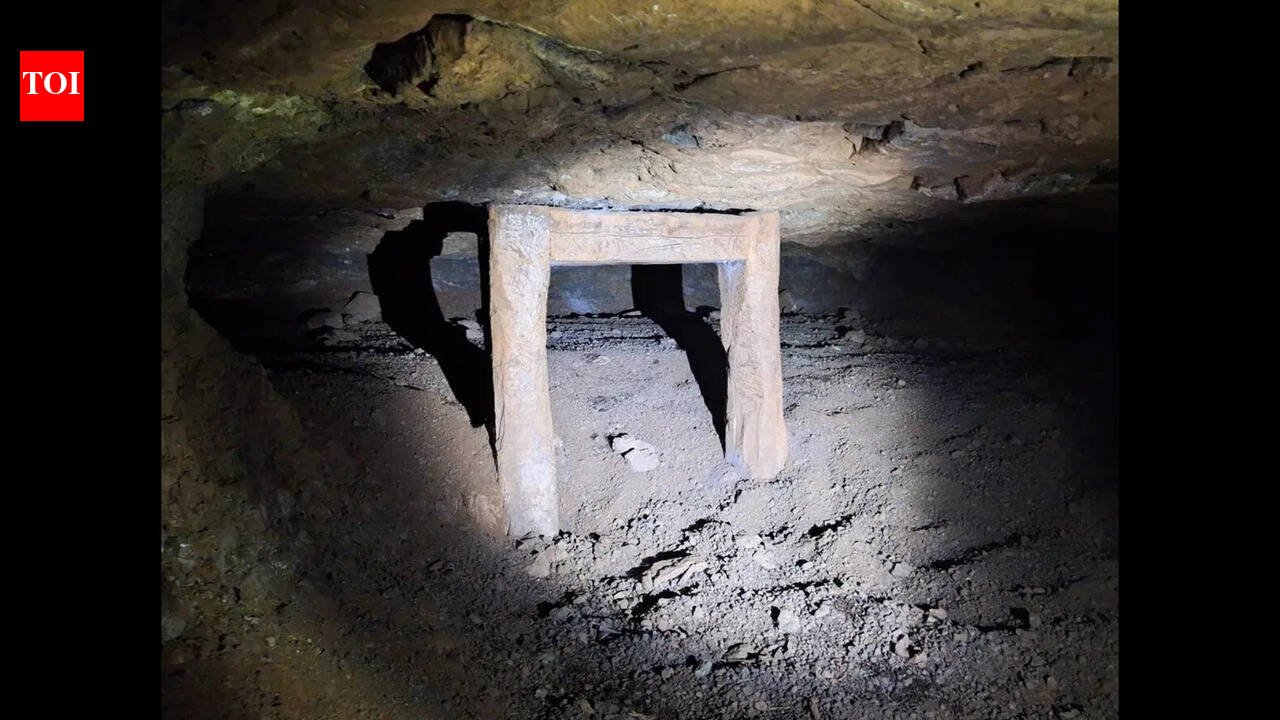
Keri: Goan researchers studying coastal history associated with Ramghat discovered a natural cave with immense potential for archaeological research. Located in the mountains near Dodamarg, the cave was a well-known route that facilitated trade between Goa and Konkan region in ancient times.Vithoba Gawde, an archaeology student, said they found the cave in Gudavale Khalsa, situated at an elevation of 716m, which is just 380m from Ramghat.The cave, now inhabited by wild animals, was once home to humans, as indicated by the paintings on its walls. “Its walls have symbols painted in white on a red-coloured background. We also found skeletons of wild animals inside the cave. It could easily accommodate more than 50 people at a time,” Gawde said.Sara Anthony, an archaeology student of the Mumbai University from Vasco, after a recent visit to Ramghat, said Ramghat was one of the important ghatways that connected kingdoms from Maharashtra and Karnataka.Anthony told TOI that the Frenchman and writer Abbe Carre, who travelled on behalf of the East India Company between 1672-1674, in his work Travels of Abbe Carre, mentioned that Ramghat was the trade route from the ghat region to the coastal areas.Gajanan Shetye, a wildlife enthusiast from Keri in Sattari taluka, said the cave, nestled amidst evergreen forests, is the origin point of the Kharadi nalla, a tributary of the Tillari river, which is known as the Colvale river in Goa.While travelling from Dodamarg to Chandgad, a pathway from Kalasgade leads to the cave. Sonu Ninu Fonde, a local, said that according to folklore, the Pandavas lived in the cave for some time during their period in exile.Namdev Gawas, a Tillari local who guided researchers and students to the cave, said that for a panoramic view of the Tillari river valley, a visit to the cave is a must.Varad Sabnis, an archaeologist from Goa, said researchers brought to his notice pieces of pottery found in the cave likely to be from the early medieval era. “But only after a systematic excavation will we know unknown facets of the history and heritage of the region,” Sabnis added.
