


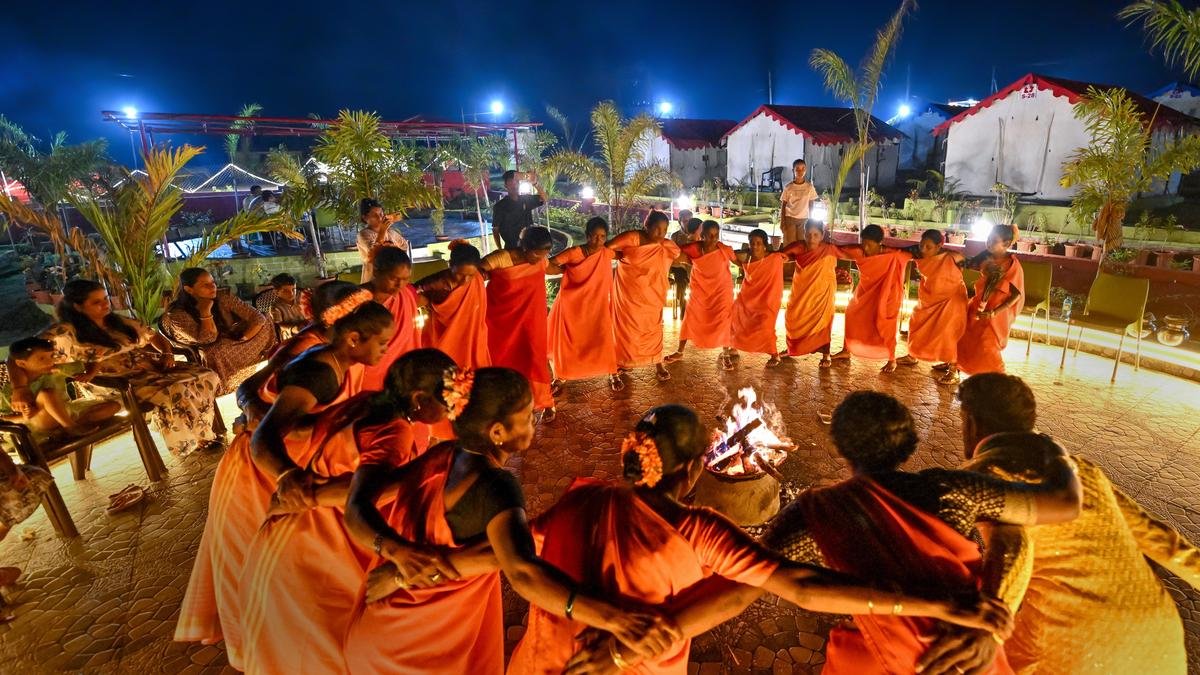
Locals from tribal communities performing Dhimsa dance around the bonfire at Araku MountainView Camping Resort in Bosubeda near Araku Valley.
| Photo Credit: KR Deepak
At Araku Mountain View Camping Resort, evenings are centred around the rhythms of dhimsa dance, bringing visitors closer to the traditions of the tribal communities of Araku Valley. As night falls across the hills, tribal drummers and dancers gather around campfires, with women performing the traditional folk dance that has long been part of community celebrations in the region.
Situated near the Madagada viewpoint road in Bosubeda village, the campsite has been founded by Colonel Y Siva Sankara Rao, recipient of the Presidential Sena Medal Award. Conceived as a nature-oriented stay amid the Eastern Ghats, the place combines mountain camping with experiences drawn from the cultural life of Araku’s indigenous communities.
Evenings here are centred around the dhimsa dance, a folk dance performed by tribal women of the region during festivals, harvests and community celebrations. Stargazing sessions continue late into the night at the campsite with visitors watching the clear skies over the Araku hills.
“We wanted visitors to experience the traditions and warmth of the people who belong to these hills,” says Siva Sankara Rao.
Tented accomodations at the Araku MountainView Camping Resort in Bosubeda near Araku Valley.
| Photo Credit:
KR Deepak
The campsite offers a mix of Swiss camps and American-style tents overlooking the valley. While the Swiss camps come with attached washrooms, beds and weather-protected structures, the American camps are designed for travellers looking for a more rugged camping experience while still enjoying basic comforts. Stargazing sessions, music evenings and open-air movie screenings add to the experience.
The emphasis on local culture sets the place apart. Adjacent to the camping site, work is currently underway on a tribal life setup that aims to recreate the traditional lifestyle of the indigenous communities of the Araku region. The upcoming space is being planned as a living cultural zone that will showcase tribal homes, local food traditions, indigenous cooking practices and everyday living patterns of the communities that have shaped the cultural identity of the valley for generations.
“Visitors will be able to walk through recreated tribal living spaces, understand the use of natural materials in housing and get introduced to traditional food prepared using locally-sourced ingredients,” says Siva Sankara Rao, adding that the initiative also aims to generate livelihood opportunities for local tribal artisans and performers.
The project aims to present aspects of daily life that often remain invisible to travellers passing through the valley. Traditional methods of cooking, the use of forest produce, locally cultivated ingredients and patterns of community living are expected to form part of the experience.
Tourism operators in Araku say experiential tourism is gradually replacing quick stopover travel in the hill destination. While destinations such as Borra Caves and Madagada viewpoint continue to attract large footfall, experiential stays have begun drawing families and younger travellers interested in spending more time within the landscape rather than merely photographing it.
Bosubeda is at a distance of about 110 kilometres from Visakhapatnam and is on the way to Araku Valley. More details are available at www.amcr.in.
Published – May 07, 2026 04:59 pm IST
