






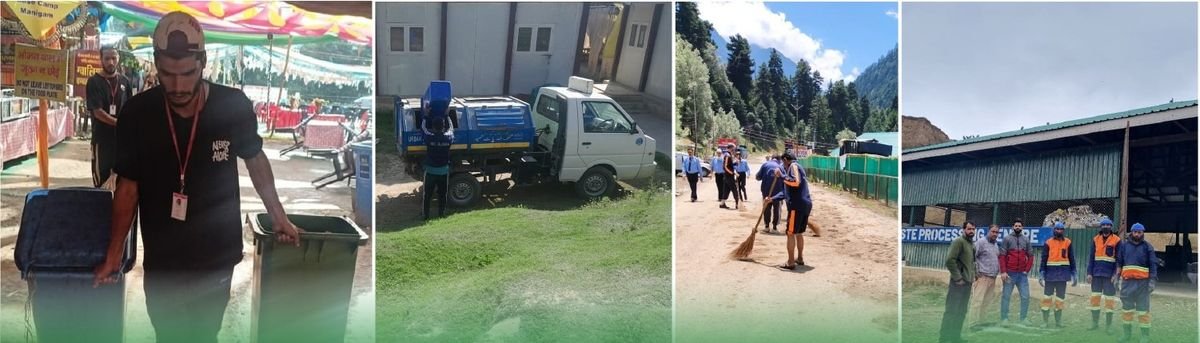
Srinagar, Aug 02: With the 57-day Shri Amarnath Ji Yatra entering its final phase, the ongoing pilgrimage has emerged as a shining example of sustainable waste management, with nearly 300 metric tonnes (MT) of solid waste collected and scientifically processed till July 30, underscoring the success of the government’s green initiatives in the fragile Himalayan region.
The annual pilgrimage, which commenced on July 3 and will continue for 57 days, has witnessed an unprecedented response from devotees. Nearly 4.5 lakh pilgrims have paid obeisance at the holy cave shrine through the Baltal and Pahalgam routes till July 30, making it one of the highest pilgrim footfalls in recent years. Despite the record rush, sanitation authorities have maintained an impressive cleanliness record, ensuring that the pilgrimage remains both spiritually enriching and environmentally responsible.
Official figures accessed by the Rising Kashmir, reveal that 291.72 MT of solid waste had been collected and scientifically processed till July 30, making this year’s Yatra one of the cleanest and most environmentally managed editions in recent years.
According to the data, 191.29 MT of waste has been collected along the Baltal axis and 100.43 MT on the Pahalgam route. On July 30 alone, sanitation workers collected 7.7 MT of waste from Baltal and 1.3 MT from Pahalgam, ensuring prompt collection and scientific processing despite the heavy daily pilgrim rush.
The figures also indicate overwhelming public appreciation for the sanitation arrangements. A total of 34,266 feedback responses have been received through the Yatra mobile application, website and digital kiosks.
More than 98 per cent of pilgrims rated toilet facilities and overall cleanliness positively on both pilgrimage routes. Officials said the limited complaints received were mainly related to temporary water supply and electricity issues at a few toilet locations.
The Department’s Information, Education and Communication (IEC) campaign has also recorded encouraging public participation. As many as 11,048 pilgrims have taken the environmental pledge, while 7,200 Responsible Yatri Certificates have been issued to visitors committing themselves to protecting the fragile Himalayan ecosystem.
To minimise plastic pollution, the Department of Rural Sanitation has distributed 1,10,200 reusable bags among pilgrims. The Bartan Bank initiative has issued 200 reusable utensil kits, of which 94 have been returned, while the Sewa Café initiative has distributed another 200 reusable bags. These initiatives are aimed at discouraging single-use plastics and promoting responsible pilgrimage practices.
A unique feature of the sanitation drive has been the large-scale use of horses to transport waste from inaccessible mountainous stretches. Around 1,000 horses operating on the Baltal axis have brought down nearly 46 MT of waste, while 590 horses on the Pahalgam route have transported another 34 MT, taking the total waste evacuated through equine logistics to approximately 80 MT.
Dr Sameer Sharma, CEO of Swaaha, the startup entrusted with scientific collection and processing of both solid and liquid waste during the Amarnath Yatra, said the figures reflect the scale of the operation and the success of the collaborative effort.
“The figures speak for themselves. Till July 30, we have scientifically collected and processed nearly 300 metric tonnes of solid waste generated during the Yatra despite a record footfall of nearly 4.5 lakh pilgrims. Our teams are working round the clock to ensure that no waste is left unattended and that the fragile Himalayan ecosystem remains protected,” Dr Sharma told Rising Kashmir.
He said Swaaha’s integrated waste management model covers both solid and liquid waste, ensuring scientific collection, transportation, segregation, processing and environmentally safe disposal throughout the pilgrimage.
“This is not just about waste collection; it is about creating a sustainable pilgrimage model. Along with managing solid waste, we are also treating liquid waste through scientific systems. The overwhelming public response, with over 98 per cent positive feedback on cleanliness, reflects the coordinated efforts of the Department of Rural Sanitation, sanitation workers, volunteers, pony operators and our field teams,” he said.
Dr Sharma said initiatives such as the Responsible Yatri campaign, distribution of reusable bags, the Bartan Bank and continuous awareness programmes have significantly reduced plastic litter and encouraged pilgrims to become active partners in conserving the Himalayan environment.
Officials said the coordinated efforts of the Department of Rural Sanitation, Swaaha, sanitation workers, volunteers, pony operators and other stakeholders have transformed this year’s Amarnath Yatra into a national model of eco-friendly pilgrimage management, demonstrating that even a record influx of pilgrims can be managed while preserving the pristine Himalayan ecosystem.


