






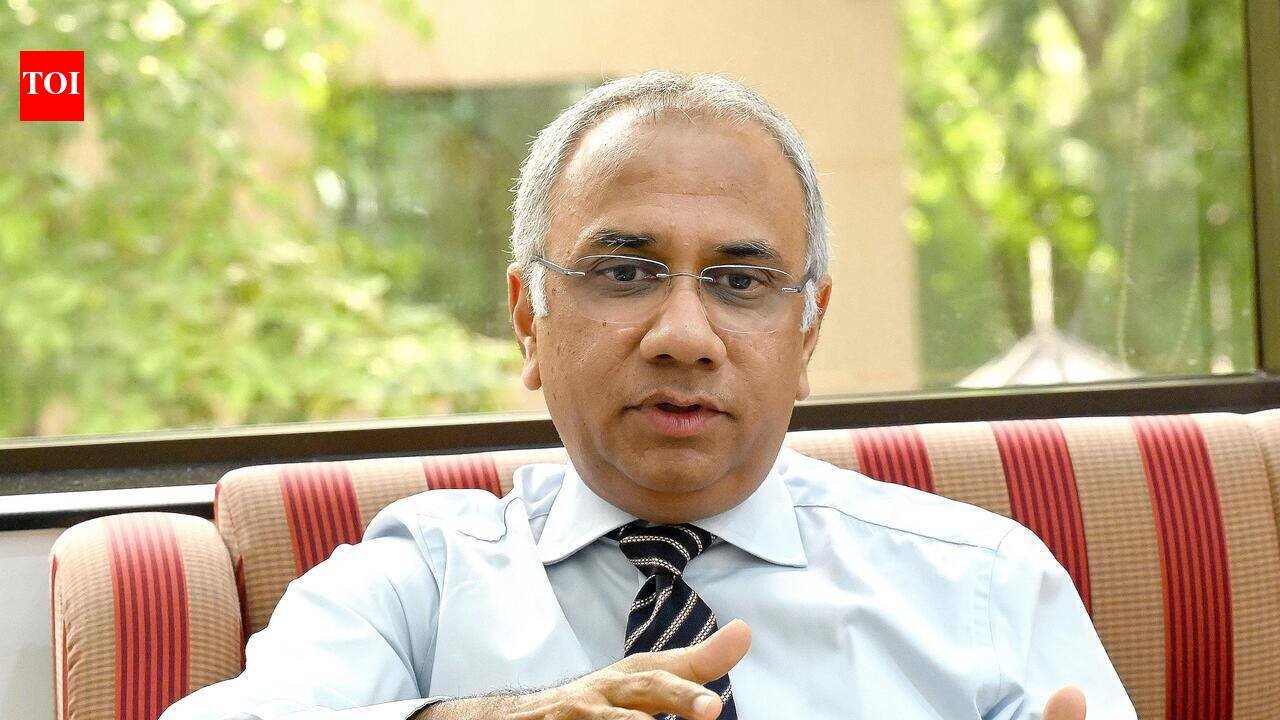
Bengaluru: When Salil Parekh took over as Infosys CEO in 2018, the company was grappling with boardroom turmoil that had shaken investor confidence. Over nine years, he helped transform Infosys, doubling revenue from $10 billion to $20 billion, securing over $100 billion in large deals, and the foundation for its AI strategy, including through partnerships with OpenAI, Anthropic and Cognition. Never one to chase headlines or make them, Parekh, who retires from the firm in March next year, built a reputation for disciplined execution, reinforcing chairman Nandan Nilekani’s approach of making Infosys “boring” in the best sense – predictable, consistent and dependable. Excerpts of an interview with TOI:Your peers like TCS and HCL have invested in data centres and AI firms. Has Infosys been risk-averse in an era that seems to reward bold bets?We look at decisions based on what will genuinely help our clients, not just what looks exciting. We moved quickly on digital transformation, from 20% to 60% of our business. We built a large-deals engine – roughly $100 billion in large deals since I’ve been here, and we’ve gone from $10 billion to $20 billion in revenue. We remain one of the fastest growing firms on an organic basis over the last eight years because of these initiatives. But we’re also disciplined – on margin, on free cash flow, on execution – with a good balance sheet that we deploy carefully toward where AI is actually taking us, not just where there’s excitement.Anthropic, OpenAI, and Microsoft are building enterprise deployment arms and could partner with or acquire mid-sized integrators. Does this worry you?The labs and tech companies want strong partnerships with Infosys, and we want the same with them. Their own approach validates that services remain essential – if the labs themselves say the foundation model alone won’t do everything, and a `deploy co’ is needed, that’s a huge validation for companies like us. We have 300,000 people and 1,800 clients, many relationships spanning 10-20 years, with deep context on those clients’ technology landscapes. That’s a natural advantage over newer entrants with far smaller headcounts..What is your message to investors who believe AI will fundamentally reshape IT services?We see AI services as a $300 billion opportunity, and with 8% of our revenue already there, that’s a solid long-term growth prospect. It’s a transformation, like with cloud or digital – you move from a low percentage to a high percentage over time, and the whole business benefits. Over a longer horizon, I see real benefit from AI services becoming a large part of the company.How would you define your legacy, and what would you have done differently?Having the opportunity to lead Infosys has been a huge privilege. The business, as I said earlier, has done really well. But one of the most important elements has been the people and leadership within the company – we’ve had a stable, cohesive team. The `One Infosys’ approach and the culture – which today feels more reminiscent of what it was maybe five to ten years before I joined – have been a huge positive.Is that stability part of why you didn’t look outside for your successor?We have incredible internal leaders. The board looked at the process and the people and given the internal leadership team we’d built over the years, that became the right place to find the next CEO. He’s (Ashiss Kumar Dash) an amazing leader, I’ve worked with him almost since I started, when he took on his current role. He’s been with the company for 30-plus years, is strong with people and clients, and has built a nicely balanced portfolio across growth, margin, and industries.Forward-deployed engineers can now build prototypes in hours using AI. Will you still need as many people for projects?When clients visit us, or when our teams meet clients at their locations, we can typically build a prototype with the client team in a matter of hours. They arrive in the morning, our team understands their requirements, and using Topaz Fabric as prompts, we build something they can see and touch by the afternoon. But taking that from an isolated prototype to an enterprise-scale deployment still takes time. It must integrate with the client’s existing technology landscape. The code generated by AI needs to be evaluated for efficiency. You also must ensure cybersecurity, performance, and scalability across the compute environment. Some of that work is done by agents, but a significant part still requires human expertise.How fast do you think outcome-based pricing will actually move? Will the FTE (headcount-based) model remain in the dominant mode?It’s difficult to say. There’s always been discussion of value-based, outcome-based pricing – even going back many years – but it gets mixed with the underlying cost structure of the work. It will come, but I don’t think it will replace everything in the next few weeks or months. I don’t think it will move at the pace some in the industry suggests.Since you took over, Infosys has signed over $100 billion in large-deal TCV. Are the challenges now less about winning deals and more about converting them into revenue?Our large-deals metric only includes contracts above $50 million and is meant to indicate where a significant part of our business is headed, not total bookings. The pace of conversion from deal wins to revenue is broadly unchanged. Large deals continue to provide good support, and AI is also driving strong growth. However, when the macro environment is weak, smaller discretionary projects tend to slow, affecting overall revenue growth. We don’t see any structural issue with deal conversion itself. This is a cyclical industry, and as global economic conditions improve, we expect broader growth to return.Is the slowdown in fresher hiring driven more by AI or the macro environment?Our view is that the macro is playing the larger part here, not AI specifically. As the macro stabilises and becomes more supportive, we expect growth to return. Some of that growth will indeed be AI-driven, but there’s also a continuing cost dynamic tied to the large deals still in progress.Have you started thinking about what’s next for you? Could a frontier AI company be a path?I have not yet started to think about it, except that I want to make sure everything we’re doing here is done in the best way possible. There is a lot of client work and a lot to ensure the transition is smooth. After that, I’ll start to look.As a Bollywood fan, how would you describe your innings with a one-liner – something like Lagaan or Dhurandhar?Both are phenomenal movies, and our approach has always been a little less flashy than that. But my view is that just as Bollywood is everywhere, AI will be everywhere too — that’s the direction this is heading.


