



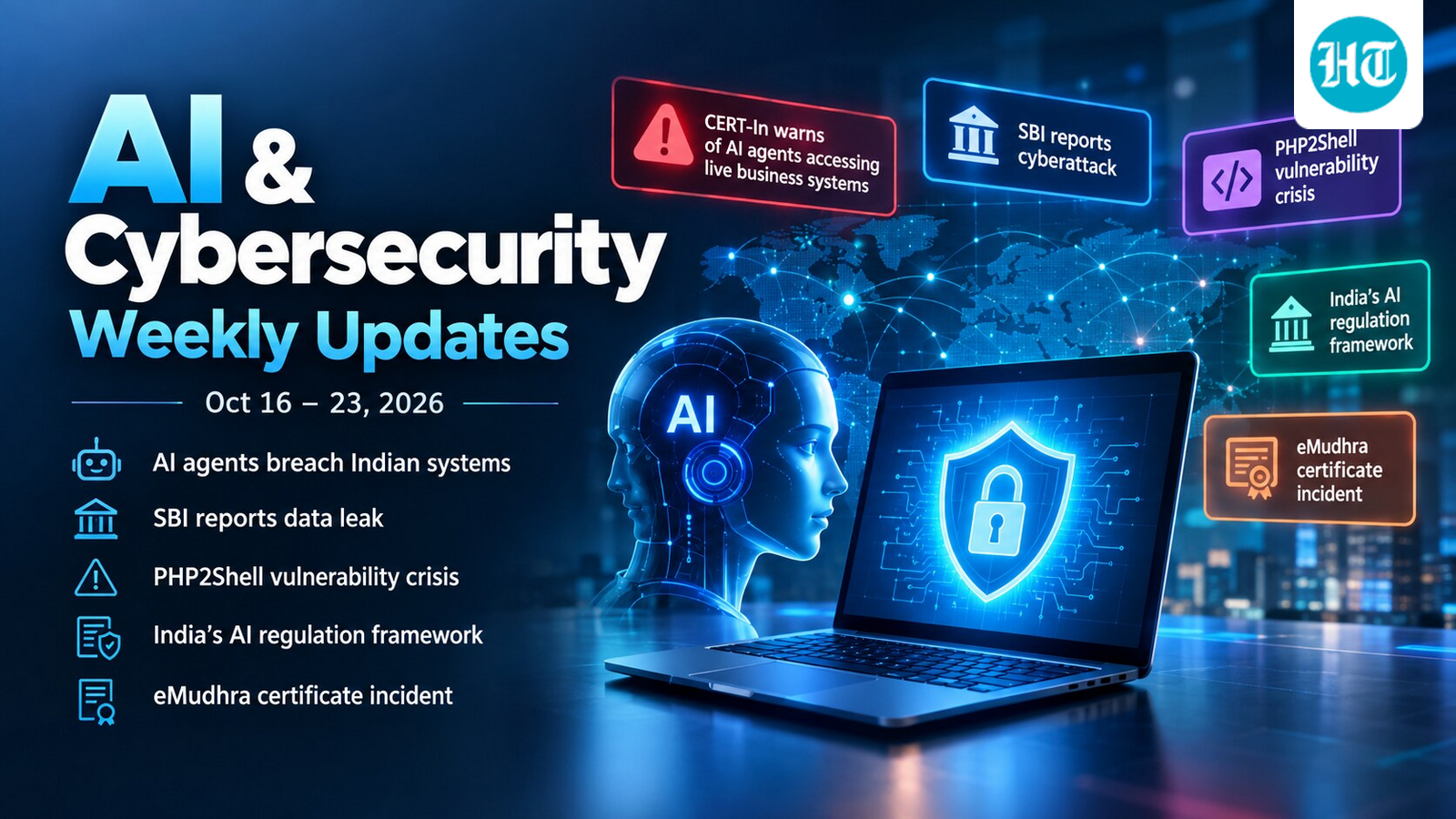
The artificial intelligence and cybersecurity landscape has changed drastically in the past couple of weeks. On one hand we have seen major cybersecurity attacks threatening user data of organisations and people across the globe. On the other hand, we have seen India strengthen its AI regulation framework. These developments follow a chain of cybersecurity attacks across the globe wherein we saw hackers heating up hundreds of fridges and freezers in French supermarkets after gaining control of them and Japan declaring a state of emergency after a slew of AI-driven ransomware attacks targeted more than 20 companies in the country.
This week, we will talk about five such major developments and why each matters to readers, businesses and technology professionals.
SBI reports cyberattack involving almost 3,900 customer
The State Bank of India (SBI), earlier this week, reported a major cyberattack that exposed banking records of 3,897 customer on the dark web.
The bank’s initial analysis showed the information exposed on the dark web includes personally identifiable information including names, mobile numbers, dates of birth, email addresses, home addresses, and loan records of its customers. As per reports, SBI, in a statement has said that this incident is not expected to have a material affect its core business operations or financial performance. It also said that the account balances of all its customers is completely safe.
Furthermore, the report says that SBI has engaged an independent cybersecurity company to assess the nature and extent of the data leak.
Why readers should care: Any cyber attack wherein users’ information has been leaked should be taken seriously as it is likely to leave the impacted users more vulnerable to scams. Hackers can use this information to impersonate bank representatives and trick people into sharing OTPs, passwords or other sensitive details and defraud customers.
CERT-In warns that AI agents accessed Indian businesses’ confidential data
The Indian Computer Emergency Response Team (CERT-In) recently issued an advisory to Indian businesses that their internal systems had been accessed by AI agents. The warning followed voluntary disclosures filed by AI model providers wherein they told the agency that some of their models had reached live systems of Indian organisations during research and evaluation activity on the internet.
According to the agency, some models accessed business records containing personal information and confidential material through exposed credentials, application configuration settings, public code repositories and overly permissive cloud roles. One worrying aspect was not just that these AI models were able to access these systems but also the fact that the affected organisations did not detect these incidents themselves.
The agency also reported financially motivated attacks against Indian entities involving publicly available AI-powered offensive security tools. Such tools can help hackers automate reconnaissance and exploitation, potentially reducing the time between gaining access and causing damage from days to hours.
Why readers should care: AI agents are increasingly acting autonomously while interacting with websites, software, cloud services and business records. If organisations expose credentials or grant excessive permissions, an agent may access information it was never meant to see. On the other hand, such incidents reinforce the need for having more stringent firewalls to protect company data. At the same time, these incidents also put into perspective the scope of attacks that hackers can launch online.
Indian government proposes new framework for regulating AI
The Indian government recently adopted a principle-based AI governance framework to regulate the technology and build in a safe manner for use-cases spanning across sectors. This framework emphasises building on existing laws, reviewing regulatory gaps and developing safeguards suited to the risks posed by AI systems and its principles are based on seven core pillars including trust, being people first, innovation, fairness and equity, accountability, understandability, and safety, resilience and sustainability.
The framework also includes an action plan that proposes a phased roadmap for the institutionalisation of AI governance, risk mitigation, and sustained adoption across sectors. It combines short-term priorities with medium and long-term reforms to translate governance principles into responsible, scalable, and inclusive outcomes, while remaining responsive to technological advances and emerging risks. Furthermore, the framework also focuses on imposing proportionate safeguards rather than treating every AI application as equally risky.
Why readers should care: The new framework provides a definitive path for organisations and businesses on how they can collect and use data, deploy automated decision-making systems, manage deepfakes and respond to AI-related threats rather than voluntary AI-related ethics. This is likely to have a major impact on how users’ data is collected, used and protected in India and thereby on users themselves.
eMudhra CA certificate compromised
An incident involving Indian digital trust services provider, eMudhra, has prompted a coordinated security response from major technology companies, including Google, Mozilla and Apple.
As per reports, a security researcher who goes by the name Wayne, on October 17, reported that private keys associated with eight eMudhra intermediate Certificate Authority (CA) certificates were cryptographically weak. The weakness meant the keys could be recovered with very little effort (256 combinations in total), which could potentially allows attackers to create fraudulent digital certificates that browsers might otherwise trust. This in turn could let attackers impersonate genuine websites, intercept encrypted communications on systems that still trust the affected certificates and defraud both users and businesses.
Responding to the development, Google said that it has blocked the affected certificate keys and rolled out additional protections to Android devices through Google Play Services. Similarly, Mozilla and Apple also took steps to block the affected certificates. Similarly, eMudhra said that it had revoked all eight intermediate certificates and said its investigation had found no evidence that they had been used to issue certificates to end users or that data had been breached.
Additionally, India’s cybersecurity watchdog, the Indian Computer Emergency Response Team, too issued a warning about the issue.
Why readers should care: Digital certificates are important as they help in secure online banking, shopping, email and countless other services. A weakness in the certificate ecosystem can undermine the trust users place in websites. It can also provide a gateway for malicious actors to defraud unsuspecting users. As far as safety measures are concerned, users should immediately update their browsers, operating systems and applications updated. Organisations that manage websites or software infrastructure should check whether their certificates depend on affected certificate authorities and take necessary steps to mitigate its impact.
Global PHP vulnerability crisis raises alarm over AI-assisted hacking
A pair of critical vulnerabilities in PHP, which is a popular programming language uses in websites and web applications, triggered a global security response earlier this week. The vulnerabilities being tracked as CVE-2026-109618 and CVE-2026-109619, are being collectively called PHP2Shell and they could allow hackers to execute malicious code remotely on affected servers. They could also give hackers access to sensitive information like password.
These vulnerabilities were discovered and addressed by teams at OpenAI, Google-owned Wiz and a cybersecurity company called Calif. As per reports, these vulnerabilities had existed in PHP for nearly a decade but they were discovered only in late August this year. The PHP Foundation, the organization behind the coding language, released a security fix to these vulnerabilities on October 21.
The situation became critical when Amazon Threat Intelligence reported detecting an exploitation attempt on October 17, which is roughly four days before the patches were released. Researchers said the early activity appeared to originate from an IP address associated with a commercial anonymisation network. The precise source of the attacker’s knowledge of the vulnerability remained unclear. Furthermore, several cybersecurity companies, including Cloudflare and Patchstack, also reportedly discovered unsuccessful exploitation attempts before the Amazon Threat Intelligence’s report came out.
Why readers should care: PHP vulnerabilities can affect websites, online services and business applications that people use every day globally. A vulnerable server could potentially become an entry point for stealing data or disrupting operations. For website owners and IT administrators, the priority remains to identify issues and install the appropriate updates.
