






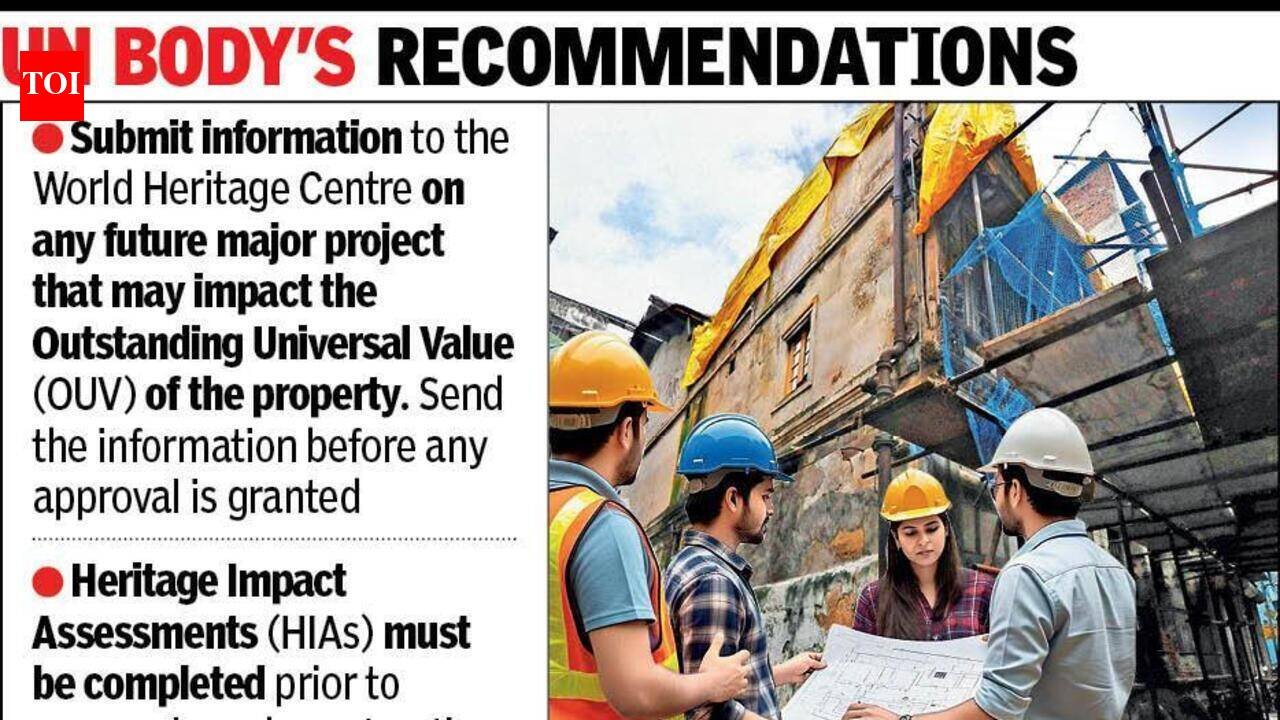
Ahmedabad: Unesco has issued an urgent advisory that Ahmedabad must heed to safeguard its Heritage City status: constructions taller than 15 metres must not be permitted in Old City.A two-member Unesco delegation visited Ahmedabad from March 16 to 23 to assess the impact of several infrastructure projects on living heritage.The projects are Kalupur Railway Station redevelopment, Danapith multi-level parking, and Geeta Mandir bus terminal. All these fall within the buffer zone of Old City’s heritage area.On Tuesday, Unesco released its 68-page inspection report. The UN body has suggested that Ahmedabad amend Comprehensive General Development Control Regulations in line with the advisory.Unesco’s ‘Report on the joint World Heritage Centre/ICOMOS Reactive Monitoring mission to the World Heritage property Historic City of Ahmedabad (India)’ has raised questions on the height of structures at the three project sites.An AMC official stated: “Kalupur Railway Station redevelopment project is being executed within the buffer zone of Ahmedabad’s heritage area.” AMC had suggested several modifications to project, the official said. The changes have been implemented.“A non-listed heritage wall was damaged during work at Geeta Mandir bus station redevelopment site,” the official added. “Therefore, the site was assessed as well.”The Unesco team also assessed development work on a heritage walk route in Old City. Officials associated with the initiative said it aligns with long-term planning, with the city expecting an increase in footfall for global events such as the Commonwealth Games in 2030. The city is also vying to host the Olympics in 2036.The Unesco team has advised Ahmedabad to conduct a Heritage Impact Assessment (HIA) before approving new constructions in Old City. The advice has been followed.Furthermore, the report recommended developing all the streets within the Old City area.Over the past year, Unesco has praised AMC’s effort to preserve and renovate heritage homes in Old City and welcomed the provision of TDR (Transferable Development Rights) granted for repairs and maintenance of heritage homes.The AMC official said: “The civic body had decided to formulate a Tourism Management Plan and a Heritage Conservation Plan (Local Area Plan) for Ahmedabad.” However, the plans have not been finalised. So, the Unesco team has urgently called for the finalisation of both the plans, the official said.“Plans to organise heritage-themed cultural programmes and heritage exhibitions have not been implemented,” the official said. “The Heritage Centre to train artisans in heritage conservation has not materialised either.”Sources reveal that World Heritage City Trust, managed by AMC, did not implement any concrete projects for the development of heritage buildings.Unesco designated Ahmedabad as a World Heritage City on July 8, 2017. Following this, the AMC made various announcements and allocated crores of rupees to promote the city’s World Heritage City status. But many of the projects were not implemented.Over the past nine years, the corporation has approved the renovation of about 200 heritage houses in the old city area, with work being completed on more than 100 of them.When the Unesco monitoring team concluded its high-stakes audit of Ahmedabad, it left local authorities with a pointed inquiry into the preservation of the city’s living heritage.According to civic sources, during their final rounds, the Unesco experts also sought details from the AMC on the current status of the historical underground water tankas —centuries-old infrastructure buried beneath the city’s dense Pol neighbourhoods.BOXUN body’s recommendationsSubmit information to the World Heritage Centre on any future major project that may impact the Outstanding Universal Value (OUV) of the property. Send the information before any approval is grantedHeritage Impact Assessments (HIAs) must be completed prior to approvals and construction.These assessments must include a comprehensive evaluation of all heritage impacts, with clearly outlined associated mitigation recommendationsOrganise training programmes in HIA preparation for AMC staff, universities, consultants, and stakeholders involved in the conservation, management, and utilisation of the property in questionSurvey and identify areas of a property where planning and design constraints may be more flexible while still ensuring OUV protectionThis could include new development sites, which do not embody any heritage values (either tangible or intangible)This would identify areas with capacity for change suitable for renewal and redevelopmentHowever, the maximum height of 15 metres should still apply to the property


