



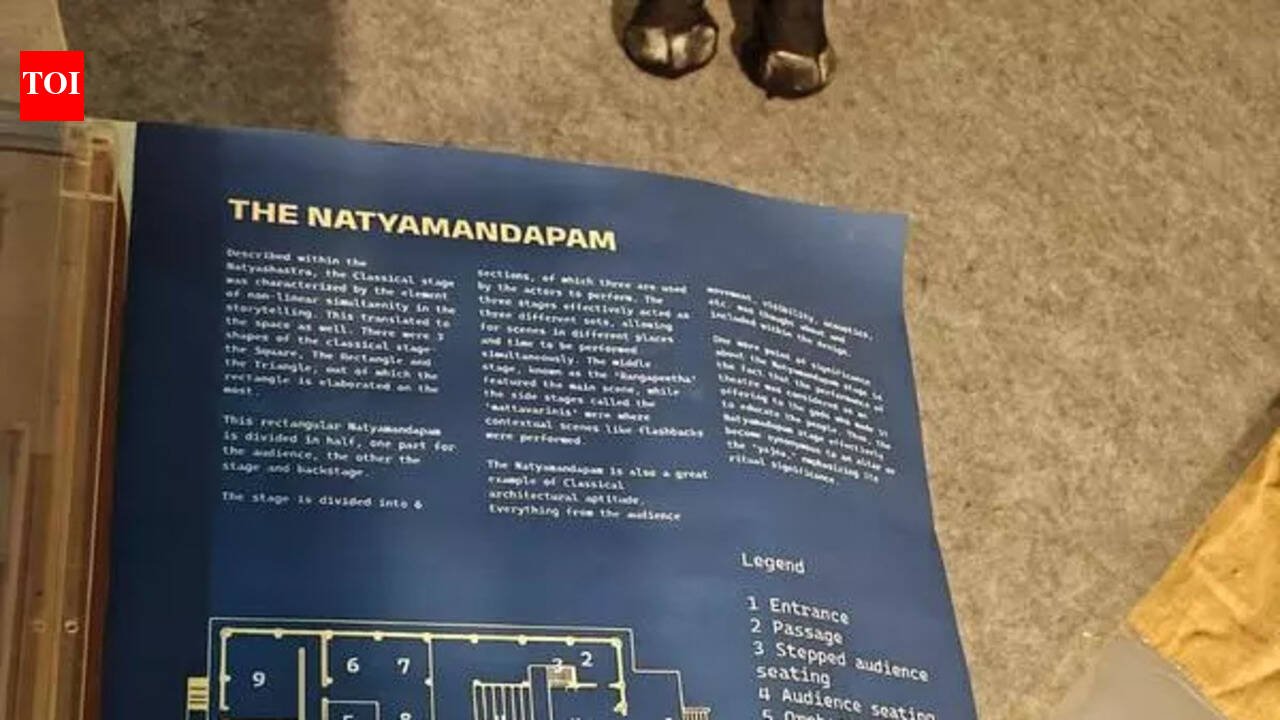
SLUG: World Theatre DayAhmedabad: The audience is seated in a row. The performance space, the proscenium, is covered behind a curtain. After a call, actors use the space to tell their tale – this is how the stage is imagined. But since ancient times, it was not the case, argues city-based theatre actor-director and architect Manvita Baradi. Daughter of acclaimed theatre scholar, the late Hasmukh Baradi, she is helming the ‘All About Natak’ theatre festival at Theatre and Media Centre (TMC) which began on March 21 and will run till March 29. “Idea of the exhibition is to talk about performances taking different shapes over different times and geographies.”“If we look at natyashastra to understand how our ancestors saw theatre as performance space, it was very different. We have tried to recreate it in the form of a model. In the scriptures, it is described as having space of 16 x 32 hastas,” she says.Curating the festival is celebrated actor and director M K Raina. He tells TOI that people are finding different ways to tell their tales. “The collaboration started with Hasmukh Baradi, and culminated in various workshops. I have also directed one of his plays, ‘Ekalu Akash’, for the festival,” he adds. “Several experiments are done in the form, and my only wish is that it should not be an elitist pursuit, and should reach the districts and talukas.” Rana says the festival is dedicated to the memory of Rajoo Barot, his junior at NSD and a good friend. Manvita talks of another interesting design is of ‘Rachh’ by Raja Mansingh Tomar (1486-1516). It is a circular design where the audience sits in the periphery and the performance – mostly believed to be raas – takes place in the middle. Baradi says that practices such as Ram Leela of Ramnagar in Varanasi are still prevalent, where an entire district is converted into a performance space for different scenes of Ramayana.


