



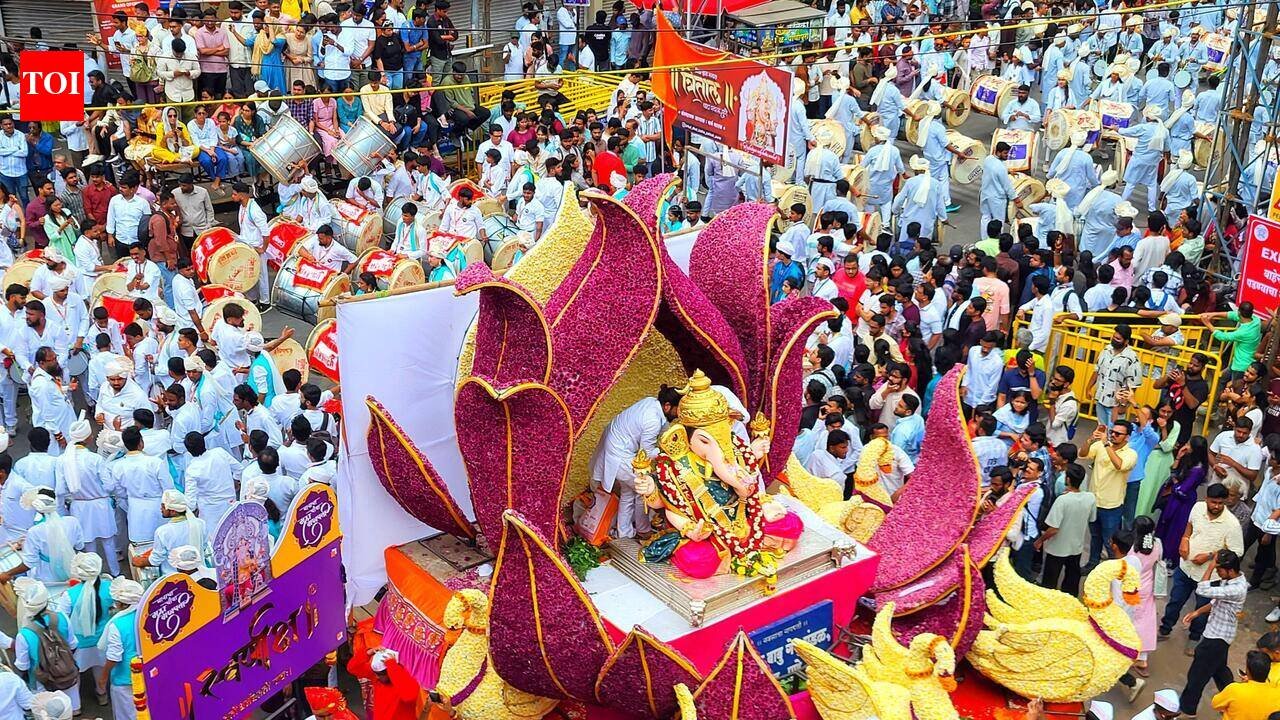
Pune: For a city that spent the last fortnight on heated debates and social media reel wars on noise during festivals, Pune began Ganeshotsav with some restraint.Maharashtra Pollution Control Board officials and the Pune police monitored noise levels across the city on Monday evening. The readings at multiple mandals showed levels above 65dB, slightly over the normal limit in residential areas till 10pm.“Most of the recorded noise is also ambient noise, which includes background noise, traffic, etc. Compared to last year, noise levels across the city on day 1 are much less,” the MPCB official said.Earlier on Monday, when the five revered Ganesha idols moved through the old city in grand processions and hundreds of idols were brought to the pandals in other areas, traditional dhol-tasha was preferred over the din of artificial sound systems.Activists campaigning for decades said years of talks, arguments, court orders and public campaigns may have finally begun to alter public sentiment towards the noise, forcing organisers themselves to consider moderating the volumes.Others differed and said the noise of dhol-tashas was equally high. Activists said only the visarjan days, when the idols are taken in processions for immersion, especially Ananta Chaturdashi, the last day, would show whether Pune has truly learnt not to be deafening.Lawyer Maitreya Ghorpade, who petitioned the NGT on behalf of Kalyani Mandke seeking strict adherence to noise pollution norms, said that in the latest order on Sept 10, the tribunal has reaffirmed that noise control norms in silent zones such as hospitals, schools, etc., notified by civic bodies across the state need to be strictly adhered to, and the police were told to enforce this rule without fail.MPCB, which outsourced the noise mapping exercise to a private agency, uses college students as field agents to get the readings from mandals across the city. A faculty member from Fergusson College said that around 40 of his students are involved in the exercise. “The mapping starts at 6pm on Day 1 for our students and will continue at regular intervals on all 12 days of Ganeshotsav,” he added.Shweta Vernekar, programme associate in Parisar, a Pune-based civil society organisation and NGO, said she observed a slight drop in the noise levels. “Though we have speakers playing songs, they are playing devotional ones and it is not deafening. All the awareness about noise pollution has finally sunk into the psyche of people. But these are early days. Actual noise is on visarjan days,” Vernekar added.More pandals using traditional dhol-tasha troupes rather than loudspeakers are related to sponsorships. Businessman Punit Balan, who sponsors many social and cultural events in the city, announced last year that he would not back mandals using DJs and Dolby systems.“This had an impact. Last year, when 50 mandals turned to traditional instruments, the mandals we sponsored were around 150. This year, the number rose to 225 or 230. This means less noise pollution. Unlike a music system, which is a machine that blares noise for hours, dhol-tasha pathaks have only 50 people. The noise it can produce is limited, and so are the hours these people can play. Hence, there is an audible change in the noise levels this time,” Balan said.Vidyanand Bapat, who made noise during Ganeshotsav a topic of every conversation across the state, said that under the pretext of tradition, dhol-tasha troupes are producing equally high noise.He said he did not find any reduction in noise in the morning hours in the Peth areas. “There were no DJ speakers that I could discern, but the noise was high. Buildings are packed together and noise gets trapped and echoes. When multiple troupes play, the cumulative effect augments the noise and it is unbearable for residents. Dhol-tasha troupes were used in open lands, especially during wars. Festivals cannot be an excuse to make noise. I don’t see any voluntary restraint among mandals to reduce the noise. They don’t realize it is detrimental to people. Hence, voluntary restraint is impossible for them. Only force can make them adhere to the rules,” Bapat said.
