


Millinocket, Maine, was once a quintessential company town built around the paper industry. For generations, the Great Northern Paper Company provided jobs, stability and a sense of community to thousands of residents. But when the mill shut down in 2008, the impact went far beyond job losses, changing the town’s economy, population and identity.YouTuber Peter Santenello explored the town and its history in a recent episode on his Peter Santenello YouTube channel, meeting longtime residents and business owners to understand what happened to the community after the mill’s closure.
A town built around the paper mill
Santenello met Dick, a longtime Millinocket resident who was closely associated with the paper mill and was involved when it eventually shut down. As he took Santenello through the former mill property, Dick recalled how deeply the company was woven into everyday life.According to Dick, Great Northern Paper Company owned virtually all the real estate in the town at one point. The company helped employees build homes by providing labour for foundations and other construction work.“When the company left, it was deeded over,” Dick explained during Santenello’s tour.The relationship between the company and the community extended beyond housing. The paper company was also a major taxpayer and supported local institutions, including schools.Dick recalled that his wife, who trained as a teacher, eventually secured a teaching position in Millinocket that was among the highest-paid teaching jobs in Maine at the time.“The paper company was the majority taxpayer, and they didn’t hesitate if the school needed something,” he told Santenello.
‘It took the life out of everybody in town’
Locals remember the jobs, community and stability that Great Northern Paper Company brought to Millinocket.
The most painful memories, however, remain tied to the mill’s closure.Dick recalled being told that the mill would remain open if workers could demonstrate profitability for two months. According to his account, employees worked hard to meet that target and succeeded.“We busted our tails to keep it operating and make a profit,” Dick said.He recalled that the mill showed a profit in both months, with the second month being particularly strong. Yet, in September, workers were told the operation would close.“Corporate said that they didn’t feel that we could sustain that profitability,” Dick recalled.The closure, he said, “took the life out of everybody in town.”The former mill worker also suggested that competition with Fraser Paper in Madawaska may have played a role, although he acknowledged that this was the explanation workers could make sense of at the time.
‘This was my life’
Walking through the abandoned mill appeared to be particularly emotional for Dick.“This was my life,” he told Santenello while looking at the machinery he had worked around for decades.He recalled spending long hours monitoring the machinery and supervising shutdowns, sometimes walking miles around the enormous paper machine to check on crews.“I loved my job. I loved the people I worked with,” he said.For Dick, the people were ultimately what made the work meaningful.“The job is a job. The people make the job,” he said.He also became emotional while looking at the walls inside the mill, reflecting on generations of his family who had worked there.“You look at this wall and you say, my father could have touched this wall. My grandfather could have touched this wall,” he said.
From ‘Magic City’ to a tourism economy
From a paper industry powerhouse to a tourism destination, Millinocket is navigating an uncertain new chapter.
Millinocket was once known as the “Magic City” because, as Dick explained, it essentially grew out of the woods around the paper industry.“Everybody had something to do in Millinocket,” he said.Today, however, the town is increasingly turning toward tourism and outdoor recreation. Its proximity to Mount Katahdin and the Appalachian Trail has helped attract hikers, seasonal residents and outdoor enthusiasts.But Dick believes tourism alone cannot replace the kind of wages and economic stability provided by manufacturing.“You need them both. People have to recreate. But people have to earn a living too,” he told Santenello.“And you have to have a balance.”
A shrinking school, but a strong community
The scale of Millinocket’s decline is visible in its schools. Dick recalled that his graduating class had around 356 students. By comparison, he estimated that the graduating class in 2026 had just 35 students.Yet the town still retains a strong sense of community.Millinocket’s football team won a state championship, providing an unexpected boost to local morale.“The houses in town are just houses. They’re just a structure. It’s the people,” Dick said. “The people are what really makes the difference.”
Small businesses are keeping the town alive
Santenello also spoke with local business owners, including Jamie, who runs a company producing products from reclaimed wood.Jamie explained that the business employs around 20 people and sells products outside Millinocket, including through Amazon, because the local population alone cannot support a large customer base.He also acknowledged the enormous economic hole left by the mill.“The mill brought in hundreds of jobs. We don’t have anything that’s replaced that,” Jamie said.Another local resident, electrician Joe, told Santenello that he had worked at the mill before its closure. After being laid off at the age of 48, he went back to college and trained as an electrician, with his education paid for through assistance available to displaced workers.His story reflects one of the ways former mill workers adapted after the industry’s collapse.
‘We’re an analog stronghold in the digital world’
Santenello also visited the Blue Ox Saloon, a longtime downtown business whose history is intertwined with Millinocket.Owner Andrew explained that his father bought the building in 1988 when it was condemned and spent years rebuilding it before opening the bar in 1994.The business once benefited from the thousands of workers employed by the mill. Andrew recalled that when his father opened the establishment, there were seven bars along the same street and the Blue Ox could have customers lined up outside.Today, business is considerably different, but his family has no intention of giving up.“I’ll never give up,” Andrew told Santenello.He described the town as being in a difficult transition, while expressing hope that a new generation could help revive it.
‘It’s the loss of a dream’
Santenello’s conversation with Andrew offered perhaps the clearest description of Millinocket’s psychological struggle.The town, he observed, was created around the mill and grew because of it. When the mill disappeared, the community was left grieving not simply an industry but an entire way of life.“It’s the loss of a dream. A loss of a life unlived,” Andrew said.At the same time, he believes the town’s resilience could eventually lead to a revival.“There’s young energy coming in,” he said, pointing to efforts to renovate parts of downtown.
A community waiting for its next chapter
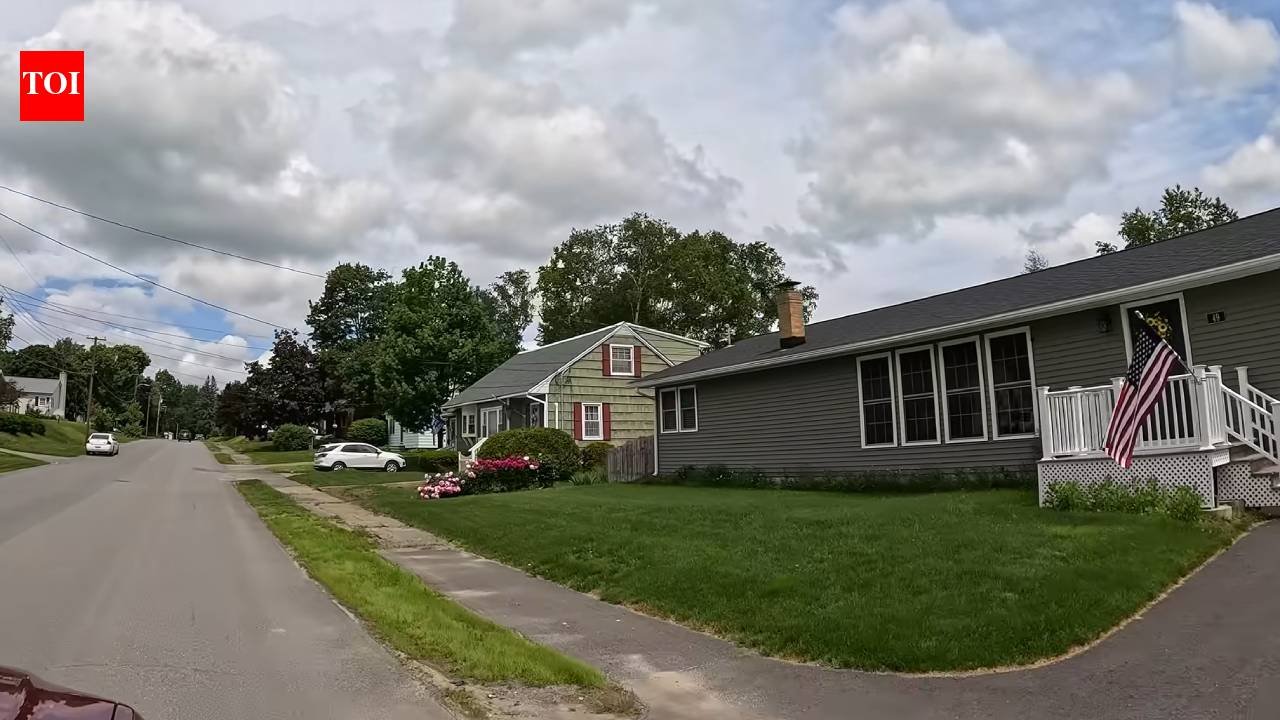
While walking through Millinocket, Santenello observed the contrast between vacant buildings, renovated properties, small businesses and homes that residents continue to maintain.There are also hopes for new industry. Residents mentioned the possibility of developments including a salmon farm, while the nonprofit Our Katahdin is working toward finding new uses for the former mill site.But for many residents, the future remains uncertain.As Dick put it, tourism can bring visitors and economic activity, but it cannot necessarily replace the high-paying manufacturing jobs that once supported generations of families.“If you don’t have that balance, you’re gonna have just a community pass-through where people come to recreate and leave,” he said.Santenello ended his visit reflecting on Millinocket’s unusual combination of decline, nostalgia and resilience.“Interesting past, unknown future, great people we met today,” he said at the conclusion of his video.For a town once built around paper, Millinocket is now searching for what comes next.
