


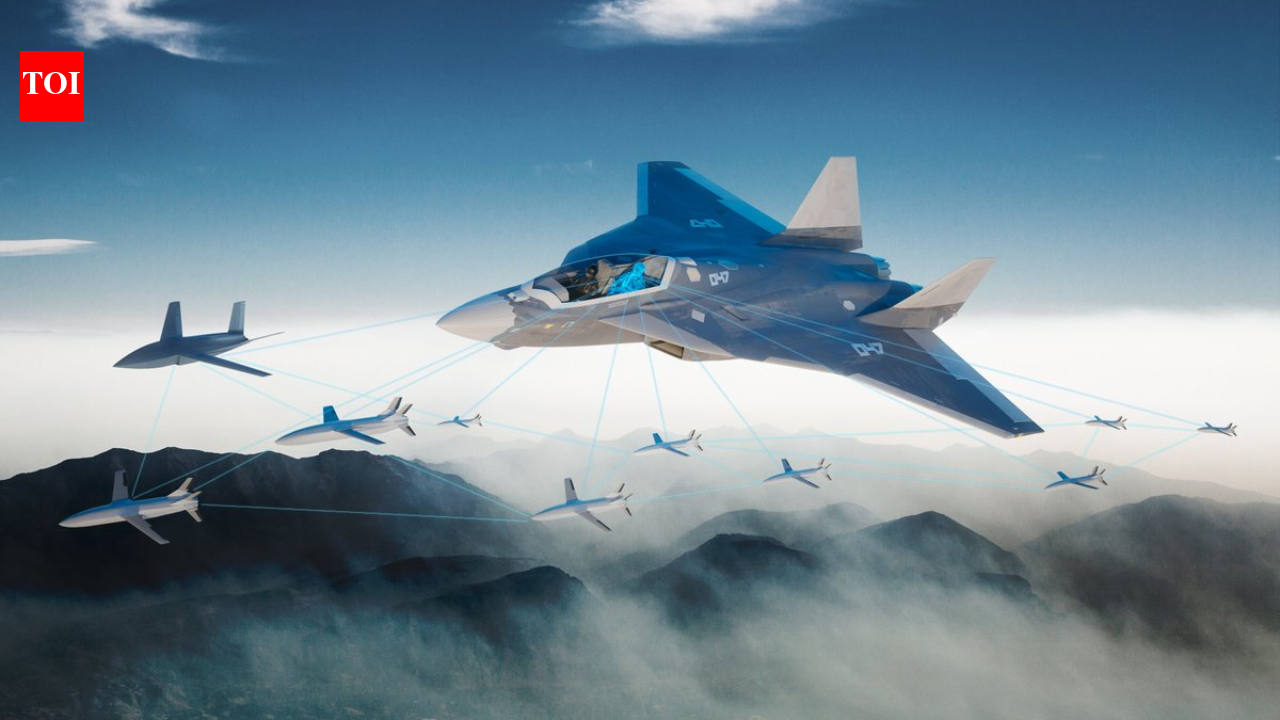
The Future Combat Air System (FCAS) may very well become India’s sixth-generation fighter aircraft. The ministry of defence informed Parliament in a written response that India is in talks with France to co-join the programme that is now spearheaded by France.This development takes place just two months after Germany left the programme, which also has Spain as a partner. The aircraft, which is still on the drawing board, is expected to have its first flight in 2028-29 timeframe. India’s fifth generation Advanced Medium Combat Aircraft (AMCA) too is expected to have its first flight in the same time-frame.Prime Minister Narendra Modi’s meeting with French President Emmanuel Macron in Nice in June set the stage for a new chapter in India‑France defence cooperation, now elevated to the level of a Special Global Strategic Partnership. The discussions between the two leaders carried a strong emphasis on co‑design, co‑development, and co‑production of advanced defence platforms, with next‑generation technologies forming the core of this strategic convergence.The Franco‑German divergence reportedly arose from disagreements over carrier operability and nuclear delivery capabilities. These requirements remain central to French doctrine but are absent in Germany’s arsenal. India, however, possesses both capabilities, making its operational vision more compatible with France’s. This alignment strengthens the case for Indo‑French collaboration on a sixth‑generation fighter that can meet the demands of both nations while simultaneously advancing their defence industrial partnership. It is in this context that the ministry of defence has informed that efforts are being initiated to co‑join the FCAS programme spearheaded by France.Following the leaders’ meeting, foreign secretary Vikram Misri had underlined India’s intent to maximise local content and manufacturing in any future defence platform. He stated that while discussions covered a wide range of topics beyond the Rafale, co‑development must translate into maximising design, production and manufacturing within India. This reflects New Delhi’s broader push for self‑reliance in defence.Earlier in June, before PM Modi’s visit, Air Chief Marshal AP Singh visited France. His engagements with General Jérôme Bellanger, Chief of Staff of the French Air and Space Force, and leading defence firms such as Dassault Aviation, Thales, Safran, and MBDA highlighted the importance of this time tested strategic relationship.Sixth‑generation fighters represent a transformative leap beyond current fifth‑generation designs. They are expected to feature all‑aspect stealth shaping, digital‑first engineering, variable‑cycle engines, gallium nitride transistors for advanced radars, and directed‑energy weapons. Integrated artificial intelligence, cyber warfare tools, and manned‑unmanned teaming with loyal wingman drones will define their operational edge.Globally, the race for sixth‑generation airpower is intensifying. The United States is advancing its F‑47 under the Next Generation Air Dominance project alongside the Navy’s F/A‑XX, while China is testing prototypes designated J‑36 and J‑50. Against this backdrop, an India‑France sixth‑generation fighter programme would not only bolster both nations’ airpower but also position them as key players in shaping the future of aerial combat.Since the elevation of India‑France ties to a Strategic Partnership in 1998, cooperation has steadily expanded across defence, civil nuclear energy and space, while more recently branching into artificial intelligence and renewable energy. Defence remains the cornerstone, marked by milestones such as the delivery of 36 Rafale jets in 2022, commissioning of the sixth Scorpene submarine in 2025, and the agreement for 26 Rafale‑M aircraft for the Indian Navy with technology transfer. Industrial depth has been added through Safran’s Hyderabad‑based MRO centre inaugurated in 2025, capable of servicing 300 LEAP engines annually, with plans for an M88 engine shop, and Airbus’s H125 helicopter assembly line in Karnataka opened in 2026. India’s procurement of French systems dates back to the 1950s with the Dassault Ouragan, AMX‑13 tanks, Mystere fighters, Alize aircraft, Mirage‑2000s, and Chetak and Cheetah helicopters, cementing France as a longstanding defence partner.
