



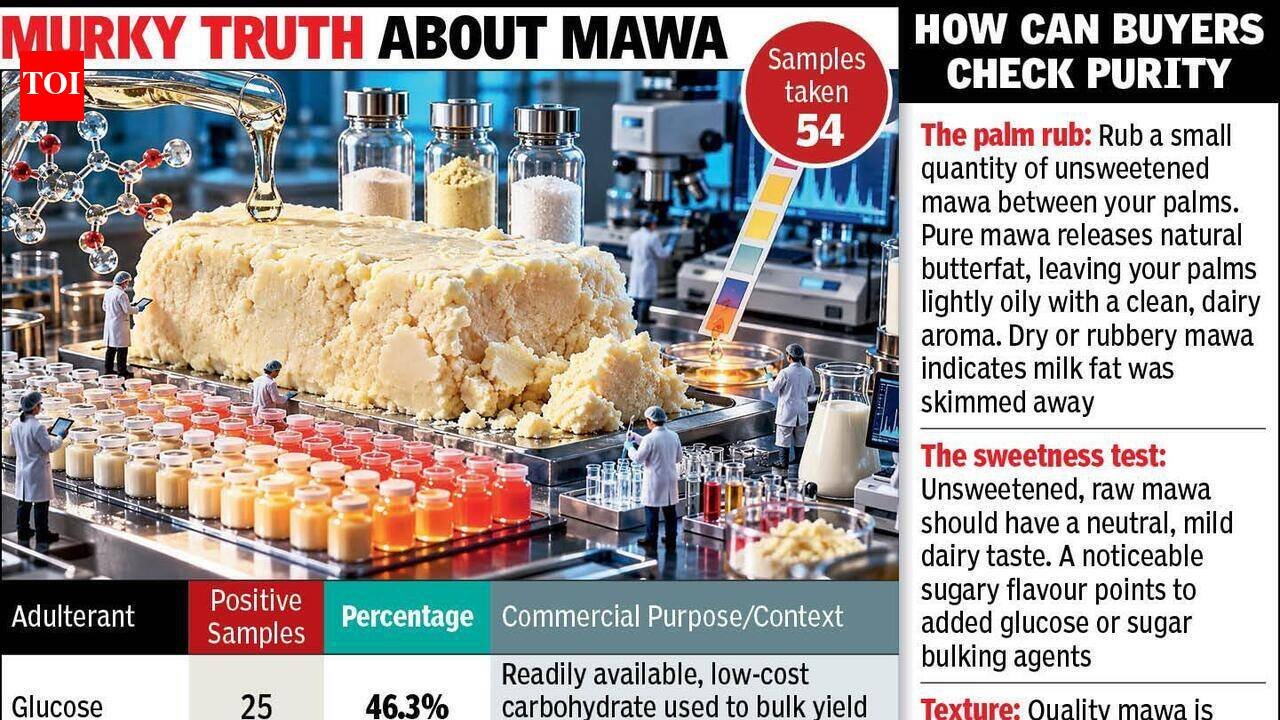
Ahmedabad: As Amdavadis celebrate Navratri and Diwali waits radiantly on the horizon, sweet shops across Ahmedabad are registering blockbuster sales, but concerns about adulteration are creeping onto the city’s festive platter.A new study has found that nearly half of the commercial mawa samples collected across central Gujarat contained added glucose, while several tested positive for chemical neutralisers and failed to meet minimum fat standards.The research, published in the Indian Journal of Animal Health, evaluated 54 market samples from across Anand, Ahmedabad, and Vadodara. While common adulterants such as starch and sucrose were rare, cheap glucose was detected in 25 of the 54 samples.Chemical neutralisers — substances added to mask acidity that builds up when milk is adulterated or stored improperly — were found in four samples.In Ahmedabad specifically, researchers analysed four markets’ mawa samples. Fat content across these samples ranged from 16.79% to 31.28% and moisture from 34.49% to 44.58% — significant variations for a product whose composition directly affects the quality and shelf life of sweets made from it.Across the full 54-sample study, fat levels ranged from 7.22% to 50.37%, reflecting widespread compositional inconsistency caused by varying milk sources — cow, buffalo, or mixed — and unstandardised boiling methods.Anand samples showed fat levels from 13.75% to 38.50%, with neutralisers detected in three samples. Two Vadodara samples showed the broadest compositional extremes: one contained both the lowest moisture in the study at 27.32% and the highest protein at 23.38%, while another recorded peak iron levels of 6.57 mg/100g alongside isolated presence of starch and sucrose.On regulatory compliance, the authors noted that “values of moisture content in all market mawa samples were below 45%” and all samples satisfied the requirement that mawa “should not contain more than 0.9 per cent titratable acidity” under Food Safety and Standards Authority of India (FSSAI) guidelines. However, several samples failed minimum fat thresholds.The research was conducted by a multi-institutional team including A I Shaikh and S C Parmar from the department of dairy chemistry at Sheth MC College of Dairy Science, Kamdhenu University (Anand), U Kumar (dairy chemistry division, ICAR-National Dairy Research Institute, Karnal), J Patel (Banas Dairy, Palanpur), alongside F A Pansuriya, IDMC, Anand, and J M Mallik of the department of dairy technology, College of Dairy Science, Kamdhenu University, Amreli.A senior AMC health department official said seasonal pressure was driving adulteration.
