



Sitting on a charpoy outside the house, Naushad Ali runs his finger across the revised electoral roll again and again. His name is there, so is his wife’s. What is missing from the list is his son Raju, who works at a hotel in Kerala.
The 60-year-old farmer pointed out that his son had voted in the 2024 general elections before leaving for Kochi.
“Now his name has suddenly been deleted from the rolls. If the father is in the list and the son is not, what are they trying to prove?” Ali posed.
In Murshidabad, where politics has long spun around religion, migration and identity, the 2026 assembly election has become a battle between a name and a blank space.
The district, which has the highest proportion of Muslims in Bengal, has also recorded the state’s third-largest deletions under the Special Intensive Revision. More than 7.48 lakh names have been struck off the rolls.
Nowhere is the shock sharper than in Samserganj, where nearly 92,000 names have disappeared from the rolls, the highest for any constituency in Bengal. Before the revision, Samserganj had 2,48,412 voters. It now has 1.56 lakh.The neighbouring Lalgola has seen the second-highest number of deletions in the state, with nearly 68,500 names removed from the rolls.
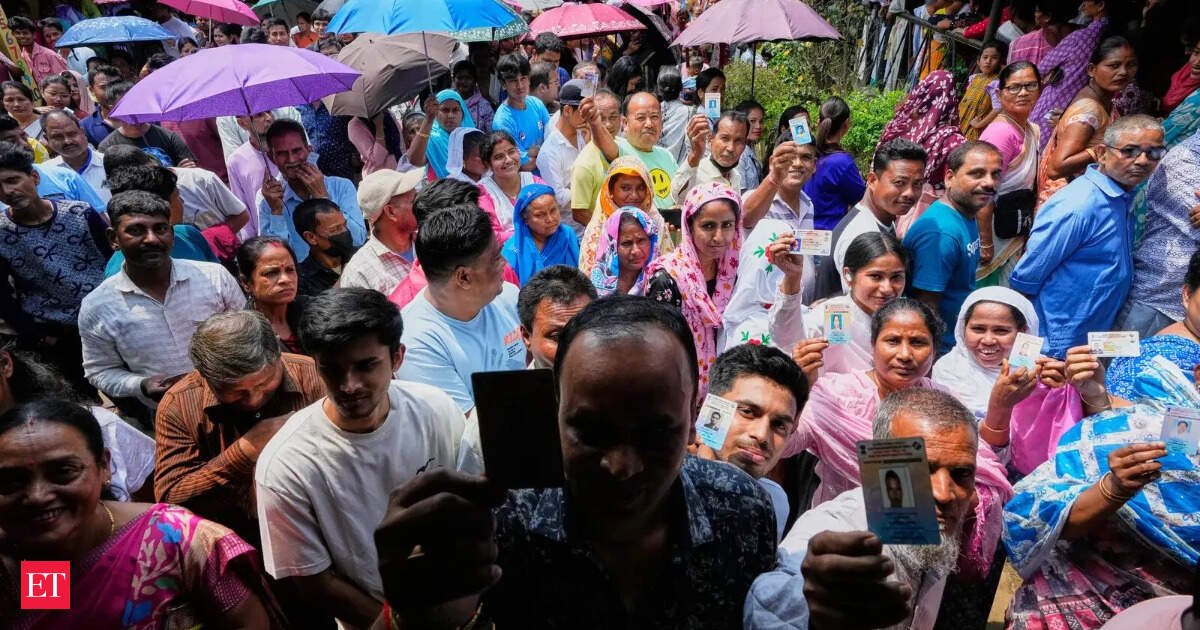
In tea stalls, outside mosques, and at crowded photocopy shops, people are no longer asking who will win Murshidabad. They are asking whether they will still exist on the electoral rolls when Bengal votes.
In Pratapganj, which has around 3,500 voters across three booths, nearly 2,500 names have been deleted. Residents claim almost all are Muslims.
Seventy-five-year-old Amelia Bibi sat outside her house holding an EPIC card wrapped in plastic.
“I have voted since the 1977 elections, after the Emergency. I voted when Indira Gandhi lost, when Jyoti Basu ruled and when Mamata Banerjee came,” she said. “Now they say my name is not there. At this age, will they call me a Bangladeshi?”
A few kilometres away, in Lalgola’s Kalmegha village, 22-year-old first-time voter Sefat Ali discovered that his elder brother remained on the list while his own name had vanished. “I was born and brought up here, but now they are asking me to prove I belong here,” he said.
Across Samserganj and Lalgola, families are opening old trunks and tin boxes, carrying bundles of photocopies — voter slips, school certificates, ration cards, electricity bills and land deeds.
The fear is no longer only of losing a vote. It is of being told that one does not belong.
The scale of the deletions has transformed what should have been a dry bureaucratic exercise into perhaps the sharpest political fault-line before the 2026 election.
For the TMC, it is proof of their allegation that the BJP was trying to achieve through electoral rolls what it failed to attain through votes — “a silent NRC in Bengal’s Muslim belt”.
For the BJP, it is evidence that years of “bogus voting and illegal infiltration” were finally being corrected.
Between the two claims lies Murshidabad, where entire villages are now discussing not who will win the election, but who will be eligible to vote in it.
The controversy is especially explosive because of where it is unfolding.
Samserganj and Lalgola are Muslim-dominated border seats in Murshidabad, a district where minority voters determine the poll outcome in constituencies such as Suti, Samserganj, Lalgola, Rejinagar, Hariharpara and Beldanga.
In many of these seats, a swing of even 10,000 to 15,000 votes can alter the result. In Samserganj alone, the number of deleted names is nearly five times the victory margin in the last assembly election.
Political parties privately admit that if the deletions remain, the electoral map of Murshidabad could look dramatically different in 2026.
The BJP argues that the abnormal growth in the voter list was fuelled by illegal migrants from Bangladesh. Between 2011 and 2016, more than 41,000 voters were added in Samserganj. Between 2016 and 2021, another 41,000 were added.
“For years, the TMC protected fake voters because they wanted votes, not verification. Now, when the list is being cleaned, they are crying conspiracy. Genuine citizens have nothing to fear. But those who entered illegally and remained on the rolls through political patronage cannot stay forever,” Samserganj BJP leader Shashi Charan Ghosh said.
Murshidabad MP Abu Taher Khan accused the BJP of “implementing NRC through the back door”.
“This is political targeting. Look at the names disappearing — from Muslim villages, poor people, women and migrant families whose sons work outside Bengal. The BJP knows it cannot defeat us politically in Murshidabad, so it wants to delete voters before the election itself,” he said.
Khan alleged that the deletions were concentrated in areas where the TMC had secured massive leads in 2021.
The Congress is trying to occupy the middle ground.
Senior Congress leader Adhir Ranjan Chowdhury said both the BJP and the TMC were feeding off the controversy. “The BJP wants to turn every Muslim into a suspect. The TMC wants to turn every deletion into panic. Both sides are doing politics over fear,” he said.
But on the ground, the issue is no longer merely administrative. It is rapidly becoming electoral.
The TMC senses that the deletions may help it consolidate Muslim voters by campaigning on the identity plank. The BJP believes that if the election becomes a debate over infiltration and bogus voters, Hindu voters may back it more sharply.
The electoral battle is no longer only over who should govern Bengal. It is over a larger and more unsettling question that may define the 2026 election itself: who gets to decide who is a citizen, and whose name deserves to remain on the voter list.


