



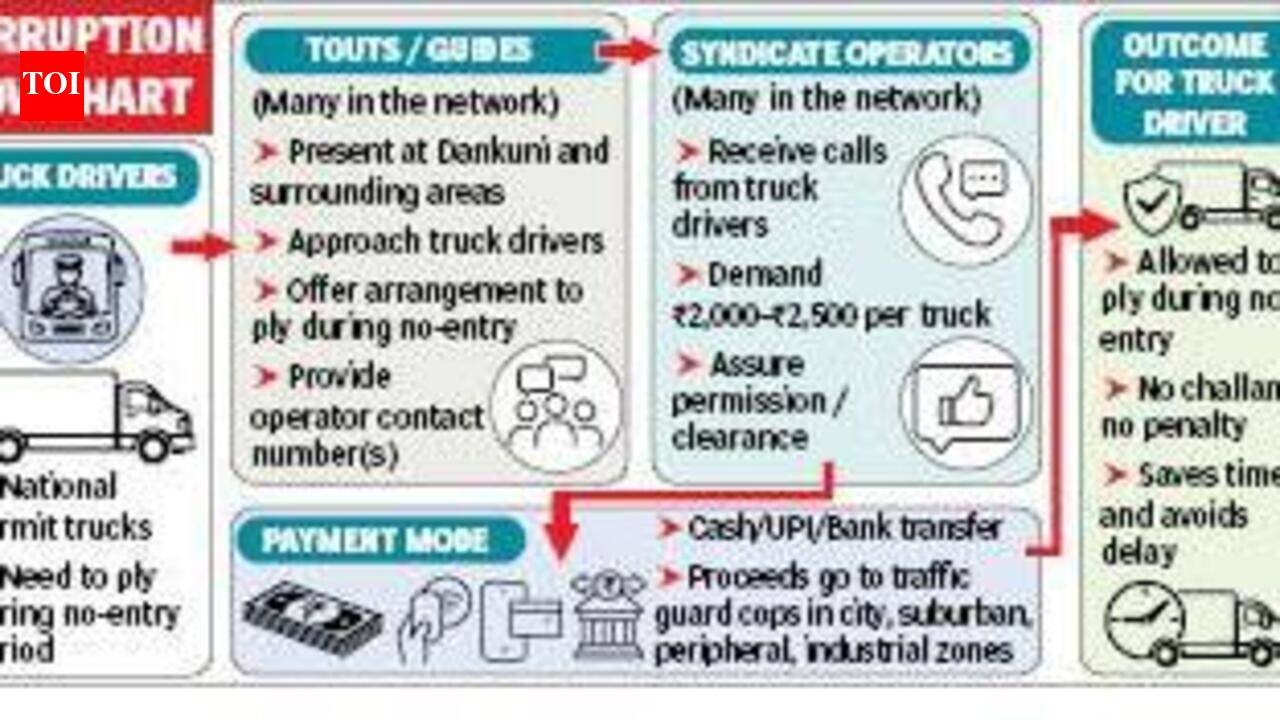
Kolkata: The Anti-Corruption Branch (ACB) has published an “elaborate corruption flowchart” that lays bare an organised decade-old extortion syndicate that was operational from the Dankuni truck terminal, involving multiple cops from traffic guards spread across Kolkata, Bidhannagar, Baruipur and Howrah commissionarates, that illegally collect extortion money from truck drivers.Once the extortion money, ranging between Rs 2,000 to Rs 2,500, was paid through UPI, truck drivers were allowed to ply unrestricted in no-entry periods, escape fines and “even get protection” from legal hassles at multiple checkpoints, said ACB official Akash Magharia. The racket also covered private and commercial vehicle drivers in exchange for allowing them to violate traffic rules.ACB has arrested a man, Sanjib, for allegedly leading this syndicate. Sanjib was caught red-handed during a targeted trap operation while accepting an extortion payment through UPI mode. According to officials, Sanjib operated as a key middleman collecting illegal payments on behalf of “corrupt” traffic guard officers.The ACB has now expanded its probe to identify and prosecute all complicit traffic guard officers, touts, and sub-operators involved in the racket.Investigators revealed that the syndicate targeted commercial vehicles entering the region, particularly around the Dankuni truck terminal, using a systematic, multi-tiered process. First, a network of local touts and guides stationed in and around Dankuni approached incoming truck drivers, offering to arrange smooth passage during restricted “no-entry” periods and handing over the contact details of syndicate operators.When drivers called these numbers, operators demanded fixed bribes ranging between Rs 2,000 and Rs 2,500 per truck, providing firm assurances that the vehicles would receive clearance to travel without cop interference. The money was collected through various payment channels, including cash, direct UPI transactions, and online bank transfers.The illicit proceeds were then distributed among complicit traffic guard officers stationed across city, suburban, peripheral, and industrial zones. In return for their cut, the officers allowed the paying vehicles to travel freely during restricted hours, deliberately refraining from issuing official challans or imposing fines while providing protection at police checkpoints..


