




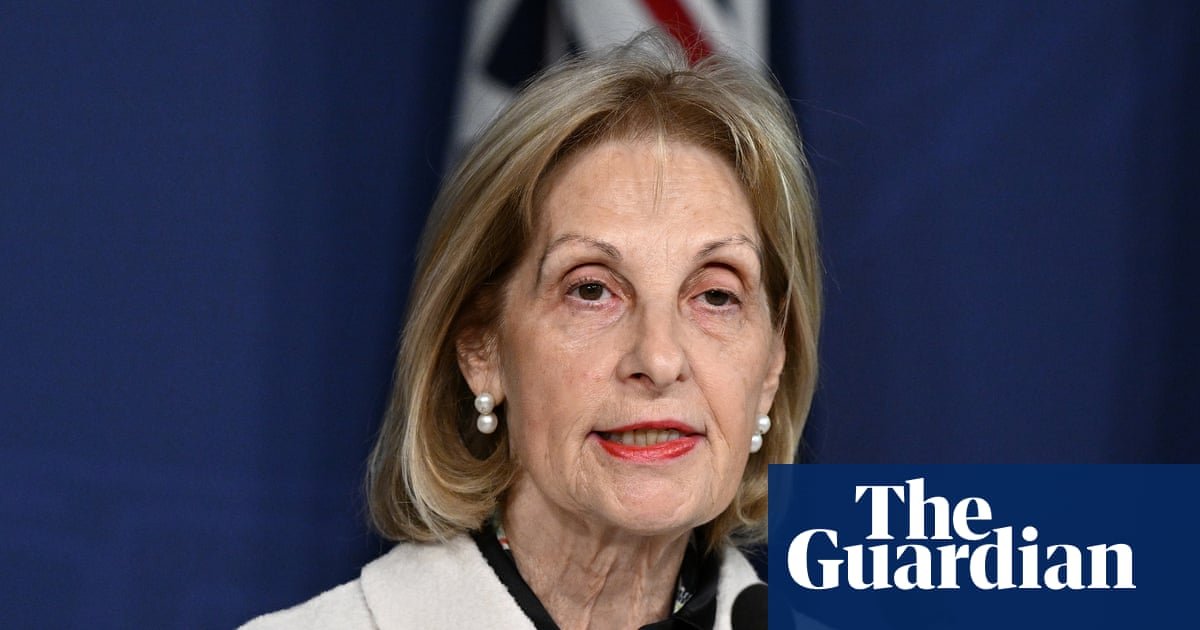
The antisemitism envoy, Jillian Segal, wants a new “oversight” committee to vet the ABC and SBS’s Israel coverage, she told the royal commission on Thursday morning.
Both the ABC and SBS have an independent ombudsman to handle complaints.
Segal said a committee outside the organisation should have oversight and that there was a “common and pervasive perception” in the Jewish community that the public broadcasters’ coverage of the war in the Middle East “lacked balance”, that there was an overemphasis on Gaza compared with other conflicts, and that the coverage gave disproportionate voice to anti-Israel perspectives.
“It’s the perception of the Jewish community feeling constantly that they are being faced with reporting about the Middle East, about Gaza and about Israel in a way that paints Israel constantly in a negative light,” Segal said.
Anti-Israel perspectives were those that are critical of Israel’s actions, she said.
The ABC editorial director, Gavin Fang, disagreed with the claim the coverage was disproportionate.
He told the inquiry that the national broadcaster had covered the rise in antisemitism, and had a range of editorial policies that outlined “a series of principles or series of higher standards that public media is often held to and which we accept”.
The policies state the ABC must meet standards around not unduly favouring one perspective over another and around impartiality, accuracy and fairness, he said.
The ABC always takes audience feedback into account, Fang said, and would do the same with Segal’s.
Segal outlined how an independent regulator could give coverage a “tick” or “guidance” to broadcasters and she spoke favourably of media watchdog Ofcom’s role in the UK.
“[Ofcom] has powers to open their own investigations. They can look at a story and direct the BBC to take it down, to look at things differently. They can fine the BBC,” she said.
Ofcom’s website states that as of this month it has a new responsibility to “consider and give an opinion on whether the BBC has observed the relevant editorial guidelines in its online material”, but it has “no enforcement powers” for that material.
Jewish Australians were almost more frustrated with the existing media watchdog, the Australian Communications and Media Authority (Acma), than with the ABC, Segal said.
Fang said the ombudsman was functioning effectively, along with the board and Acma.
“I’m not sure how another oversight body might function in addition to that existing oversight body, which already has the power to review and to examine the ABC’s content,” he said.
The ABC receives a “huge amount of organised campaigns where the complaints are identical, or similar” about the Middle East war, ABC ombudsman Fiona Cameron told the inquiry.
From October 2023 to May 2026, her office settled 19,000 content complaints of which 42% (8,000) were complaints about the ABC’s coverage of Israel and Gaza.
They were often very emotional, she said, and from “interested parties”.
Cameron said an episode of Q&A after 7 October 2023 had nearly 2,000 complaints that were “organised” and alleged the program was pro-Israel.
She said since then there was a definite trend towards campaigns complaining that its coverage is pro-Palestine. About a dozen campaigns in the last six months have delivered 50 to 100 complaints at least weekly.
The ABC said in a statement this week that Middle East coverage generates more complaints than any other topic, and that no complaints of bias in ABC News had been upheld by the ombudsman or investigated by Acma.
“In the six months July-December 2025, 51% of complaints claimed the ABC’s Israel-Gaza coverage was broadly pro-Palestinian and 47% claimed it was broadly pro-Israel,” the statement said.
“This indicates that perceptions of bias are arising from strongly held views across the community rather than systematic editorial favouritism.”
There have been five breaches of editorial standards found by the ombudsman.
The commissioner, Virginia Bell, asked Segal how a committee that included people with a particular “bandwagon” would affect people’s trust in the ABC’s independence. Segal said the committee could be appointed without a Jewish representative as long as the members understood antisemitism.
The royal commission on antisemitism and social cohesion was established in response to the Bondi beach terror attack, where 15 people were killed at a Hanukah event.
after newsletter promotion
One theme of the hearings so far has been how to define antisemitism, and how to avoid conflating it with criticism of Israel’s actions in Gaza, which a recent UN commission of inquiry described as a genocide – a finding Israel has categorically rejected.
This block of hearings has so far focused on social media, how quickly antisemitic material can circulate on the platforms, the challenges in detecting and stopping it, and how some platforms barely try.
Both the ABC and SBS have made submissions to the inquiry.
They have both chosen not to use the contested International Holocaust Remembrance Alliance (IHRA) definition of antisemitism, which the royal commission is using. Critics claim that definition conflates criticism of Israel with antisemitism, which would have a chilling effect on discussions about the Middle East, and could be “weaponised”.
The counsel assisting Richard Lancaster SC said earlier in the inquiry that some submissions were “highly critical” of the public broadcasters’ reporting on the Middle East conflict.
“There are complaints that the ABC and the SBS have produced coverage that is inaccurate or unbalanced, both in their selection of stories and focus and in the reportage that they produce,” he said.
As an example of problematic coverage, Segal pointed to a mistake in an ABC report that “14,000 babies that will die in the next 48 hours” in Gaza unless aid could reach them. That report was based on a UN spokesperson speaking to the BBC, and should have been that 14,000 babies would die in the next year.
The BBC had issued a correction to that story before the ABC went to air. The ABC corrected its own reporting.
Segal said it took too long to correct, that the correction had less prominence than the original story, and that it should have been checked before being aired.
“It was a bad mistake,” Fang said.
He said the ABC had a transparent corrections and clarifications policy, and its approach was to attempt to correct errors at the first opportunity.
“Sometimes we don’t achieve that, because we’re attempting to ensure we fully understand what the issue might have been,” he said, adding they also try to make sure the same audience that heard the mistake also hear the correction.
Fang said the ABC paid close attention to weighing up public interest with stories that had the potential to do harm.
“Part of the role of a public media organisation is also to do challenging stories, to do brave journalism in the attempt to allow the community to be informed and make up their own mind about issues,” he said.
Fang said he could see that if there was “unfairly negative coverage” that could lead to antisemitism by people conflating individuals with the state of Israel, and that the ABC’s role is “to provide accurate and impartial information to Australians to make up their own mind about events”.
Another example of problematic coverage Segal gave was SBS using the Gaza health ministry as an official source of statistics. Those statistics have been “grossly inflated”, she said.
Israel has accepted the ministry’s estimates that the death toll is more than 70,000 as broadly accurate.
There is more focus on Israel’s behaviour than that of Hamas, she said, and the reporting of Israel’s actions in Gaza has led to antisemitism in Australia.
“If Israel has misconducted itself, then accurate reporting, it is what it is. But if the reporting is not accurate, then I think the broadcaster has some responsibility and that’s what I’m dealing with.”
The broadcasters could also run positive stories about other things Israel is doing, Segal said.


