


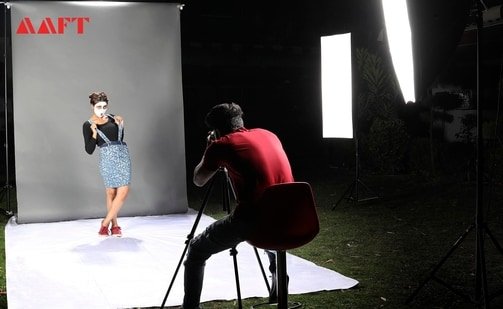
Every smartphone today can capture a photo or video, but professional visual storytelling demands far more than access to a camera. As businesses, brands and digital platforms increasingly rely on high-quality visual content, the demand for skilled photographers and videographers continues to grow.
AAFT’s BA in Photography and Videography is a three-year undergraduate programme designed to prepare students for careers in professional photography and visual storytelling. Offered at AAFT Noida in Delhi NCR, the course provides hands-on training with DSLR, mirrorless and film cameras across fashion, food, product, wedding and wildlife photography.
Students also benefit from mentorship by Industry Dean Dr Latika Nath, four or more industry masterclasses each academic year, and opportunities to build a professional portfolio. Admission is merit-based for students who have completed 10+2 with a minimum of 50% marks in English.
Why is photography a serious career option in India in 2026?
India’s media and entertainment sector reached ₹2.78 trillion in 2025, and digital media crossed ₹1 lakh crore to become its largest segment, according to the FICCI-EY report. Digital advertising alone hit ₹94,700 crore, which is across 63% of all ad spend in the country. Every rupee of that needs an image attached. Trained photographers and videographers are now hired by brands, marketplaces, agencies, OTT platforms, live-events producers and wedding studios across India.
Read that as a production brief rather than a market statistic. E-commerce and point-of-sale advertising grew 50% to ₹22,000 crore last year. That growth does not come from copywriting. It comes from pictures.
The demand is not slowing either. FICCI-EY projects the sector will reach ₹3.3 trillion by 2028, with new media crossing half of all industry revenue. Live events, the fastest-growing segment in 2025 with 44% growth, are also driving demand, as almost every event is now documented as content.
High-quality cameras are no longer out of reach for most aspiring creators. Professional photography, however, still depends on technical expertise, creative vision and practical experience. That is why a structured degree continues to matter.
What is AAFT’s BA in Photography and Videography?
AAFT’s BA in Photography and Videography is a three-year undergraduate degree at AAFT Noida, Delhi NCR. Admission is merit-based, and eligibility is 10+2 with 50% marks in English. Students train on DSLR, mirrorless and film cameras across fashion, food, product, wedding, wildlife and architectural photography, and graduate with a professional portfolio, a dissertation and a final portfolio project. Classes run five days a week.
The programme sits within AAFT’s School of Photography, which has been running for over three decades at an institution with a global alumni network of more than 37,000 graduates. Students receive a welcome kit with study materials on joining.
Learn more about the BA in Photography and Videography, including the curriculum, fee structure and admission schedule, on the course page.
What do you study in a BA Photography and Videography course?
The three-year curriculum covers camera operation, composition, lighting, colour, and visual storytelling; genre modules in fashion, food, advertising, and architectural photography; videography, motion graphics, and digital design; and post-production. Entrepreneurship, marketing and research methodology are taught as core subjects, not electives. Every student completes a dissertation and a final photography portfolio project, plus simulated shoots across fashion, food, product and wedding setups.
Year by year, the structure moves from fundamentals to specialisation to portfolio. What separates it from a short course is the last part: students are pushed to pick a genre and build a body of work in it before they graduate, rather than leaving with a folder of competent but unfocused images.
The genre coverage is deliberately wide – tabletop, wildlife, landscape, portrait, fashion, wedding and product, so the choice is informed rather than accidental. Students also learn to produce images to publication standards for newspapers, magazines, books, exhibitions and commercial clients.
Which cameras and software do AAFT photography students train on?
AAFT students train on DSLR, mirrorless and film cameras with professional lenses, lighting rigs and advanced studios. The software stack covers Adobe Photoshop and Lightroom for retouching, Illustrator, InDesign and CorelDRAW for design and publishing, Premiere Pro for video editing, and After Effects for motion graphics. Students work with this equipment throughout the programme rather than in a single practical module.
The reason the video tools sit alongside the stills tools is commercial, not academic. Clients now buy stills and video as one line item. A photographer who cannot deliver a cut alongside the frames is quoting for half the brief.
Students apply the full stack across fashion and portrait work, branded campaigns, cinematic shorts, digital marketing content, magazine layouts and event promotions.
Who teaches photography at AAFT?
AAFT’s School of Photography brings together industry mentorship and academic expertise through Industry Dean Dr Latika Nath, an acclaimed conservationist and wildlife photographer, alongside experienced faculty and visiting practitioners. Students attend four or more industry masterclasses each academic year with professionals including Ravi Dhingra, Vipin Gaur, Smita Srivastava, Umesh Mehta and Adete Roshni, covering lighting, styling, optics, portfolio review and professional practice.
Dr Nath’s involvement extends beyond guest lectures to portfolio reviews, mentorship and internship guidance. For aspiring photographers, constructive portfolio feedback from an experienced industry professional can play a significant role in refining both technical skills and career readiness.
Students also showcase portfolios at exhibitions and global cultural events, and AAFT’s Career Resource Cell connects them to recruiters before they graduate.
More on the faculty and facilities at the AAFT School of Photography.
What jobs can you get after a BA in Photography and Videography?
Graduates work as commercial, fashion, wedding and wildlife photographers, videographers, film and video editors, cinematographers, photojournalists, social media visual strategists and creative directors. Employers include media houses, film production companies, advertising agencies, fashion brands, D2C and marketplace content teams, publishing houses and creative studios. AAFT reports the highest package of 24 LPA and 2,800+ recruiters, with alumni at brands including Zara, Chanel, Godrej, HT and Inshorts.
One structural point worth knowing before you choose this field. The market is a barbell, not a ladder.
At one end are salaried roles across production houses, creative agencies, in-house brand studios, marketplace content teams and live-event production. At the other end are independent professionals, including studio owners and specialist photographers. The middle ground, where generalist freelancers compete across multiple segments, is becoming increasingly competitive, making specialised skills and a strong portfolio more valuable than ever.
AAFT’s photography and videography course forces the choice early. The genre specialisations and the final portfolio project exist to push students towards one end of the barbell deliberately, instead of drifting into the crowded middle.
Can you start your own photography business after this degree?
Yes. Many working photographers in India work independently or run their own creative businesses. Kofluence’s 2026 research puts India’s creator base at 4 to 4.4 million professionals, but only around 15% are registered as businesses or GST entities. That gap is where earnings separate. AAFT teaches entrepreneurship, marketing and research methodology inside the core BA curriculum, so graduates can price work, quote clients and license images.
The scale of the opportunity is not in question. BCG’s From Content to Commerce, released at WAVES 2025, estimates India’s creators already influence over $350 billion of annual consumer spending, headed past $1 trillion by 2030. India’s influencer marketing sector alone is growing at 22% CAGR toward ₹5,000 crore by 2027.
Weddings are the largest single market. The Confederation of All India Traders estimates roughly 4.6 million weddings in the 45-day peak season alone, carrying ₹6–6.5 lakh crore of spending, and photographers are consistently the most-sought vendor category. Globally, wedding photography is a $25 billion market headed to $52 billion by 2034, with Asia-Pacific the largest region.
Is AI replacing photographers?
No. AI is streamlining execution—masking, culling, background clean-up and first-pass grading, but not creative judgement. The World Economic Forum’s Future of Jobs Report 2025 lists creative thinking among the fastest-growing skills through 2030, while repetitive precision work shows the sharpest declines. AI cannot capture real moments, direct people, build client trust or own the rights to an image. Roughly 59% of Indian creators already use AI tools routinely, making AI fluency a baseline professional skill rather than a competitive edge.
There is a sharper consequence the industry has not said out loud. AI has not taken the photographer’s job. It has taken the assistant’s job.
The three years of assisting that used to teach a young photographer lighting, client handling and turnaround are thinning out. That apprenticeship has to happen somewhere, and a structured programme with the equipment, the briefs and the supervision is now one of the few places left that can deliver it.
What are the eligibility criteria and how do you apply to AAFT?
Eligibility for AAFT’s BA in Photography and Videography is 10+2 with 50% marks in English, and admission is merit-based. The programme runs for three years, five days a week, at AAFT Noida in Delhi NCR. Students receive a welcome kit with study materials. AAFT also offers an MA in Photography and Videography (2 years), a Diploma in Still Photography (1 year) and a 3-month Certificate for applicants at different stages.
The MA is for graduates advancing toward roles such as Creative Director, Specialised Photographer or Visual Researcher. The Diploma and Certificate cover camera specifications, lens optics, composition, lighting, studio setups, media ethics and portfolio building for those testing the field before committing three years.
Applications for the current intake are open. Explore the BA in Photography and Videography or the MA in Photography and Videography.
Conclusion
India will spend ₹3.3 trillion on media and entertainment by 2028, most of it new media, almost all of it visual. The cameras are already in everyone’s hands. The judgement to use them well, and the business sense to get paid properly for it, are not.
AAFT’s BA in Photography and Videography exists to close that gap in three years with the studios, the mentors, the portfolio, and the pricing model included.
