



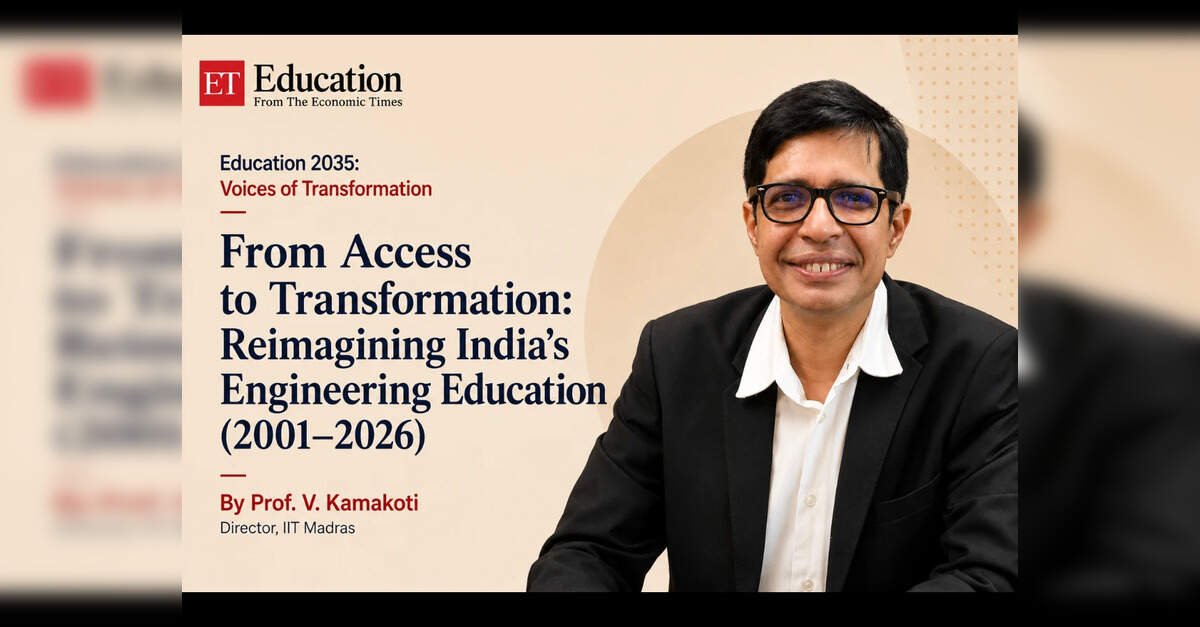
By V Kamakoti
Over the past 25 years, India’s engineering and technology education ecosystem has undergone a significant transformation, shaped by rapid technological advances, changing industry expectations, and a national push to expand access to quality education.
In the early 2000s, India emerged as a global software services hub during the Y2K era, leading to rapid growth in computing, communication, and mobile technologies. However, engineering education at the time remained largely theory-driven, with limited exposure to real-world problem-solving. This highlighted the need for stronger alignment between education, research, and practical application.
A major turning point came through structured industry-academia collaboration. Institutions began creating ecosystems where industry and academia could work together on research, innovation, and product development. At IIT Madras, the establishment of a research park in the mid-2000s reflected this vision of embedding industry within academia to encourage collaborative research and translational outcomes.
This shift gradually transformed research from being publication-oriented to impact-oriented. Engineering education also evolved from a purely theoretical model to one focused on combining strong fundamentals with application and innovation.
Experiences from indigenous technology initiatives, including processor development projects at IIT Madras, demonstrated that traditional curricula were insufficient for preparing students for real-world innovation. As a result, institutions continuously refined academic programmes to better align with emerging technologies, research needs, and industry practices. The focus today is not on reducing academic rigor, but on making knowledge more practical, contextual, and relevant.
The impact of these changes is visible in the rise of innovation and entrepreneurship across campuses. Academic institutions are increasingly becoming centres of intellectual property creation, startup incubation, and enterprise development. IIT Madras, for instance, has witnessed significant growth in startup activity and research translation, reflecting a broader national trend of institutions moving from knowledge dissemination to knowledge creation.
Another major transformation was accelerated by the COVID-19 pandemic, which pushed higher education toward digital learning at scale. Platforms such as NPTEL and SWAYAM demonstrated that quality education could reach learners across geographies through online delivery.
Building on this momentum, hybrid learning models have emerged as a powerful tool for expanding access. IIT Madras introduced flexible B.S. programmes that combine online instruction with in-person assessments, offer multiple exit options, and remove barriers such as rigid entry pathways and age restrictions. With large-scale enrolments, such models are redefining higher education as a continuous learning journey that supports upskilling, reskilling, and lifelong learning.
Policy reforms have also played a crucial role in enabling this transformation. The National Education Policy (NEP) 2020 and related regulatory changes introduced flexibility through multiple entry and exit pathways, parallel academic programmes, and integration of online learning within formal education systems. These measures have improved both accessibility and inclusivity.
At the same time, engineering education is becoming increasingly interdisciplinary. Modern challenges in areas such as sustainability, healthcare, and finance require expertise across domains. Institutions are responding by enabling students to combine disciplines such as engineering, data science, and finance, while startup ecosystems increasingly thrive on collaborative, cross-functional teams.
At its core, this transformation is guided by the larger goal of making quality education accessible to all. Technology-enabled learning is helping extend educational opportunities to those who may not have access to traditional campuses. Aligned with the vision of the United Nations Sustainable Development Goal 4, the emphasis is on ensuring equitable access to affordable, high-quality education irrespective of geography, age, or socio-economic background.
As India looks ahead, the future of engineering education will be defined by deeper industry integration, scalable hybrid learning, interdisciplinary education, and lifelong learning. The strength of India’s higher education system will increasingly lie not only in its institutions, but in its ability to create large-scale societal impact through innovation, inclusion, and relevance.
About the author: Prof V Kamakoti is Director of the Indian Institute of Technology Madras (IIT Madras). A renowned computer scientist and academic leader, he has been instrumental in advancing industry-academia collaboration, indigenous technology development, digital learning, and innovation-led engineering education in India.
DISCLAIMER:The views expressed are solely of the author and ETEducation does not necessarily subscribe to it. ETEducation will not be responsible for any damage caused to any person or organisation directly or indirectly.


