



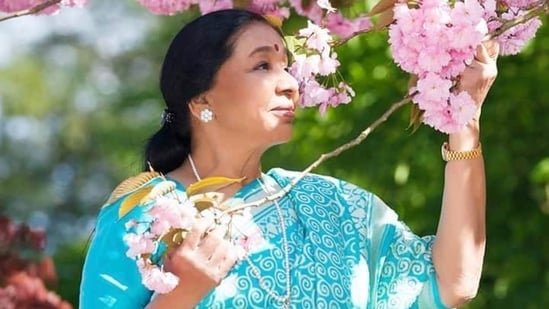
Veteran singer Asha Bhosle, whose voice defined Bollywood for over eight decades, passed away on April 12. While her music shaped generations, her personal style was equally enduring, rooted in the saree.
Chiffon was perhaps her most faithful companion, lending ease and fluidity, while silk sarees in rich, jewel-toned hues marked formal occasions. For everyday wear, she leaned towards cottons and georgettes that felt as natural on her as breathing.
The runway ‘ichcha’
In 2013, the singer walked the ramp at Lakme Fashion Week for Manish Malhotra, sharing the runway with Priyanka Chopra Jonas, Hema Malini, and Sidharth Malhotra. In a tribute post for her, Malhotra wrote, “You said I have one ichcha to walk on the ramp and when we asked you to, you walked with so much elan, style, and happiness. Everyone in the audience stood up as a mark of respect… Something I haven’t seen ever at a fashion show. You have our dil forever, Asha ji.”
A cultural identity
In an interview with Curly Tales, she explained her preference: “The saree, as a garment, is extremely graceful, which helps to conceal the curves of a woman. Secondly, it is steeped in the rich culture and history of India.” For her, the garment was both aesthetic and a daily expression of identity.
A son’s insistence
In the same chat, she credited her son, Anand Bhosle for her unwavering commitment to the saree. He never quite warmed up to seeing her in a salwar suit or trousers. Even while travelling, when she considered more comfortable options, he would gently insist she stay in a saree, preserving the image he associated with her of a smiling young mum.
An experimentation
“Didi (late singer Lata Mangeshkar) and I used to wear white sarees all the time. We thought white colour suited our complexion better. If we wore other colours, we would look darker,” Bhosle had once said on Amrita Rao and RJ Anmol’s podcast, adding, “ Later, I started wearing pink sarees, and didi would give me a side-eye, but I slowly began adding colours with pink.” Over time, while the palette expanded, the saree remained constant.
An intuitive elegance
“Asha Bhosle’s elegance was never accidental. It was deeply instinctive. The way she paired her sarees with jewellery, her choice of earrings, the way her hair was styled, even the smallest details like a bracelet, everything came together with an effortless sense of precision. There was a certain faultlessness in her style, but it never felt constructed. It felt lived. What makes her truly inspiring is that this consistency did not lead to repetition. It created identity. She made the saree entirely her own,” she says.
Mishra further connects her influence to the broader Indian experience: “In many ways, I see that influence reflected in my own life. My mother, like many Indian women, has worn a saree every single day and continues to do so even today. Through her, I have understood what it takes to keep something timeless feeling new. To reinvent within continuity. To remain elegant, fresh, and expressive, even within the discipline of a single garment. That, to me, is the true power of the saree. It is perhaps the only garment in the world that one can wear every day for a lifetime and still never feel repetitive. It allows for infinite interpretation while holding on to its essence.”
Celebrated designer Anju Modi echoes this sentiment, highlighting Asha Bhosle’s role as a patron of Indian craft: “Her style was truly remarkable. She made it a point to wear sarees representing the rich textile traditions of nearly every state in India. She carried our heritage with immense grace and pride, and it was a great honour for all of us to see her championing Indian textiles on the global stage.”


