


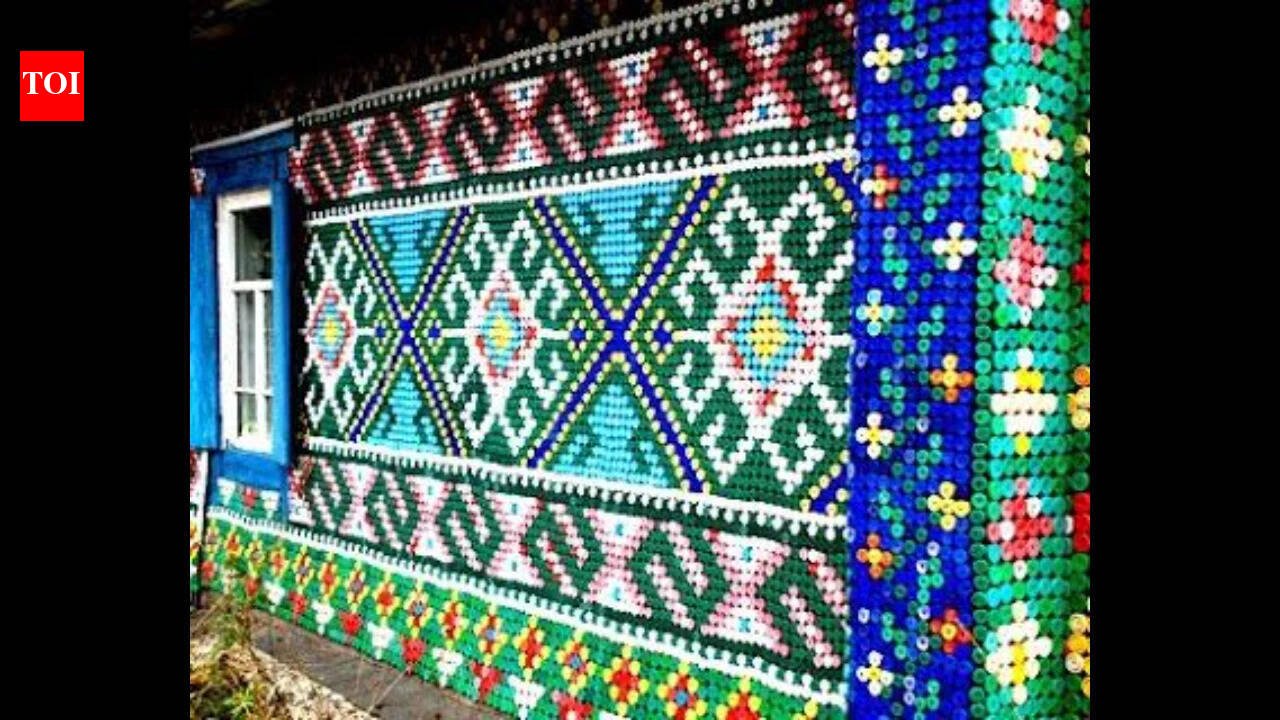
What do you do with a plastic bottle cap once the drink is gone? For most people, it is the smallest part of the bottle and one of the easiest things to throw away. For Russian pensioner Olga Kostina, however, those colourful little caps became something far more ambitious. Over several years, she collected thousands of discarded bottle caps and eventually used them to transform the outside of her wooden home in the Siberian village of Kamarchaga into a giant, colourful mosaic. The result is less like ordinary home decoration and more like a piece of folk art made from everyday waste. Scroll down to know more…
Her house became her canvas
Kostina’s home, located in the Siberian taiga near Krasnoyarsk, was originally a fairly ordinary wooden house. She began collecting colourful plastic bottle caps and gradually found a way to turn them into decorative patterns.
According to the SPACES Archives, which documents the work using photographs credited to Reuters photographer Ilya Naymushin, an estimated 30,000 bottle caps were eventually attached to the wooden surface of the house. Each cap was hammered separately through its centre with a nail. Rather than placing the caps randomly, Kostina arranged them into carefully planned designs. The patterns include abstract forms inspired by traditional regional embroidery and weaving, along with images of animals associated with the surrounding woodland, including squirrels and deer. From a distance, the individual bottle caps blend together to create larger patterns. Up close, the unusual material becomes obvious.
It took years to collect the material
The striking part of the project is how ordinary its raw material was. Kostina collected plastic caps from soft-drink bottles over a period of years, saving something that would normally have little value once the bottle itself had been discarded. Contemporary accounts of the project consistently report that she eventually accumulated more than 30,000 caps.The scale of the collection is difficult to picture. Thirty thousand individual objects means thousands of tiny decisions about colour, placement and pattern. And Kostina did not stop with the main house. Reports say she also used the caps to decorate other structures around her property, extending the colourful designs beyond a single building.
Why bottle caps work surprisingly well
Bottle caps are not an obvious artistic material, but their uniform shape makes them particularly suited to mosaic-style designs. Each cap acts almost like a tiny pixel. Different colours can be grouped together to create outlines, borders and larger images. The repetitive nature of the material also allows intricate patterns to emerge without requiring expensive artistic supplies.Kostina’s approach is therefore a form of upcycling, in which discarded material is given a new purpose rather than immediately becoming waste. The idea also has a long history in contemporary and folk art. Artists around the world have used bottle caps, discarded packaging and other everyday objects to create sculptures, mosaics and large-scale installations.
From discarded plastic to a local landmark
What began as a personal decorating project eventually attracted attention far beyond the remote village. The house became known for its unusual facade, with the bright caps standing out against the wooden structure and the surrounding Siberian landscape. Sources describing the project have referred to it as a local attraction and landmark.
There is something particularly striking about the contrast. The material is associated with disposable consumer culture, while the finished work is deliberately permanent. A bottle cap might have a useful life of only a few minutes. On Kostina’s house, it becomes part of something designed to be looked at for years.Kostina’s bottle-cap-covered home is a striking example of how everyday discarded objects can be transformed into something remarkable. Rather than building a house from plastic caps, she turned the exterior of her existing wooden home into an enormous, colorful work of art using more than 30,000 collected caps. Her project shows how creativity, patience, and a willingness to see value in ordinary waste can completely transform a familiar space. What began as simple bottle caps ultimately became a unique piece of folk art that captured international attention.
