


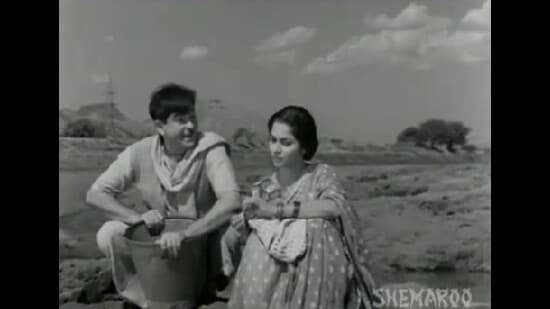
Sixty years ago, a beautiful film was released in theatres, and failed spectacularly at the box office.
The producer, now drowning in debt, died a few months later. The marvellous lyricist Shailendra backed only this one film in his lifetime, and did not live to see it win a President’s medal, or the many accolades that followed. He died not knowing it would become a landmark in Hindi cinema.
Teesri Kasam was based on a short story written in 1954 by the legendary Phanishwar Nath Renu, from Purnea district in Bihar. He was known as the master of “aanchalik” or “regional” literature. In this tale, he told the heartrending story of Hiraman, an upright bullock-cart driver, and Hira Bai, a ravishing nautanki dancer.
There was no need for Shailendra, considered one of the greatest lyricists in the history of Hindi cinema, to think of producing a movie. He was at the peak of his career. But he had an urge to make a great artistic film.
He fell in love with the story of the innocent Hiraman who ferries Hira Bai to a village fair many miles away, where the Great Bharat Nautanki Company is set to perform. Shailendra approached Renu for the film rights, and the writer agreed immediately. A hugely talented group coalesced around the project: Basu Bhattacharya as director, Shankar-Jaikishan as music composers, Subrata Mitra as cinematographer, Raj Kapoor as Hiraman and Waheeda Rehman as Hira Bai.
But production was plagued by waste, pilferage and an array of problems.
In her book Shailendra – A Love Lyric in Print (2024), the lyricist’s daughter Amla Shailendra Mazumdar paints a bleak picture of how he had borrowed heavily to finance the project, and was taken advantage of during its making.
Raj Kapoor graciously took just one rupee as his fee, but other members of the cast insisted on advance pay. Shailendra’s wife Shakuntala eventually had to open her cupboard, shake out all her saris, and collect up all the cash she had saved on behalf of her family, just so shooting could begin.
The outdoor shoot in Bina, Madhya Pradesh, turned out to be chaotic. Friends and relatives gathered to go hunting every day, and held giant barbecues at night, “turning each evening into a grand party”, Mazumdar writes. Alcohol flowed, costs were inflated, costumes vanished. The bulls needed for Hiraman’s cart would mysteriously disappear and, every other day, new ones would have to be bought, and so on.
Five years in the making, the film finally premiered in Delhi in September 1966. Shailendra died months later, in December, just 43 years old.
After he died a broken man, she writes, creditors swarmed around the family. Raj Kapoor helped secure a mortgage on their Khar home, from the singer Mukesh, and after long-drawn-out court proceedings, all the creditors were finally paid. Mukesh then gave the title deed back to the family, returning their beloved home to them.
It is strange to think that, from this tragic mess, one of Hindi cinema’s most memorable films emerged. There is a kind of eternal quality to Hiraman’s purity, Hira Bai’s sensitivity, and the heartfelt story of the love they develop for each other. The visuals of the bullock cart creaking over uneven village paths, the rustic dialogue flavoured with colloquialisms, and the soulful soundtrack, create a timeless mood.
Songs such as Sajan Re Jhoot Mat Bolo and Duniya Bananewale feel eternal, as do the achingly lovely folksongs that Shailendra incorporated into the film.
Teesri Kasam is also an ode to nautanki, the folk theatre of Uttar Pradesh, and its lively milieu: the village fair, with the hypnotic drumming announcing the performances, the “cloth house” in which performances were held, and the enthusiastic audiences. The film captures this tradition at a time when its pulsating music and dance, and its dramas drawn from mythology, history and legend, still ruled the brightly lit nights at rural fairs.
The scintillating nautanki dance sequences were choreographed by Kathak maestro Lachhu Maharaj and further enhanced by the qawwals Shankar Shambhu.
There was a suggestion that if the melancholic ending, in which Hiraman and Hira Bai part, was changed to a happy one, the film’s fortunes might pick up. When Renu was asked if this could be done, the story goes, he said they had better then delete his name from the credits. Shailendra, even though he was now buried in debt, said he would not change the ending either.
Still, when he died, Renu was heartbroken. He felt that if he had withheld assent, Shailendra might have continued to live a comfortable life with his family, as one of the industry’s most sought-after lyricists.
What a haunting backstory for this sublime gift of a film.
(Email poonamsaxena3555@gmail.com. The views expressed are personal)
