






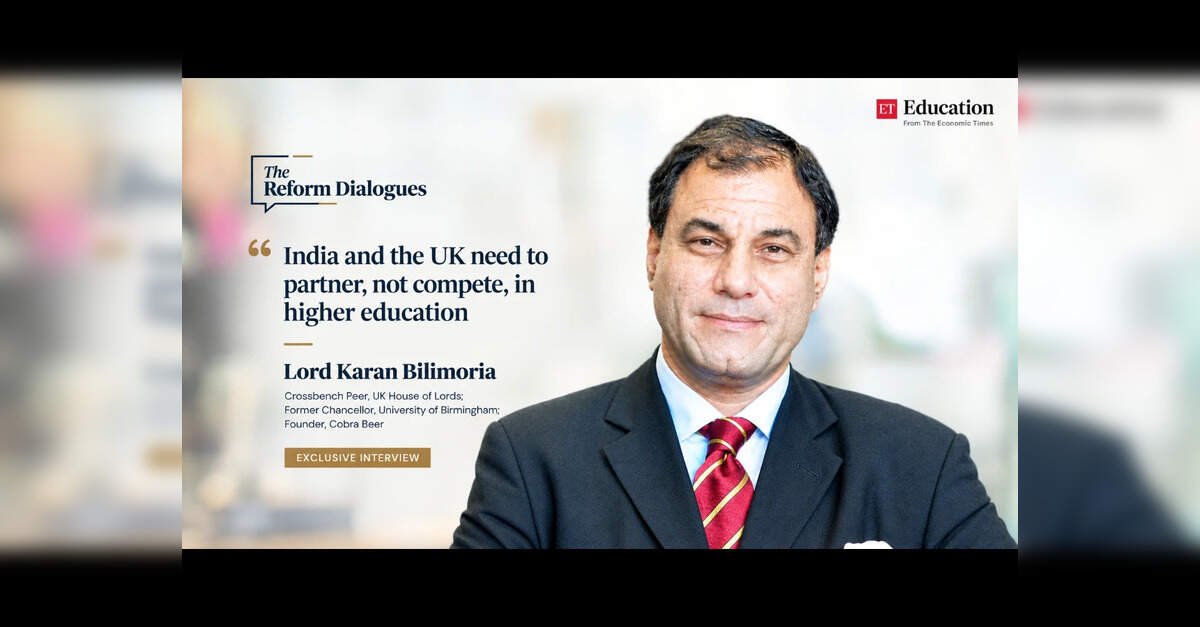
India and the UK may have different higher education systems, but they face common challenges around employability, skills and preparing graduates for a rapidly changing world of work. Lord Karan Bilimoria, who has been closely involved in the India-UK business and education dialogue, believes the two countries should focus on building partnerships rather than competing with each other.
In this exclusive interview with ETEducation, the former University of Birmingham Chancellor discusses what India and the UK can learn from each other, the role of industry in universities, joint degrees and research, international student mobility, the impact of AI on higher education and the need to build greater capacity in India.
Q. India and the UK have very different higher education systems, although India inherited much of its university system from Britain. What can each country learn from the other, particularly on employability?
Lord Karan Bilimoria: There is a mutual challenge around employability. When I was Chancellor of the University of Birmingham, we were always proud of our position in employability rankings. In my graduation speeches, I would tell students, “If you haven’t already got a job, you will get a job,” because that is what we were doing.
The closer universities work with industry, the better. You have to have industry partnerships. At Birmingham, we worked with the railway industry and produced the world’s first hydrogen-powered train, which was demonstrated at COP26. We also partnered with Rolls-Royce, where our PhD students worked within the company on aero-engine research. Around 100 PhD graduates from Birmingham now work at Rolls-Royce.
It is not only about research. You are getting employability as well. The UK also has degree apprenticeships, where students work and study at the same time, with companies such as British Airways, the Bank of England and Rolls-Royce. The university benefits, the student benefits and the company benefits. We can have more degree apprenticeships in India.
The other area is lifelong learning. I benefited from it myself. Eight years after starting Cobra Beer, I went to Cranfield School of Management and completed a business growth programme. It changed my life.
India could also develop programmes through business schools to support small and medium-sized enterprises. The UK has the Small Business Charter, which recognises business schools for their ability to work with SMEs. I believe India should have a similar system.
Q. You have spoken about industry partnerships. What about collaboration between universities in India and the UK, particularly in research and transnational education?
Lord Karan Bilimoria: Research is equally important. Collaborative research can have a much greater impact.
When I was Chancellor of Birmingham, our Pro-Vice-Chancellor for Education demonstrated the benefit of cross-border research. A Birmingham project with Panjab University on cross-border air pollution had a field-weighted impact of 4.5, compared with 2.7 for Birmingham and 2.3 for Panjab University individually. A project with Harvard had a similar multiple effect.
So you get a greater impact from working together. We should also do many more joint degrees. During my time at Birmingham, we launched two joint master’s programmes with IIT Madras, one in AI and Digital Science and the other in Sustainable Energy.
They were 18-month programmes in which students could spend time in Chennai and Birmingham and receive a joint degree from the two institutions.
That is a very powerful model for India and the UK. We should do many more of these.
Q. Are universities moving fast enough to respond to what employers need, particularly as AI and automation reshape jobs?
Lord Karan Bilimoria: Faculty in business schools, both in the UK and India, need to be much more trained, aware and engaged with AI. In many cases, students are ahead of faculty when it comes to knowledge and use of AI. Faculty should be in tune with their students.
I am also doing a business doctorate at Cambridge University. Three years ago, you were not allowed to use AI because it was considered cheating. Now they are saying you have to use it.
In my own research, I have thousands of pages of interviews from around the world. Previously, I would have had to analyse them manually, looking for keywords and themes. With AI, I can do that in minutes. It saves time.
But it does not save the thinking. I still have to interpret, analyse and think for myself. I cannot let AI do the thinking for me.
That ability to work with AI is what students need to develop. It is also increasingly linked to employability because graduates need to be proficient in using these tools.
Q. India is seeking to become a stronger talent and knowledge economy. What changes are needed in Indian universities and business schools to make graduates more globally competitive?
Lord Karan Bilimoria: India has some of the best students in the world, particularly at the IITs and IIMs. Yet that quality is not fully reflected in global university rankings.
India needs to create greater capacity and partner internationally. For more than 20 years, I have been saying that India should allow foreign universities to open campuses here. That is now happening, and I think it is wonderful news.
You can already see UK and Australian universities operating or committed to operating in India. More universities from around the world will follow. Indian students will benefit from that additional capacity and from exposure to international standards.
I also think it is wonderful that leading business schools in India and the UK are working together. Thirty-nine UK business schools have come across for this dialogue, with an equivalent number from India.
This is not competition. We are going to help each other, learn from each other and collaborate with each other. That is the way forward.
Q. India-UK relations in higher education are moving beyond student mobility towards deeper institutional and academic partnerships. Where do you see the biggest opportunity?
Lord Karan Bilimoria: Mobility remains very important. I am president of the UK Council for International Student Affairs and a patron of the Indian Students and Alumni Association. I also co-chair the International Students All-Party Parliamentary Group.
India has now become the largest source of international students going to the UK, overtaking China. Almost 100,000 Indian students go to the UK, with around 80% pursuing one-year master’s programmes. Mutual recognition of qualifications is another important development. India is now recognising the UK’s one-year master’s degree. The programme is more intensive, but it does not necessarily provide less education than a two-year programme.
I also want more British students to come and study in India, particularly at the IITs and IIMs. Mobility should work in both directions.
Q. What is stopping more international students from coming to Indian institutions, and what should change?
Lord Karan Bilimoria: At the moment, it is very difficult to get into many of the top Indian institutions. If they were to say, “Every year we really want to bring in some foreign students in each cohort,” you just need to make a start.
Once foreign students graduate from the IITs, IIMs and other leading institutions, they will become ambassadors for Indian higher education. Other students will want to come, and their employability will also benefit from the experience.
International students contribute much more than fees. In the UK, they contribute to the economy, but perhaps more importantly, they contribute to the culture of universities.
British students learn from the international students they study with. They become friends for life. That cultural exchange is incredibly powerful, and India can benefit from it by bringing in students from the UK and elsewhere.
Q. How can universities bring industry closer to the classroom without allowing immediate employer needs to overshadow broader education and critical thinking?
Lord Karan Bilimoria: There are many ways. One is through case studies. In a business school, students are exposed not just to a textbook but to a live situation that actually happened. Quite often, the people involved in the case come into the classroom and explain what happened.
Entrepreneurs and business leaders can also speak to students about their experiences, challenges and how they overcame them. Those were my favourite classes at Harvard Business School, London Business School and Cranfield.
Mentoring and internships are also very important. I have had internship programmes running for decades. I have seen the benefit to the interns and to the companies. Students gain experience, improve their employability and often find it easier to get jobs after having worked within organisations.
Universities should therefore build much stronger links with businesses and make work experience an integral part of education.
Q. Looking ahead to the next decade, what will distinguish graduates who thrive from those who struggle to find meaningful employment?
Lord Karan Bilimoria: Employability is absolutely essential. Students should be exposed to the world of work through internships, work experience, visits to businesses and interaction with business leaders. They need to be work-ready.
The skills you learn at business school are not just textbook learning. People skills, negotiation and communication are going to make you employable, alongside the theoretical knowledge you acquire.
You also need to inject into students a passion for what they are doing to love what they are studying, the world of business and entrepreneurship. Then you have people who are following their passion, not their pension.
And there is entrepreneurship. I came up with my idea for Cobra Beer when I was a student at Cambridge University. I always tell students that some successful entrepreneurs dropped out of university, but I say: don’t drop out. Finish your education and then implement your business idea.
Your education is one of the best qualifications you have for life. You can always fall back on it if your business idea does not work.
But come up with ideas while you are studying. You do not necessarily have to get a job. Become an entrepreneur as well.


