



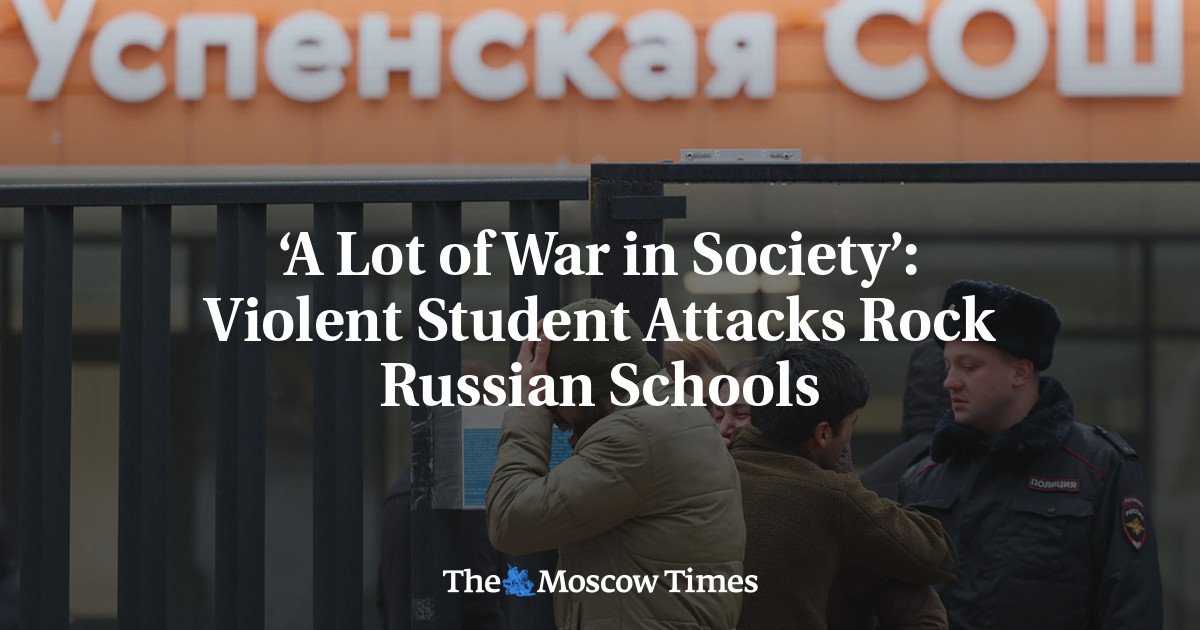
There was the seventh-grade boy in the Moscow region who stabbed his 13-year-old classmate in the neck on their way to school.
There was the Ufa teenager who shot his teacher with an airsoft gun and set off a firecracker at his school — and the seventh-grade girl in Siberia who attacked a classmate with a knife on the same day.
There was the 17-year-old student who opened fire at a technical college in the Black Sea resort city of Anapa, killing a security guard and injuring three others.
And there was the 14-year-old girl in Siberia’s Krasnoyarsk region who set fire to a classroom and assaulted students with a hammer.
A rash of stabbings, shootings and other violent incidents involving students in Russian schools has spread across the country in recent weeks.
Experts say the trend is linked to both tighter control and surveillance inside schools as well as the growing militarization of schools that has followed Russia’s 2022 invasion of Ukraine.
Of 117 recorded violent incidents at Russian schools since 2000, around half have occurred in the past five years, according to data compiled by school psychologist Yury Lapshin and social anthropologist Alexandra Arkhipova.
“In the last five years alone, including 2026, there have been 51 cases. That’s roughly half,” Lapshin told The Moscow Times. “This is growth. And it’s steady growth.”
‘The freest place in a school is the bathroom’
Experts say a key shift is that violence is increasingly taking place inside school buildings, even as they have become more tightly controlled environments.
“Schools are becoming more and more closed spaces,” Lapshin said.
Security measures were tightened after the 2004 Beslan school siege and reinforced following subsequent school attacks, including in 2014 and 2018. While this has helped schools more effectively prevent outsiders from entering, they cannot stop enrolled students from bringing weapons inside.
As a result, incidents were rare in the early 2000s but started to increase after 2014, with numbers reaching their highest levels in recent years, Lapshin and Arkhipova’s data shows. Most attacks are targeted at specific individuals rather than indiscriminate “spree” killings, though both types of attacks occur.
Since 2018, students have also been barred from leaving school grounds during the day without parental permission.
“In the past, someone could say: ‘Let’s go outside and talk.’ Now everything happens inside the school,” Lapshin said.
Dmitry Belitsky / Moskva News Agency
Schools have meanwhile ramped up surveillance, with security cameras installed in most areas except bathrooms.
“The freest place in a school is the bathroom, because there are no cameras,” he said. “Many conversations — including difficult ones — take place there.”
Militarization, war propaganda and normalization of violence
Psychologists say that the surge in school violence is linked to the broader normalization of force in Russian society amid the war in Ukraine.
“Militaristic discourse is becoming more and more popular, more and more imposed,” Lapshin said.
He noted that war is framed not only as heroic but also as a legitimate way to resolve conflicts.
“Authoritative adults talk about it and invite children to play it as if it were an interesting game. War is presented as something just — we are defending our values and honor. At the same time, there is this underlying message: people solve their problems by going to war,” he said.
Alexandra Ivanova, a clinical psychologist working with adolescents, said exposure to narratives like this, combined with what she described as a perceived lack of accountability for violence, can distort how teenagers process conflict.
Courtesy photo
Throughout the war in Ukraine, Russian media have reported cases of men returning from the front, committing violent crimes and avoiding prison by re-enlisting.
Military servicemen, including Wagner mercenaries, have also regularly visited school classrooms to speak to students since the start of the war.
“When violence is normalized in society — and it is being normalized now — plus the absence of punishment, which they also see and hear about, these people who come back from the war and what they are allowed to do without consequences — then teenagers don’t have an adequate picture of reality,” she said.
While a Wagner mercenary might not necessarily become a role model to students in a direct sense, his visit amid the wider school militarization signals to students that this is normal, she said.
Pavel Talankin, a former school videographer in the Chelyabinsk region, said he witnessed a major shift toward military and patriotic-themed lessons at his school soon after the invasion in 2022.
“We started receiving prepared lesson plans, presentations and video materials. There was a lot about the war,” he told The Moscow Times.
Talankin’s film “Mr. Nobody Against Putin,” which documents the militarization of Russian schools during the war, won the 2026 Academy Award for best documentary feature.
He said his school was instructed to broadcast slides and hold mandatory patriotic classes. While formally labeled “additional education,” refusal was often not an option in practice.
He also noted the growing presence of weapons in schools during visits by military personnel.
“Military personnel come in, show grenades, show real weapons and teach [students] how to use them,” Talankin said. “They show them where to put the bullets, how to disassemble and assemble the rifle, how to clean it, and explain which weapons are more effective and which are less effective.”
“There is a lot of war in society,” Lapshin said. “And if there is a lot of it in society, there will be a lot of it in people’s heads.”
Talankin argued that the impact is less about direct imitation and more about desensitization.
“When children are given very aggressive information in a very aggressive form, that human life is worth nothing, children become angry,” he said.
novostitambova.ru
Officials also appear to have anticipated the rise in school violence, Talankin said. After leaving Russia in 2024, he remained subscribed to his school’s mailing list. That September, he received new guidelines “on how to identify violent and terrorist tendencies in children.”
Surveillance and ‘risk groups’
As the school violence has increased, authorities have increasingly framed it as an issue of extremism and national security.
The guidelines distributed to educators in 2024, which Talankin shared with The Moscow Times, classify “Columbine” and “school shooting” alongside extremist ideologies.
The document also links school violence to foreign influence and lists warning signs such as social isolation, low self-esteem and criticism of political leaders — traits that psychologists say are typical of adolescence and not necessarily a sign of violent tendencies.
arbuztoday.ru
In 2022, schools introduced “advisers for educational work” tasked with identifying at-risk students, including through monitoring social media activity, and reporting them to police if needed. Educators say this work is most often carried out informally.
“It effectively turns teachers into informants,” Talankin said.
This monitoring is especially claustrophobic in the occupied territories of Ukraine, where “a so-called ‘mentorship’ system allows older students to check younger students’ phones at any time to make sure they are not subscribed to certain communities. That’s essentially hazing,” he said.
A separate set of recommendations focused on the newly annexed regions of Ukraine largely situates youth radicalization within the context of “Ukrainian nationalism,” foreign intelligence services and ideological warfare.
Psychologists note that extremist online communities rarely create violence from scratch. More often, they provide language and imagery for conflicts that are already unfolding.
‘Adults don’t notice them’
“For a teenager to resort to violence, they have to feel bad for a long time,” Lapshin said, noting that many perpetrators are quiet students whose struggles with sustained bullying, a conflict with peers or feelings of exclusion go unnoticed.
“Adults don’t notice them. Or don’t want to notice,” Lapshin said.
As a former school psychologist, he said effective prevention depends on two increasingly scarce resources: time and attention. Officially announced salary increases in education have largely been achieved through intensifying workloads rather than reducing them, he explained.
“A key instrument in a psychologist’s work is freedom — freedom of attention, readiness to seek contact independently, to be open, to create opportunities and, most importantly, to think about where to turn and what to do,” he said.
Teachers themselves can make matters worse through their treatment of students, Talankin said.
“Some teachers also add fuel to the fire. Especially older ones,” said Talankin. “They don’t understand modern children, and children don’t understand them. They resort to shouting, humiliation — it’s constant. Bullying by teachers toward students is also at a high level.”
In this kind of environment, teenagers who already feel alienated may conclude that there is no adult they can safely turn to.
And when accumulated anger meets normalized aggression, teenagers can start to view violence as the only remaining way to assert control, psychologists warn.
“If nothing changes, the series [of attacks] will continue,” said Lapshin.
“We will face such problems in society… These children will graduate from school, and then they will have children of their own and raise them. It doesn’t look optimistic. This will last for many years — for a generation ahead,” said Talankin.
A Message from The Moscow Times:
Dear readers,
We are facing unprecedented challenges. Russia’s Prosecutor General’s Office has designated The Moscow Times as an “undesirable” organization, criminalizing our work and putting our staff at risk of prosecution. This follows our earlier unjust labeling as a “foreign agent.”
These actions are direct attempts to silence independent journalism in Russia. The authorities claim our work “discredits the decisions of the Russian leadership.” We see things differently: we strive to provide accurate, unbiased reporting on Russia.
We, the journalists of The Moscow Times, refuse to be silenced. But to continue our work, we need your help.
Your support, no matter how small, makes a world of difference. If you can, please support us monthly starting from just $2. It’s quick to set up, and every contribution makes a significant impact.
By supporting The Moscow Times, you’re defending open, independent journalism in the face of repression. Thank you for standing with us.
Continue
Not ready to support today?
Remind me later.
×
Remind me next month
Thank you! Your reminder is set.


